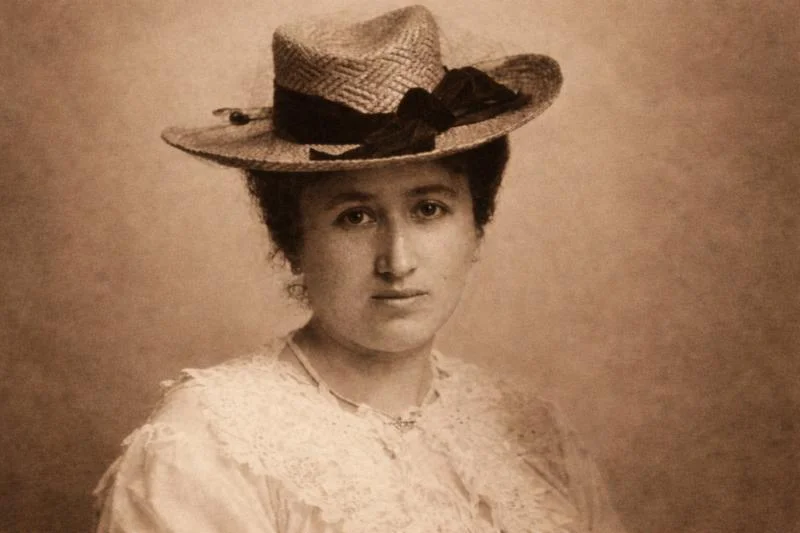
Rosa Luxemburg (1871–1919) was one of the most influential leaders of the international labor movement. Her biography serves as a prime example of how the German Empire (Kaiserreich) used criminal law and “preventive detention” to silence a charismatic intellectual and anti-militaristic voice.
Persecution as an “Alien” and a Woman
From the beginning of her career in Germany, Luxemburg was a target of state surveillance and social exclusion.
- Triple Marginalization: As a woman in a male-dominated political landscape, as a person of Jewish descent, and as a native Pole, she represented everything the conservative Prussian establishment feared and loathed.
- The Sham Marriage: To avoid immediate deportation and to gain German citizenship—a prerequisite for political activity in the Empire—she had to enter into a sham marriage with Gustav Lübeck in 1898.
“Lèse-Majesté” and “Incitement to Class Hatred”
The justice system of the Empire regularly reacted to her speeches and writings with prison sentences.
- 1904 (Lèse-Majesté): She was sentenced to three months in prison for criticizing the German Emperor.
- 1906 (Incitement): Following a speech in Weimar, she was sentenced to two months for “inciting class hatred.”
The Fight Against Militarism: The Frankfurt Trials (1914)
Shortly before the outbreak of World War I, the state’s pressure reached a new peak. Rosa Luxemburg became the most prominent voice against the impending mass slaughter.
- The Call for Disobedience: In a speech in Frankfurt am Main, she called on soldiers to refuse orders to kill their “French brothers.”
- The “Insulting the Military” Trial: She was sentenced to one year in prison for “inciting disobedience.” During the trial, she turned the courtroom into a political stage, famously declaring: “If we are expected to take up lethal weapons against our French or other foreign brothers, then we call out: No, we will not do that!”
World War I: “Protective Custody” and the “Junius Pamphlet”
While the SPD leadership largely supported the war (Burgfriedenspolitik), Luxemburg remained steadfast. The state reacted with administrative measures:
- Preventive Detention: From 1915 to 1918, she spent most of her time behind bars—not as a convicted criminal, but in “protective custody” (Schutzhaft). This was a tool used by the military authorities to neutralize “dangerous” individuals without a trial.
- Illegal Publications: From prison, she wrote the “Junius Pamphlet,” the most important anti-war document of the time, and co-founded the Spartacus League.
The Radical End: 1919
Released from prison by the November Revolution of 1918, she spent her final weeks fighting for a socialist republic.
- State-Sanctioned Murder: On January 15, 1919, Rosa Luxemburg and Karl Liebknecht were abducted and murdered by members of the Garde-Kavallerie-Schützen-Division—with the tacit approval or at least the failure of the SPD-led government of the time.
- Disposal in the Landwehr Canal: To cover up the crime, her body was thrown into the Landwehr Canal and was not found until months later.
Analysis of the Repression Methods
| Period | Repression Method | Objective of the State |
| 1898–1914 | Criminal Prosecution | Silencing through short prison sentences and fines |
| 1915–1918 | Protective Custody | Neutralization of anti-war agitation |
| 1919 | Extrajudicial Execution | Physical elimination of the revolutionary leadership |
Conclusion: Freedom for the Dissenters
Rosa Luxemburg’s famous sentence—“Freedom is always and exclusively freedom for the one who thinks differently”—was not a theoretical phrase, but a reflection of her own experience with state repression. On politischeverfolgung.de, she stands as a symbol of intellectual resistance against militarism and the misuse of the justice system for political purposes.