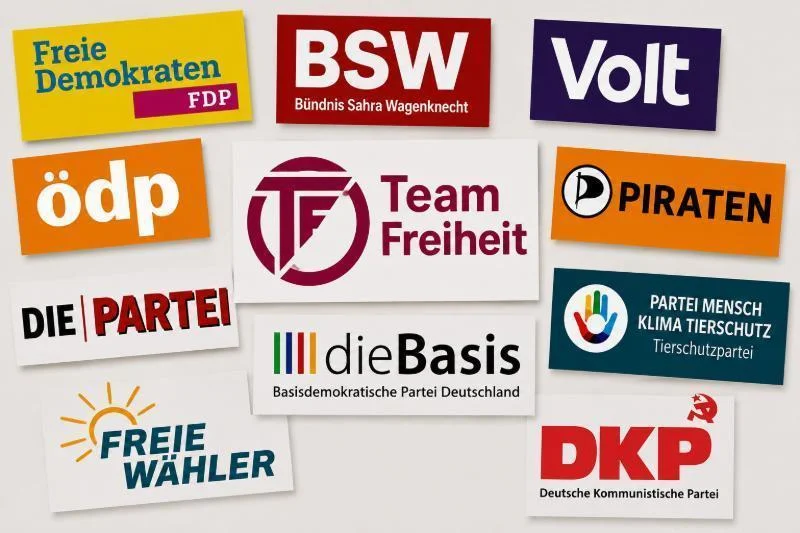
The 5-percent electoral threshold (Fünf-Prozent-Hürde) is the most well-known yet omnipresent instrument of the German federal electoral system. Officially cited as a historical lesson designed to prevent parliamentary fragmentation like that of the Weimar Republic, a closer analysis reveals its true nature: it serves as a highly effective, structural tool of repression for the established cartel of legacy parties. Through continuous manipulations of the electoral rules, established parties secure their privileges, suppress emerging political alternatives such as Frauke Petry’s “Team Freiheit,” and effectively disenfranchise millions of citizens from parliamentary representation. On PolitischeVerfolgung.de, we analyze how this “threshold clause” has been transformed from a safeguard of governmental stability into a protected sanctuary for the establishment.
The Myth of “Weimar”: The Historical Legend as a Facade for Legitimacy
Representatives of the party-dominated state endlessly justify the existence of the 5-percent threshold by warning against “Weimar conditions.” However, this constructed historical narrative hardly withstands critical scientific scrutiny:
- The Misinterpretation of History: The instability of the Weimar Republic stemmed primarily from deep societal polarization, constitutional flaws (such as the abuse of emergency decrees under Article 48 of the Weimar Constitution), and a lack of entrenched democratic values among the ruling elites—not from the mere presence of smaller parties in the Reichstag.
- The Protective Shield Narrative: Today, references to Weimar serve as an ideological shield used to immediately brand any call for broader parliamentary diversity, direct democracy, or equal opportunity as a “threat to stability,” nipping reforms in the bud.
Repressive Potential: Brake on Democracy and Protection for the Cartel
The structural design flaws of the threshold clause lead to severe distortions of the popular will in daily parliamentary practice. This instrument deploys its repressive potential across several strategic levels:
1. The Systematic Disenfranchisement of Citizens’ Votes
In federal and state elections, millions of votes regularly fall by the wayside. When up to 10 or 15 percent of total votes are cast for parties that fail to cross the 5-percent mark, it constitutes a massive violation of the principle of equal voting power (“one person, one vote”). A substantial portion of the population remains entirely unrepresented in the legislative body—their democratic participation is functionally annulled.
2. The Psychological Suppression Effect (Anticipated Self-Censorship)
The threshold triggers a cascade of “tactical voting.” Fearing their votes will be “wasted,” many citizens refrain from voting according to their actual political convictions and instead choose the “lesser evil” among the political establishment. This psychological blackmail mechanism guarantees the legacy parties a monopoly on parliamentary seats and prevents the organic rise of new movements.
3. Deprivation of Party Financing and Media Access
The electoral threshold interacts directly with state party funding laws and public broadcasting statutes. Parties outside parliament face isolation in televised debates and receive drastically reduced state funding. A vicious cycle ensues: without parliamentary presence, there is no media visibility—and without media visibility, crossing the 5-percent threshold becomes practically impossible.
The Federal Constitutional Court Ruling of July 30, 2024: The Failed Manipulation Attempt
The brazenness with which the governing coalition uses electoral law as a weapon against parliamentary competitors was highlighted by the Traffic Light (Ampel) coalition’s electoral reform. The coalition intended to completely abolish the constitutionally anchored basic mandate clause (Grundmandatsklausel).
Historically, this clause allowed a party to enter the Bundestag with full parliamentary group strength via party list votes even if it fell below 5%, provided it won at least three direct constituency seats (a protective mechanism that historically benefited the PDS/Die Linke and the CSU).
The Rebuking from Karlsruhe
On July 30, 2024, the Federal Constitutional Court delivered a landmark ruling (Case No. 2 BvF 1/23 et al.):
- Unconstitutionality of Uncompensated Abolition: The court clarified that a 5-percent threshold lacking a balancing corrective (such as the basic mandate clause or a secondary vote system) is unconstitutional. Without such a safety valve, the threshold encroaches unacceptably on equal political opportunity and core democratic principles.
- Exacerbation of the Legitimacy Crisis: The legislature’s attempt to eliminate a rule specifically designed to prevent the exclusion of inconvenient regional or ideological opponents exposed its reform agenda as raw power politics disguised as administrative simplification.
Matrix: Stability Doctrine vs. Reality of Repression
| Dimension | Official Justification (System Narrative) | Critical Analysis (Repression Perspective) |
| Parliamentary Function | Prevents fragmentation & ensures governance capability | Cementing the power monopoly of established legacy parties |
| Popular Will | Channels political currents into compromise-ready blocs | Disenfranchises millions of votes & distorts equal voting power |
| Political Competition | Protects against anti-constitutional splinter groups | Prevents market entry of new political ideas & actors |
| Electoral Law 2024 | Technical streamlining of the Bundestag | Attempted disenfranchisement of regionally rooted opposition |
Escalation of the Debate: Alice Weidel (AfD) Calls for Complete Abolition
The debate surrounding the democratic legitimacy of the threshold gained fresh momentum in 2026. Driven by rulings of the Federal Constitutional Court and initiatives by former constitutional judges—such as former BVerfG President Hans-Jürgen Papier, who classified the threshold as obsolete—opposition leadership joined the fray.
The AfD party and parliamentary group leader, Alice Weidel, explicitly advocated for the complete abolition of the 5-percent threshold in federal and state elections. She rejected proposals for a mere reduction (e.g., to 3 percent) as insufficient:
- Critique of Competitive Distortion: Weidel argues that the threshold constitutes a “severe flaw” resulting in a systematic “distortion of democratic competition” by rendering millions of citizens’ votes void.
- Reaction of the Establishment Parties: While representatives of established factions (including parts of the CDU/CSU) seek to retain the threshold to stabilize power constellations and government formation on their own terms, the opposition’s initiative demonstrates how deeply the electoral system’s legitimacy crisis runs.
From the perspective of PolitischeVerfolgung.de, this demand highlights the core of the conflict: what the party cartel markets as “stability” is evaluated by system-critical forces and dissidents as administrative protection against the uncontrolled entry of new political competition.
Conclusion: Parliamentary Purges Through the Backdoor
Whether one classifies the 5-percent threshold as a “necessary evil” or as “political repression” is not a theoretical question of faith, but a matter of power mechanics. While threshold clauses may fall within the legal discretion of sovereign states under international law, German practice shows that the threshold loses its legitimacy the moment it no longer serves public stability, but is instead abused to administratively eliminate parliamentary competition.