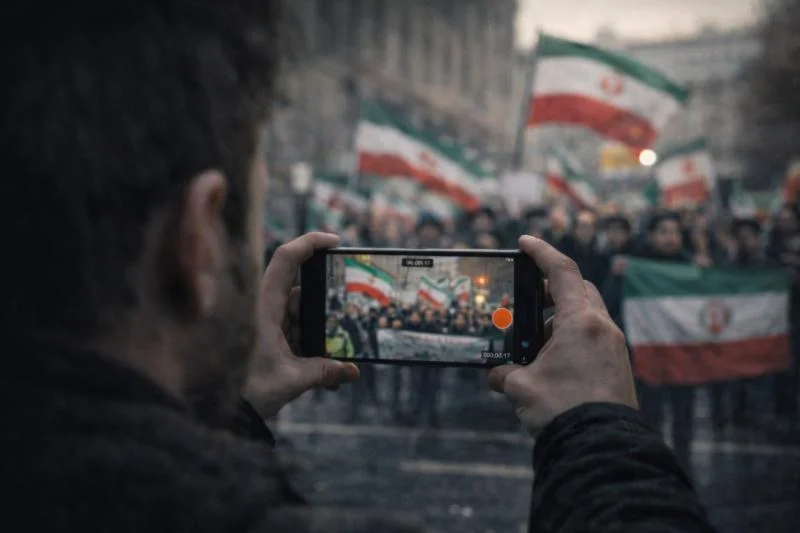
Political persecution by Iran is not confined to its own borders. While the global public focuses on geopolitical tensions in the Middle East, the Mullah regime is waging a covert war against dissidents on German soil. In 2026, cities like Berlin, Hamburg, and Cologne have become stages for systematic persecution aimed at silencing the exiled opposition.
The Strategy of Boundless Fear
Transnational repression is not a new phenomenon, but it has reached a new level of intensity following the “Woman, Life, Freedom” movement. The regime in Tehran utilizes an arsenal of methods to neutralize critics in Germany:
- Digital Surveillance & Spyware: Activists are targeted with sophisticated malware. The goal is to access communication networks to expose contacts within Iran—which often results in their execution.
- Collective Retribution (Sippenhaft): This is the regime’s most effective weapon. Dissidents in Germany receive threatening calls detailing the whereabouts of their parents or siblings in Iran. The message is clear: “Stay silent in Berlin if you want your family in Tehran to survive.”
- Physical Intimidation: In major German cities, prominent exiled Iranians are openly photographed on the street or followed by vehicles with diplomatic license plates. This “marking of presence” signals the regime’s constant reach.
Infiltration and “Cultural Work” as Cover
A central pillar of this repression is the exploitation of legal structures. Despite the 2024 ban on the Islamic Centre Hamburg (IZH), new networks have emerged:
- Front Organizations: Seemingly harmless cultural associations and religious foundations serve as recruitment and intelligence centers for the Iranian Ministry of Intelligence (MOIS).
- Use of Criminal Networks: To obscure state responsibility, Tehran increasingly hires organized crime actors to carry out arson attacks or physical assaults on opposition figures in Europe.
The “Berlin List” 2026
In February 2026, it was revealed that Iranian agents had compiled a detailed database containing profiles of over 600 critics living in Germany. This list includes not only political activists but also journalists, artists, and academics.
The Consequence: Many of those affected are withdrawing from public life, leading to a massive restriction of freedom of speech within Germany.
Critique of German Security Policy
On politischeverfolgung.de, we document the tension between diplomatic restraint and the protection of civil rights:
- Gaps in Protection: While the German state takes massive action against internal dissidents (such as Alexander Bittner), many exiled Iranians feel abandoned by the Office for the Protection of the Constitution regarding real threats from foreign hit squads.
- Abuse of Interpol: The regime increasingly uses “Red Notices” to flag critics globally, restricting their freedom of movement.
Analysis: Exile Repression Matrix (As of 2026)
| Method | Objective | Impact in Germany |
| Doxxing & Character Assassination | Social Isolation | Job losses / Fear in social circles |
| Extortion via Family | Political Silence | Psychological attrition of activists |
| Cyber-Attacks | Exposing Networks | Endangering informants within Iran |
| Physical Violence | Total Elimination | Climate of fear across the community |
Conclusion: German Sovereignty Under Scrutiny
When a foreign regime hunts people on German streets who sought refuge here, it is an attack on the German Constitution (Grundgesetz). Transnational repression must not be dismissed as a “bilateral problem.” We demand a truly effective safe haven for the Iranian opposition.