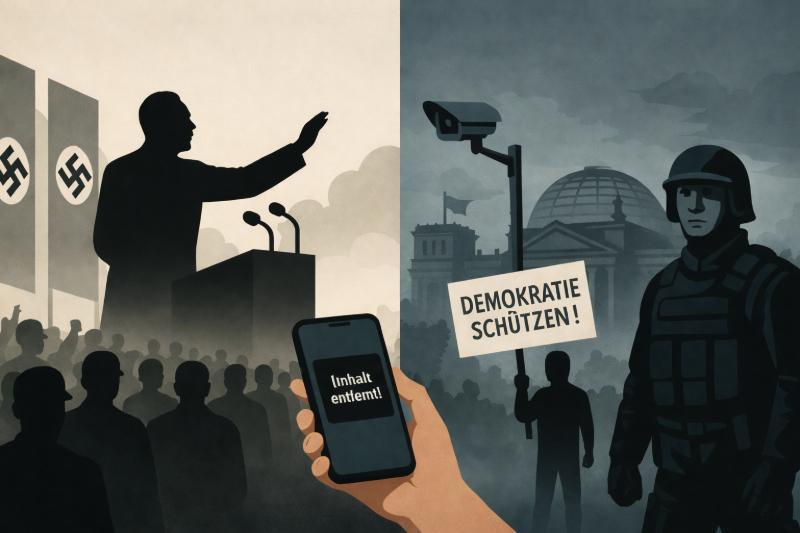
Is Germany reaching an “authoritarian tipping point”? While the Federal Republic formally remains a democracy, sociologists and political analysts warn of a creeping erosion of democratic values. On politischeverfolgung.de, we analyze the transition from a liberal society toward a climate of “defensive” repression.
Data from 2024 to 2026 shows a clear trend: satisfaction with the functioning of democracy is plummeting, while the desire for “strong-hand” leadership and closed-minded worldviews is on the rise.
The Authoritarian Dynamics (2024–2026 Findings)
Recent long-term studies, such as the Leipzig Authoritarianism Study 2024, reveal a massive shift in the mindset of the German population:
- Collapse of Democratic Acceptance: For the first time in decades, satisfaction with democratic practice has dropped significantly, not only in the East but increasingly in Western Germany as well.
- Manifest Exclusion: Xenophobic and chauvinistic attitudes are no longer fringe phenomena; they are becoming a “nationally shared resentment.”
- Longing for Leadership: Approximately 15–20% of respondents now express a preference for a “leader” (Führer) who governs with a strong hand for the “good of all.”
From “Defensive Democracy” to State Repression
The German state has responded to these social tensions by massively expanding security laws, often under the banner of protecting the “liberal-democratic basic order” (FdGO).
- Delegitimization of the State: This new category created by domestic intelligence (Verfassungsschutz) allows for the surveillance of citizens who do not break any laws but criticize the state’s functioning in a way deemed “subversive.”
- Preventive Detention: Laws like the Bavarian PAG (Police Powers Act) have set a precedent: individuals can be detained for extended periods without having committed a crime, based solely on a “threat prognosis.”
Key Indicators of Authoritarianism in the 2020s
| Indicator | Current Implementation |
| Social Exclusion | Labeling critical voices as “enemies of democracy” to justify their removal from public discourse. |
| Biopolitics | Utilizing health or climate crises to enforce far-reaching surveillance and behavioral control systems. |
| Institutional Racism | Despite official rhetoric, studies (such as InRa 2026) show persistent structural discrimination within state authorities. |
| Legal Warfare (Lawfare) | Utilizing §§ 129/129a (criminal/terrorist organization) against activists to freeze their financial assets and social status. |
The Chilling Effect and Civil Silence
The mechanism of modern authoritarianism in Germany does not rely on overt violence, but on the “Chilling Effect.” When doctors, lawyers, and civil servants see colleagues lose their livelihoods for dissenting opinions, “anticipatory obedience” sets in.
As Martin Niemöller’s warning reminds us: The silence of the majority is the most powerful tool of any authoritarian development.
Conclusion: The Future of the Republic
By 2026, the global balance is sobering: According to the V-Dem Report 2025, the number of autocracies worldwide exceeds the number of liberal democracies for the first time since 1945. Germany is not an island. The “authoritarian drift” is a reality that manifests in both social resentment and state overreach.
At politischeverfolgung.de, we document this process. Our goal is to break the silence and remind the state that its legitimacy arises from the protection of individual rights—not from the disciplining of its citizens.