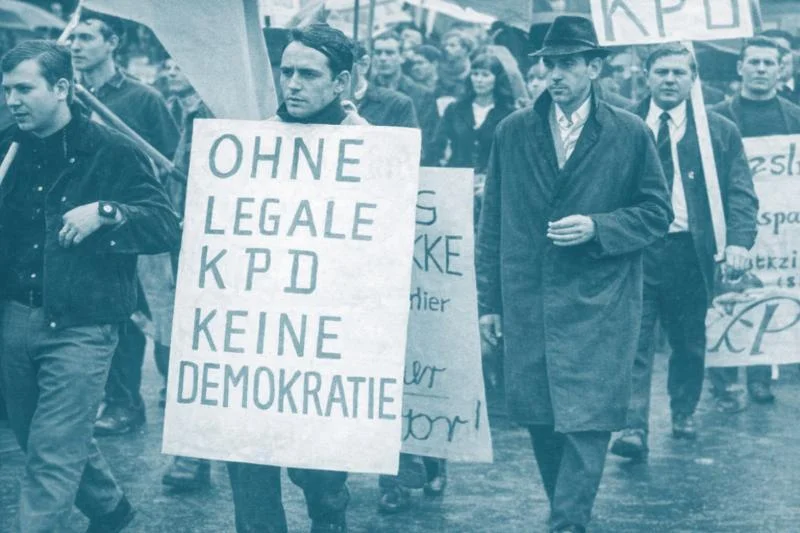
Party bans represent one of the most drastic instruments in Germany’s “militant democracy” (streitbare Demokratie). Article 21, Paragraph 2 of the German Basic Law establishes the legal basis for banning political parties that seek to undermine or abolish the free democratic basic order. This constitutional provision reflects Germany’s historical experience with the collapse of the Weimar Republic and serves to protect democracy from its enemies.
Historical Precedents: Banned Parties in German History
The Socialist Reich Party (SRP) Ban – 1952
Historical Context:
The SRP, founded in 1949, represented a direct successor organization to the NSDAP. In the early years of the Federal Republic, it achieved notable electoral success in some state elections.
Reasons for the Ban:
- Anti-constitutional goals and Nazi ideology
- Organizational continuity with the NSDAP
- Hostility to the constitution and democratic order
Consequences:
- First party ban in the history of the Federal Republic
- Strengthening of the constitutional state
- Establishment of Federal Office for the Protection of the Constitution
The Communist Party of Germany (KPD) Ban – 1956
Historical Context:
In the climate of the Cold War and growing East-West tensions, the KCD was perceived as a Marxist-Leninist party oriented toward the Soviet Union.
Reasons for the Ban:
- Revolutionary goals and dictatorship of the proletariat
- Hostility to the constitution
- Orientation toward the Soviet Union
Political Implications:
- Demonstration of equidistance toward extremisms
- Intensification of East-West conflict
- Long-term political controversies
Current Procedures and Legal Standards
The Ban Procedure
Competent Authorities:

- Federal Constitutional Court as decision-making body
- Federal Government, Bundestag, or Bundesrat as applicants
- Extensive evidentiary requirements
Legal Requirements:
- Evidence of active, aggressive fight against the free democratic basic order
- Overall assessment of party’s goals and behavior
- Weight of intervention proportional to threat
The Free Democratic Basic Order
Definition and Protected Goods:
- Human dignity as central principle
- Popular sovereignty
- Separation of powers
- Accountability of government
- Administration bound by law and justice
- Multi-party principle and equal political opportunities
- Right to form parliamentary opposition
Current Debates and Controversial Cases
The NPD Ban Procedure (2003-2017)
First Procedure (2003-2003):
Failure due to involvement of informants from state protection authorities
Second Procedure (2013-2017):
- Extensive evidence collection
- Consideration of party’s lack of success
- Final decision: No ban despite anti-constitutional goals
Reasoning of the Federal Constitutional Court:
Lack of concrete evidence for success chances of anti-constitutional efforts
Current Discussions About AfD
Political Debates:
- Classification as suspected right-wing extremist
- Discussions about possible ban procedure
- Political and legal assessment challenges
Legal Hurdles:
- High evidentiary requirements
- Consideration of electoral success
- Assessment of concrete endangerment potential
Comparative Perspectives: Party Bans in European Context
European Comparison
Different Legal Traditions:
- Germany: Strong constitutional barriers
- Other EU states: Varied handling
- International law standards
Notable Cases:
- Turkey: Frequent party bans
- Spain: Handling of separatist parties
- Belgium: Procedural approaches
Historical Classification and Political Implications
Learning from History
Weimar Experience:
- Weakness of democracy toward its enemies
- Importance of defensive mechanisms
- Balance between freedom and security
German Division:
- Different handling in East and West Germany
- Instrumentalization of ban practices
- Lessons from SED dictatorship
Current Challenges and Future Perspectives
Modern Forms of Anti-Constitutional Activity
New Challenges:
- Digital communication channels
- International networking
- Hybrid threat scenarios
- Legal strategies to circumvent bans
Reform Discussions
Proposed Changes:
- Lowering thresholds for bans
- Alternative instruments (funding restrictions)
- Improved cooperation with European partners
Conclusion: The Delicate Balance
Party bans in Germany represent a constitutionally intended but extremely cautious instrument. Historical experience shows both the necessity of defensive mechanisms and the dangers of excessive use. The high hurdles for party bans reflect the fundamental tension between protecting democracy and safeguarding political freedom.
Key Findings:
- Party bans remain ultima ratio
- High constitutional hurdles are intentional
- Historical experience shapes current practice
- European context requires comparative perspective
The future of party ban practice will depend on society’s ability to find the balance between necessary defense against enemies of democracy and protection of political pluralism. The instrument of party bans remains an essential component of Germany’s militant democracy, requiring constant review and careful application.