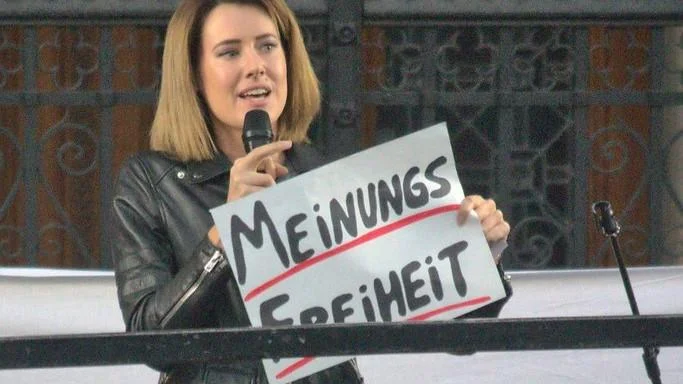
Germany’s Berlin Republic faces a profound democratic dilemma: how to balance legitimate security concerns with the fundamental right to free expression. While Germany maintains a robust democratic framework with strong constitutional protections, recent years have witnessed concerning trends where measures ostensibly designed to combat extremism and hate speech have been increasingly weaponized to silence political dissent. This analysis examines the systematic mechanisms through which freedom of expression is being curtailed in contemporary Germany, potentially creating an environment where political persecution under the guise of legal enforcement becomes increasingly possible.
The tension between security and liberty is not new to democratic societies, but Germany’s historical burden gives this balance particular significance. The country’s 20th century trauma with both Nazi and Communist regimes has created a constitutional commitment to “wehrhafte Demokratie” (defensive democracy) – a principle that allows the state to take proactive measures against forces seeking to undermine the democratic order. However, there is growing evidence that these protective mechanisms have increasingly been directed against legitimate opposition and dissent rather than genuine anti-democratic threats .
International observers have begun noting these developments with concern. As highlighted by the Economist in April 2025, “The threat to free speech in Germany. One of the freest countries in the world takes a hammer to its own reputation” . This international criticism underscores the global significance of Germany’s internal debate about the boundaries of acceptable discourse.
Constitutional Framework and Its Limitations
Legal Foundations of Free Expression
Germany’s Basic Law (Grundgesetz) provides strong protections for freedom of expression. Article 5 states: “Every person shall have the right freely to express and disseminate his opinions in speech, writing, and pictures and to inform himself without hindrance from generally accessible sources. There shall be no censorship” . This constitutional guarantee establishes free speech as “schlechthin konstituierend” (absolutely constitutive) for a liberal democratic order, as emphasized repeatedly by Germany’s Federal Constitutional Court .
The Constitutional Court has further elaborated that this protection extends to all opinions – whether “true or false, rational or emotional, valuable or worthless, dangerous or harmless” . This broad protection is intended to create a “free communicative process” where ideas can be contested through open debate rather than suppressed by authority .
Permissible Limitations
Despite these strong protections, German law recognizes several limitations on free expression:
- General laws (Art. 5(2) GG) that protect other important legal interests
- Youth protection provisions
- Personal honor rights
- Specific criminal prohibitions against incitement to hatred, Holocaust denial, and use of symbols of unconstitutional organizations
These limitations are based on the understanding that freedom of expression finds its boundary where it violates the dignity or rights of others . However, as this analysis will demonstrate, the application of these limitations has increasingly become a subject of controversy and concern.
Mechanisms of Suppression: How Free Speech Is Curtailed
Criminalization of Political Expression
Germany’s criminal code contains several provisions that have been increasingly applied to political speech:

Section 130 (Volksverhetzung – Incitement to Hatred)
This provision against incitement to hatred has been applied beyond its original intent to include government criticism on issues like migration and COVID-19 policies. The broad interpretation of what constitutes “hate speech” has created significant uncertainty about the boundaries of acceptable political discourse.
Section 129 (Forming Criminal Organizations)
This provision has been controversially applied to groups like the “Letzte Generation” (Last Generation) climate activists. Critics argue that treating civil disobedience organizations as “criminal organizations” represents a dangerous politicization of criminal law that could potentially target any organized protest movement.
Preventive Measures and Surveillance
The German state employs various preventive measures that impact free expression:
Assembly Bans
Preemptive bans on demonstrations, particularly those related to controversial issues like the Israeli-Palestinian conflict, have increased significantly. These bans are often justified based on “dangers to public order” without concrete evidence of imminent violence .
Surveillance of Activists
Climate activists, left-wing groups, and other dissenting voices are increasingly subject to state surveillance by domestic intelligence agencies, even when no criminal conduct has occurred. This creates a chilling effect where citizens may self-censor to avoid attracting state scrutiny.
Platform Censorship and Media Pressure
Network Enforcement Act (NetzDG)
This law requires social media platforms to remove “obviously illegal” content within 24 hours or face significant fines. While intended to combat hate speech, it has led to over-removal of content as platforms err on the side of caution. Politically sensitive posts, including criticism of arms exports or government policies, often disappear without clear justification .
Indirect Media Influence
There is growing concern about indirect pressure on media outlets through political channels. Critics point to disproportionate coverage of certain issues (like right-wing networks in authorities) while other stories receive less attention, suggesting possible political influence on editorial decisions .
Case Studies: Testing the Boundaries of Free Expression
The Compact Magazine Ban
In July 2024, Germany’s Interior Ministry under Nancy Faeser banned the controversial magazine Compact and its associated film company, citing their dissemination of “anti-Semitic, racist, minority-hostile, historical revisionist, and conspiracy-theoretical content” . The ministry argued this represented a danger to Germany’s free democratic basic order.
However, in August 2024, the Federal Administrative Court in Leipzig suspended the ban, noting significant doubts about whether the cited content characterized the magazine’s overall orientation and whether a complete ban was proportionate . By June 2025, the courts ultimately ruled the ban unconstitutional, dealing a significant blow to the government’s approach.
This case illustrates the tension between legitimate efforts to combat extremism and the potential for overreach that threatens media pluralism. Even publications with controversial content enjoy constitutional protection unless they clearly cross into unlawfulness.
The David Bendels Case
In April 2025, journalist David Bendels received a seven-month suspended sentence for altering and sharing an image of Interior Minister Nancy Faeser . The case sparked widespread controversy about the limits of political satire and expression.
Table: Comparison of Legal Standards for Defamation
| Type of Defamation | Protected Interest | Maximum Penalty | Applicable To |
|---|---|---|---|
| Regular Defamation (§§186-187 StGB) | Personal honor | Fine or imprisonment up to 2 years | All citizens |
| Enhanced Political Defamation (§188 StGB) | Political reputation | Imprisonment up to 5 years | “Persons in political life” |
| Insult of Organs (§90b StGB) | Institutional dignity | Imprisonment up to 3 years | Constitutional institutions |
Bendels himself described the judgment as an attack on press freedom and announced legal challenges. The case attracted international attention, with U.S. Vice President J.D. Vance questioning whether American taxpayers would accept “someone in Germany going to jail just because he posted a mean tweet” .
This case exemplifies concerns about special protections for political figures that potentially undermine equal treatment under the law and robust political discourse.
The “Ministry of Truth” Concern: Proposed Laws Against “Disinformation”
Coalition negotiations have included discussions of legislation against “intentional misinformation” – ostensibly to protect democracy . However, such proposals raise profound questions about state power to determine truth.
The Problem of Definitional Power
The fundamental challenge with criminalizing “false information” is determining who decides what is true. If the government assumes the role of arbiter of truth, it creates several dangers:
- Political instrumentalization: The definition of “truth” could shift with changing political majorities
- Historical precedent: Positions initially dismissed as “conspiracy theories” (like the COVID-19 lab leak hypothesis) have later gained credibility
- Chilling effect: Uncertainty about what might be deemed “false” could lead to self-censorship on complex issues
Alternative Approaches
Rather than legislating truth, experts suggest more speech-protective alternatives:
- Media literacy education to help citizens critically evaluate sources
- Transparent debate even on uncomfortable topics
- Targeting manipulation rather than opinion (e.g., combating bots rather than critics)
As one analyst noted, “A democracy survives not through censorship but through educated citizens” .
International Perspectives and Criticism
Amnesty International’s Assessment
Amnesty International has expressed significant concern about freedom of expression and assembly in Germany. In its report “Under-protected and over-restricted,” the organization documents several worrying trends :
- Peaceful protests increasingly restricted through blanket assembly bans
- Preventive detention and excessive police force against demonstrators
- Criminalization and stigmatization of peaceful protesters
Amnesty calls for a clearer separation between legitimate criticism and criminal conduct, stronger independent courts against arbitrary prosecution, and more transparent criteria for assembly bans and surveillance .
Comparative Context
Germany’s approach differs significantly from that of other democracies, particularly the United States. As noted in the search results, the U.S. protects “freedom of speech” rather than “freedom of opinion,” allowing even Holocaust denial and distribution of fake news in many circumstances . This transatlantic difference in philosophical approach creates tension in how each society balances free expression against other values.
Consequences for Democratic Culture
The Chilling Effect
Surveys indicate approximately 40% of Germans now avoid controversial topics like migration or climate policy for fear of repercussions . This self-censorship represents a significant erosion of the open discourse necessary for democratic functioning.
The “chilling effect” occurs when vague laws and aggressive enforcement create uncertainty about what expression might trigger legal consequences. This uncertainty leads citizens to retreat from public discourse, particularly on sensitive issues .
Polarization and Erosion of Trust
When state actions are perceived as targeting specific political viewpoints, several damaging consequences follow:
- Increased polarization: Suppressed debates migrate to filter bubbles and echo chambers where they become more radicalized
- Erosion of trust: Citizens who perceive the state as an opponent become less willing to participate in democratic processes
- Legitimacy crisis: When governments are seen as manipulating discourse, overall system legitimacy suffers
These dynamics create a vicious cycle where suppressed criticism leads to alienation, which further undermines democratic resilience.
Conclusion: Rebalancing Security and Freedom
Germany faces a significant challenge in recalibrating the balance between protecting democracy and preserving the open discourse that defines it. The country’s historical trauma with totalitarianism has legitimately created a heightened sensitivity to extremist speech, but there is growing evidence that the protective mechanisms have increasingly been directed against legitimate dissent.
To address these concerns, several reforms appear necessary:
- Clearer distinctions between legitimate criticism and truly criminal speech
- Stronger judicial oversight of preventive measures and surveillance
- Greater transparency in decision-making about assembly bans and content removal
- Resistance to temptation to legislate “truth” or create government arbiters of acceptable discourse
Germany’s democracy remains robust, but its continued health requires constant vigilance against the natural tendency of states to expand their control over discourse. As one legal scholar noted, restricting freedom of expression “to protect the liberal democratic constitutional state will not strengthen its resilience – on the contrary” .
The solution to harmful speech remains more speech, not less – countering bad ideas with better ones rather than attempting to suppress them through state power. Germany’s future as a vibrant democracy depends on rediscovering this fundamental truth.