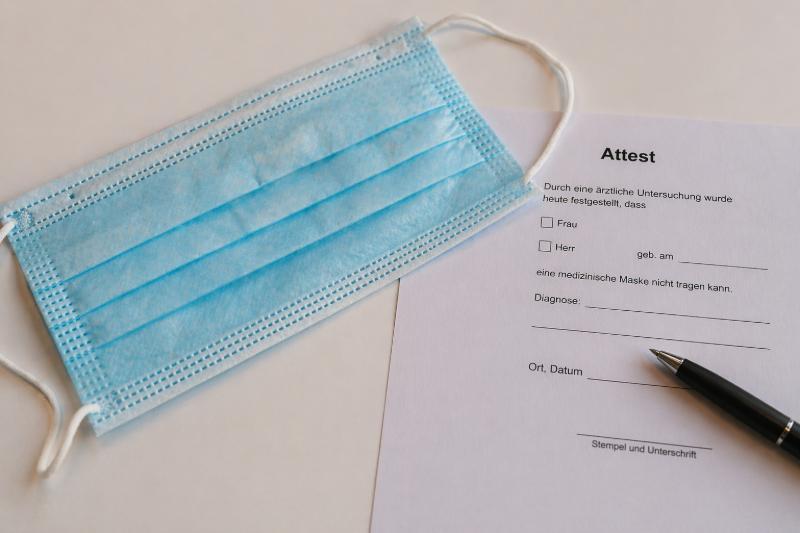
In April 2026, a 61-year-old general practitioner stands trial in Hamburg. The accusation: He is alleged to have issued mask exemptions (so-called “Maskenatteste”) in over 100 cases, sometimes following telephone consultations or via email. While the legal assessment seems straightforward, the case raises a fundamental question that is rarely asked: Why is the formal practice of issuing certificates being prosecuted, while the proportionality of the measures themselves remains unquestioned?
A Trial in Hamburg and an Uncomfortable Question
The judicial evaluation focuses on the “issuance of incorrect health certificates.” However, this case exposes a significant blind spot in the legal and social processing of the pandemic era. During the COVID-19 period, the scope of action for physicians suddenly shifted—but not in all directions. Mask exemptions were prosecuted if they did not meet strict formal requirements, even as patients were simultaneously permitted to obtain sick notes via telephone, often without a physical examination. This is where the actual fault line begins.
Telephone Sick Notes: An Exception or the New Normal?
What many have forgotten (or choose to ignore) is that telephone-based sick leave was introduced during the pandemic and, as of 2026, has been permanently established. It is no longer restricted to respiratory illnesses but applies to all conditions with an expected mild course.
The requirement is simply that the patient is known to the practice and that a video consultation is not feasible. In these cases, incapacity for work can be certified by phone for up to five calendar days. In plain terms: Today, a doctor is officially permitted to certify an incapacity for work without having seen the patient in person.
The Contradiction
This is where it becomes interesting. The very practice that is permitted within the current system—making a medical assessment from a distance—is criminalized in the context of mask exemptions. The core question is: Why is a telephone-based sick note legitimate, while a telephone-based mask exemption is potentially a criminal offense?
Double Standards for the Same Method?
Both situations are based on the same principle: a physician makes a decision without a physical examination, relying on the patient’s description of symptoms. The difference lies not in the method, but in the context. Issuing a sick note is seen as “system-compliant,” while issuing a mask exemption is viewed as “system-critical.”
Legal Reality vs. Social Debate
Courts argue from a purely formalistic standpoint:
- A medical certificate (Attest) must be medically justified through examination.
- Sick notes (Krankschreibungen) are subject to different administrative rules.
However, this distinction appears increasingly constructed when identical diagnostic paths are evaluated differently.

The True Reckoning is Still Pending
The Hamburg case is more than an isolated incident. In previous proceedings at the same court, an 80-year-old physician was sentenced to one year and ten months of probation and banned from issuing further certificates. The court emphasized that this was “not a political trial” but rather the punishment of incorrect health certificates.
What remains disturbing is not the verdict itself, but the pattern behind it: while the legality and proportionality of the original mandates are rarely subject to judicial clarification, individual doctors are being prosecuted years later for their handling of those very mandates.
Conclusion
As long as this imbalance persists, a sense of unease remains—that it is not just medical diligence being evaluated, but whether a person’s behavior “fitted” the system at the time.
This leaves us with the central question: Why is the form being prosecuted, but not the substance? Or, to put it more bluntly: What exactly is this trial in 2026 supposed to clarify? Is it truly about medical care, or about making an example of someone in hindsight?
One thing is obvious: while the system has long since grown accustomed to medical decisions made without personal contact, exactly these types of decisions are being retroactively criminalized if they did not fit the political narrative of the time. This is no longer understandable to the public. If doctors are still being dragged to court in 2026 for mask exemptions issued during an exceptional situation while the underlying political decisions remain untouched, this is not a legal reckoning—it is selective memory.