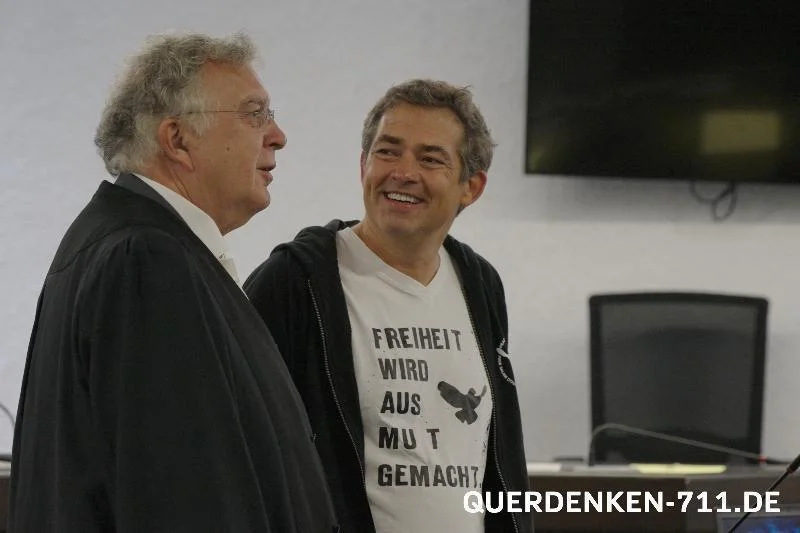
On July 31, 2025, one of the most spectacular trials in German post-war history ended with a crushing defeat for the Stuttgart Public Prosecutor’s Office. Yet, months after the extensive acquittal of Michael Ballweg, it is becoming clear: a judicial victory does not necessarily end repression in today’s political landscape. Between existential tax seizures and the political dismantling of his defense attorney, we are witnessing the face of an apparatus that refuses to forgive.
The Revenge of the Executive: The Tax Office as a Tool
The verdict of the Stuttgart District Court was unmistakably clear: nothing remained of the massive allegations of commercial fraud in over 9,000 cases. The chamber firmly established that the financial support for the “Querdenken” (Lateral Thinking) movement did not constitute fraudulent activity but was rather the legitimate exercise of fundamental rights (Art. 8 GG – Freedom of Assembly). However, the hoped-for rehabilitation never came. Instead, as of December 2025, we are witnessing a continuation of the proceedings through administrative means.
While the criminal court ruled that organizing demonstrations does not constitute a business, the tax authorities stubbornly refuse to recognize this legal reality.
- Seizure Instead of Compensation: Although the court awarded Ballweg compensation for his 279 days of pre-trial detention, not a single cent has been paid. Since the prosecution appealed the verdict (Revision), the judgment is not yet legally binding, and the compensation remains frozen.
- Fiscal Stranglehold: Simultaneously, tax authorities have directly accessed escrow accounts that were actually supposed to be released. Over 110,000 Euros have already been seized through tax liens. Observers view the fact that authorities simply ignore a court’s legal assessment—which stated these were not taxable business earnings—as a dangerous signal: the state continues to fight where the judiciary has stopped it.
Collateral Damage: The “Tribunal” Against Defense Lawyer Reinhard Löffler
Particularly concerning is the political sidelining of Ballweg’s defense attorney, Reinhard Löffler, a member of the State Parliament for the CDU. His case illustrates the high price of defending a systemic critic:
- Political Execution: Löffler was severely penalized during the nomination process for the 2026 state elections. He reports a party-internal “tribunal” where it was suggested he either drop his mandate for the “Corona denier” Ballweg or resign from his political office.
- Attack on the Legal Profession: When elected representatives face political dismantling because of their professional legal mandates, it strikes at the core of the independent legal profession and the separation of powers.
System Check: Signs of Politically Motivated Persecution
To categorize the Ballweg case, it helps to look at typical characteristics of politically motivated instrumentalization of justice (often referred to as Lawfare):
- Disproportionality: Nine months of pre-trial detention for allegations that ultimately collapsed.
- Conflict of Powers: Executive tax authorities continuing sanctions that the criminal court dismissed as unfounded.
- Pressure on the Social Environment: Professional and political sanctions against the defense lawyer.
- Criminalization of Fundamental Rights: Redefining the right to assembly as a “commercial operation” to generate tax leverage.
- Attrition Tactics: Artificially prolonging proceedings through appeals and new administrative hurdles to ruin the individual financially and psychologically.
Conclusion: A Dangerous Precedent
The Michael Ballweg case teaches us that freedom can be won in the courtroom but lost in the back offices of government agencies. When the prosecution stalls for time through appeals while tax authorities create “facts on the ground” and defense lawyers are politically sanctioned, the democratic fabric begins to unravel.
What we are observing here is a form of “cold” persecution: it is no longer about proving a crime, but about the long-term wearing down of a symbolic figure of protest.