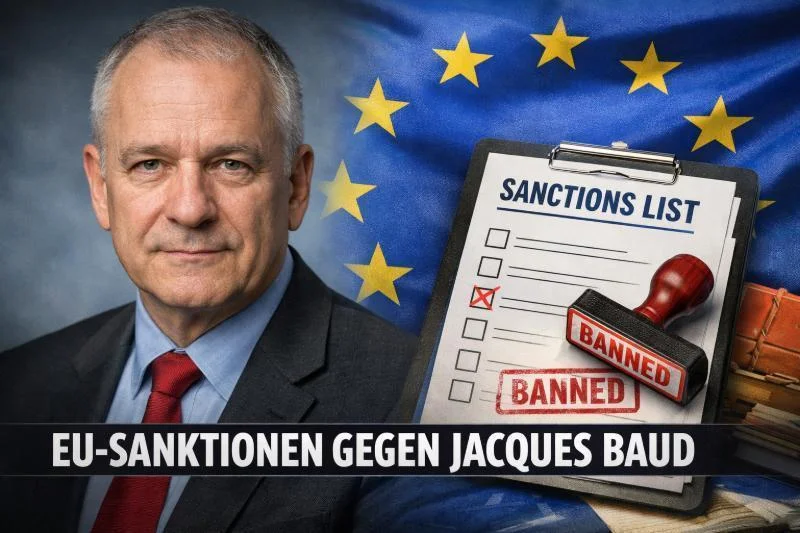
It is a development that shakes the foundations of Swiss neutrality and European freedom of speech: Jacques Baud, a former Colonel of the Swiss Armed Forces and a veteran of the Strategic Intelligence Service, has been placed on the European Union’s sanctions list. This case raises a critical question: At what point does a dissenting military analysis become a sanctionable “threat”?
The Listing: “Propaganda” as an Offense Without a Trial
Jacques Baud is a well-known figure in the world of geopolitics. As a former expert for the Swiss intelligence services, NATO, and the OSCE, he spent decades in the power centers of international security. However, since the beginning of the Ukraine conflict, his publications and analyses—which deviate significantly from the official NATO and EU narratives—have placed him in the crosshairs of the authorities.
The EU has placed Jacques Baud on its sanctions list, claiming that his appearances in Russian state media and his publications contribute to “disinformation” and undermine the territorial integrity of Ukraine.
For Baud and his defenders, this is an unprecedented overreach. The core criticism is that the EU is not sanctioning actions, but rather narratives.
System Check: Does the Jacques Baud Case Meet the Criteria for Political Persecution?
Based on our standardized checklist for politically motivated proceedings, the following picture emerges:
1. Sanctions Without Due Process
Finding: Inclusion on the sanctions list is carried out by the EU Executive (The Council of the EU). Analysis: This is the hallmark of modern political repression in Europe. There is no formal indictment, no defense attorney, and no judge before the penalty (freezing of assets, travel ban) takes effect. The affected person often only learns of the sanction when their credit card is declined.
2. “Civil Death” within the Financial System
Finding: Swiss banks adopt EU lists almost blindly due to compliance pressures. Analysis: For a Swiss citizen like Jacques Baud, this results in economic isolation within his own country. The closure of bank accounts and exclusion from the payment system amount to the destruction of one’s livelihood—a tool previously reserved for major criminals or terrorists.
3. Criminalization of Expert Knowledge
Finding: Baud’s analyses are based on his experience as an intelligence officer using open-source intelligence (OSINT). He reaches different conclusions than the EU Commission. Analysis: When a state or a supranational body defines which military analysis is “permissible” and which is punished as “propaganda,” free scientific and journalistic discourse is effectively over. This meets the criteria for persecution based on political conviction.

Conclusion: A Dangerous Precedent
The Jacques Baud case represents a new level of “cold” persecution. It is no longer just about arresting activists in the streets; it is about using administrative levers (sanctions lists) to silence intellectuals and experts who possess a wide reach.
If a well-founded—even if highly controversial—analysis is sufficient to place an individual on the same level as war criminals, then the instrument of sanctions has shifted from a tool of foreign policy to a weapon of domestic repression.
SRF.ch: In der Schweiz hat Baud hingegen nichts zu befürchten. Die 2022 eingeführten EU-Wirtschaftssanktionen trägt der Bundesrat mit, nicht aber das 2024 eröffnete Sanktionsregime wegen Propaganda und Desinformation.
Ihr “Befund: Die Schweiz übernimmt die EU-Sanktionen gegen ihre eigenen Staatsbürger. Analyse: Hier wird die neutrale Schweiz zum Vollstrecker ausländischer Exekutiventscheidungen. Ein Schweizer Bürger verliert seinen Rechtsschutz gegenüber seinem eigenen Staat, weil dieser sich einer supranationalen Liste unterwirft.” Warum verbreiten Sie diese Lüge?
Vielen Dank für ihre Anmerkung. Nach kurzer Prüfung werden wir den Artikel dementsprechend ändern.