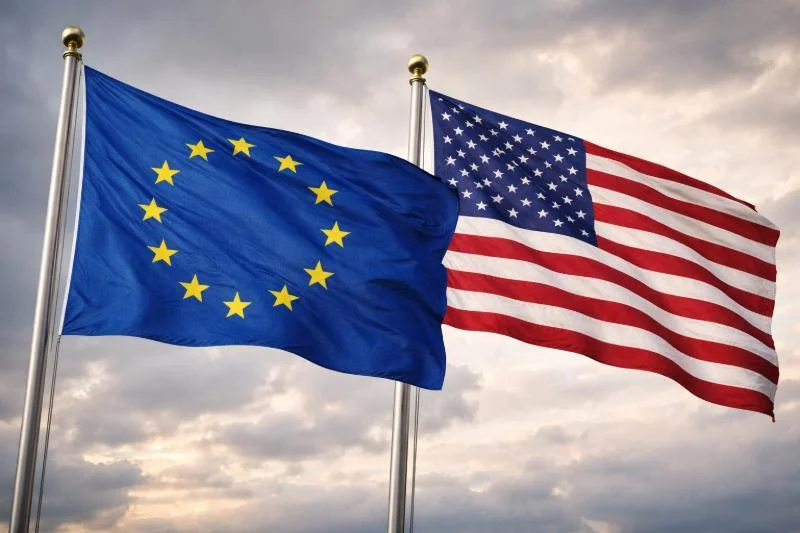
EU flag and U.S. flag side by side against the sky – symbolic image for transatlantic relations between the European Union and the USA
While the European Parliament loudly criticizes U.S. sanctions against EU bureaucrats, it remains conspicuously silent about the systematic censorship and persecution of government-critical voices within its own legal sphere.
On February 25, 2026, the Committee on the Internal Market and Consumer Protection (IMCO) of the European Parliament addressed a matter that goes far beyond technical platform regulation. Under the internal reference IMCO/10/05183, an “Exchange of views” was held under the programmatic title:
“When U.S. sanctions target EU citizens: Defending the DSA and Europe’s Digital Sovereignty.”
What sounds technical at first glance marks a politically explosive conflict: The United States has imposed visa or travel sanctions against European actors in connection with the Digital Services Act (DSA), and the European Parliament has responded with a demonstrative defense of its regulatory framework.
The question that arises, however, is this: Is this about legitimate legislation, or about the institutional safeguarding of an increasingly narrow corridor of opinion?
The Formal Framework
The session took place as part of a regular IMCO meeting.
Committee: Committee on the Internal Market and Consumer Protection (IMCO)
Format: Exchange of views
Internal reference: IMCO/10/05183
Date: February 25, 2026

Agenda, committee highlights, newsletter, and multimedia archive clearly document that this agenda item was officially scheduled and conducted. The session recording is available. The formal record is clear.
Who Spoke – and Who Did Not?
The official documents list the following individuals:
Thierry Breton (former EU Commissioner)
Anna-Lena von Hodenberg (HateAid)
Josephine Ballon (HateAid)
Clare Melford (Global Disinformation Index)
The framing was equally clear: defense of the Digital Services Act, emphasis on European digital sovereignty, and rejection of accusations that the regulation amounts to “censorship.”
What is striking, however, is what did not occur. The hearing gathered actors who criticized sanctions, but not voices that themselves have been affected by European measures in the context of “disinformation.” The perspective remained institutionally closed.
The Core of the Conflict
In Brussels, the Digital Services Act is considered a milestone in digital regulation. It obliges large platforms to conduct risk analyses, establish transparency mechanisms, and implement structured reporting procedures. Officially, it is about accountability and the protection of fundamental rights.
Critics, however, see in its practical implementation a system that, through algorithmic prioritization, reporting offices, and regulatory pressure, effectively influences the visibility of opinions.
When a third country—here, the United States—responds with sanctions, a paradoxical situation emerges: While Brussels defends the DSA as a protection of freedom of expression, Washington views parts of the regulation as an infringement upon that very freedom.
During the hearing, the European Parliament clearly stood behind its regulatory framework. Sanctions imposed by third countries against European actors were regarded as a problematic intrusion into the European legal sphere.
Digital Sovereignty: A New Power Concept
“Digital sovereignty” has long been more than a buzzword. It has become a guiding political principle. Behind it lies the claim to enforce European rules vis-à-vis global platforms and foreign governments.
But every form of sovereignty has a reverse side: Those who set rules also define boundaries. Those who regulate content influence visibility. And those who defend regulation inevitably defend its consequences.
The IMCO hearing of February 25, 2026, was therefore not merely a reaction to visa sanctions. It was a political signal: Europe will not allow its digital order to be questioned from the outside.
A Broader Context
For German readers, this development is particularly relevant. In Germany, too, the fight against “disinformation” is increasingly being institutionalized through reporting centers, networks, platform obligations, and regulatory expansion.
The key question, therefore, is not only whether U.S. sanctions are appropriate. The real question is: How far may regulation go before it itself becomes the subject of geopolitical power conflicts?
The hearing is documented. The Parliament’s position is clear. The defense of the DSA stands.
What remains is not a technical detail, but a core issue of power politics: How much regulation still constitutes protection—and at what point does it become an instrument of discipline? Who defines that boundary? Parliaments? Authorities? Platforms? Or a combination of all three that increasingly escapes democratic control?
As long as these questions are not openly debated, the reference to “digital sovereignty” remains a powerful slogan—but not an answer to the growing concern that, under the banner of protection, a system is emerging that controls visibility and increasingly narrows the space for debate.
A Gap in the Debate
What was also noticeable during the hearing: European measures against dissenting voices were not discussed.
While Brussels reacted with clear indignation to U.S. visa sanctions, it went unmentioned that within Europe, for years, listings, account freezes, platform exclusions, and regulatory pressure have also been used—always in the name of combating “disinformation.”
Those affected include:
- The globally known case of the Swiss publicist and former intelligence officer Jacques Baud.
- Less widely known cases such as the German journalists Alina Lipp, Thomas Röper, and Hüseyin Doğr, who have faced sanctions amounting to de facto exclusion.
Here, a tension inevitably arises: If the European Parliament criticizes third countries for imposing restrictive measures on European citizens, the question arises by what standard actions are taken within its own legal sphere.
Who decides which opinion counts as legitimate criticism and which is labeled “security-relevant influence”? Who determines when regulation is protection and when it becomes political marking—with very real consequences for freedom of movement, reputation, and economic existence?
When a European author and geopolitical analyst such as Jacques Baud finds himself effectively stuck in Belgium, while Brussels simultaneously debates U.S. sanctions against EU citizens with grand gestures, a troubling image emerges.
Outrage outward. Silence inward.
These questions were not raised during the IMCO hearing. They were not problematized. And they were certainly not answered.
The real explosiveness lies less in the diplomatic exchange with Washington than in the refusal to consistently apply the same standard to one’s own actions.