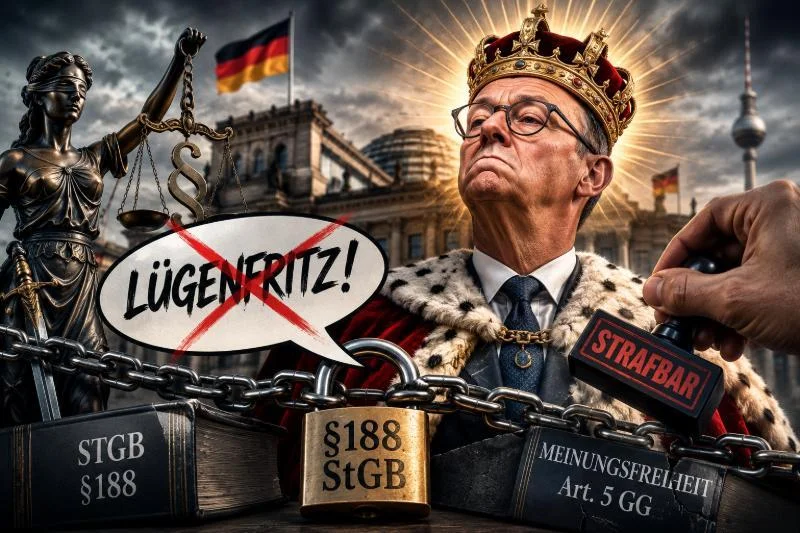
Historically, political debate in Germany was characterized by sharp polemics, biting satire, and robust vocabulary. Anyone entering the federal political arena knew they needed thick skin—that was the unwritten rule of a vibrant democracy. However, the tide has turned. The cartel of established politicians increasingly weaponizes the state apparatus as a personal legal department to crush dissent. A recent, mind-boggling case has brought this authoritarian shift to its absolute peak: a legally binding criminal conviction over the use of the term “Lügenfritz” (roughly translating to “Lying Fritz”) aimed at CDU leader Friedrich Merz. This verdict exposes the absurd reality of weaponized justice under the current regime.
The Incident: Transforming Childish Taunts into Criminal Offenses
The term “Lügenfritz” belongs in the realm of harmless, almost childish mockery. It is a colloquial, mocking nickname for someone accused of untruthfulness or political opportunism. In a pluralistic society, one would assume that confronting a top politician over severe contradictions in his public statements—be it regarding migration, energy policies, or coalition firewalls—falls under the absolute protection of free speech.
Yet, reality paints a grim picture. At the behest of political elities and through the enforcement of the notorious Paragraph 188 of the German Criminal Code (StGB)—which grants special criminal protection against the “insult of persons in political life”—a penal order was fast-tracked. This conviction for Lügenfritz sends an unmistakable signal: the constitutional space for citizens to voice frustration over the credibility of their political leaders is being systematically dismantled.
Constitutional Double Standards: “How Else Are We Supposed to Call Him?”
The utter absurdity of this verdict becomes even more evident when analyzing the political track record of the individual shielded by the court. Friedrich Merz is a politician whose career is defined by rhetorical u-turns. A politician who demands the abolition of social benefits in the morning and signals coalition willingness in the name of “reason” by the evening must expect harsh, polemical evaluations from the public.
Defense lawyers and independent civil rights observers are raising a fundamentally legitimate question: How else are we supposed to call a politician whose promises routinely vanish into thin air once elections are over?
By classifying the term “Lügenfritz” as a criminal defamation, the judiciary does not merely ban a word; it criminalizes the political analysis behind it. The goal is to establish a taboo. No ordinary citizen shall dare to shake the credibility of the ruling class without fearing a police raid or a crushing fine.
Paragraph 188 StGB: The Establishment’s Legal Shield
This specific ruling is part of a broader, concerted crackdown orchestrated by elite politicians across all mainstream parties. Whether it is Robert Habeck triggering a wave of criminal complaints over being called a “Schwachkopf” (blockhead), Annalena Baerbock’s endless lawsuits against internet memes, or this judicial shield for Friedrich Merz—the blueprint remains identical.
Through the continuous expansion of digital censorship frameworks and modifications to the criminal code, the state has built a mass-surveillance and prosecution infrastructure. Special state prosecutors scour the internet for terms that used to be standard political folklore in any local tavern. This industrial-scale prosecution aims for a chilling effect: the fear of financial ruin is designed to force citizens into self-censorship.

International Outrage: US Diplomat Accuses Germany of Censorship
The authoritarian overreach of the German judiciary has long since sparked international condemnation and diplomatic bewilderment. US diplomat Sarah B. Rogers addressed the case on the platform X, explicitly accusing the Federal Republic of “censorship”. Rogers countered the pseudo-argument often raised in international circles—that Germany should be granted a certain leeway for speech restriction due to its unique history—by stating: “Here is an example of what German censorship extends to”. The fact that a harmless Facebook comment under a police drone warning in the city of Heilbronn is sufficient to sentence a citizen to 30 daily fines via a penal order exposes Germany’s draconian practices to the global public.
The justification provided by the Heilbronn prosecution highlights the pinnacle of this judicial madness: the term “Lügenfritz” was deemed criminal because it was allegedly suited to “shake confidence in the integrity of the victim” and to “fuel negative prejudices or aggression”. The sheer arbitrariness of this weaponized justice is perfectly illustrated by a bizarre double standard: while “Lügenfritz” is criminalized, the very same prosecution office dropped a case involving the term “Pinocchio,” ruling it as permissible criticism of power protected by free speech. This absurd hair-splitting proves that legal certainty has been replaced by political whim. The transatlantic divide over freedom of speech is growing rapidly; just in December 2025, the US imposed travel bans on the leaders of the state-funded censorship NGO HateAid, after US Secretary of State Marco Rubio accused European ideologues of forcing American platforms to suppress opinions they dislike.
Conclusion: The Death of the Political Arena
The conviction for Lügenfritz marks a definitive low point for freedom of speech in modern Germany. If top politicians who aspire to govern a nation and dictate the lives of millions cannot withstand a harmless, mocking nickname, they have lost all moral and political legitimacy.
The judiciary has ceased to act as an objective guardian of constitutional rights, transforming instead into the executive arm of a panicked establishment that can no longer win arguments on merit. However, this strategy will backfire: the harder the state criminalizes everyday criticism, the wider the chasm grows between an isolated elite and a population that refuses to be silenced.