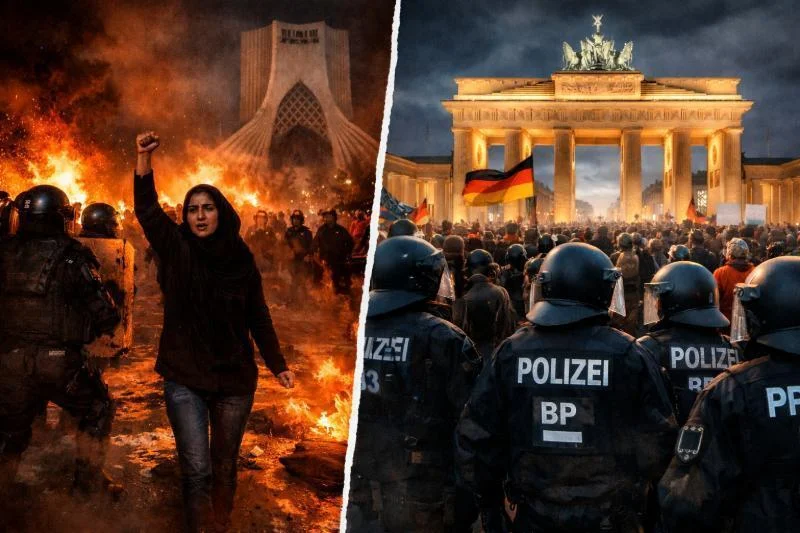
Berlin, 1967. Berlin, 1992. Berlin, 2026. The locations remain the same, the actors change, but the pattern persists: For decades, Iran has used German territory as an operational base for the persecution, intimidation, and liquidation of opposition figures. We analyze the chronology of transnational repression, stretching from the German Empire to the digital age.
Alliances of Repression and Persecution between Iran and Germany
The Foundations: The German Empire as the “Third Partner” (1871–1918)
The history began with Persia’s (as Iran was then officially known) hope to find a disinterested partner in Germany to counter the colonial pressure of Russia and Great Britain.
- The Honest Broker: In 1873, Nasir al-Din Shah visited Berlin. The German Empire provided military advisors and engineers. Germany was perceived as a protective power against British-Russian imperialism.
- WWI Secret Operations: German agents like Wilhelm Wassmuss (the “German Lawrence”) supported Persian tribes against British occupiers. Simultaneously, Berlin became a safe haven for Persian nationalists, who published the influential magazine Kaveh there—marking the beginning of a long tradition of Iranian exile in Germany.
Nazi Germany: Ideology and the “Persian Corridor” (1933–1941)
Under Reza Shah Pahlavi, relations intensified significantly. Germany became Iran’s most important trading partner, but this rapprochement came at a high price.
- The “Aryan” Narrative: Nazi propaganda exploited linguistic ties, declaring Iranians to be “Aryans.” In 1935, at the suggestion of the Iranian legation in Berlin, the country was officially renamed “Iran” (Land of the Aryans)—a name immediately instrumentalized by Berlin for propaganda.
- The 1941 Catastrophe: These close ties served as a pretext for the Anglo-Soviet invasion of Iran. The Shah was forced to abdicate, and the country was occupied. This experience of lost sovereignty shaped Iranian paranoia toward foreign interference for generations.
The Bonn Republic: The Era of the “Jubelperser” (1967)
After WWII, West Germany became the Shah’s most vital Western partner. However, this friendship was built on the suppression of dissidents.
- Exporting Violence: During the 1967 state visit, agents of the Iranian secret service (SAVAK), disguised as “Jubelperser” (Cheering Persians), attacked protesters with unprecedented brutality.
- The Fall of the Rule of Law: German police protected the thugs instead of the citizens. The killing of student Benno Ohnesorg became a rallying cry for an entire generation. It was here that the Iranian regime learned that dissidents could be hunted on German soil with near impunity, provided economic interests (oil) were at stake.
From Mykonos to Cyber-Repression (1992–2026)
Following the 1979 Revolution, the ideology changed, but the hunt for opposition members in Germany became professionalized.
- State Terrorism: In 1992, Iranian agents murdered four Kurdish exile politicians at the Mykonos restaurant in Berlin. The 1997 verdict by the Berlin Higher Regional Court proved for the first time that the highest levels of the Iranian leadership had ordered the assassinations.
- The Digital Matrix 2026: Today, Iran utilizes transnational repression. Through smartphone infiltration and “Sippenhaft” (family liability)—threatening relatives back in Iran—activists in Berlin or Hamburg are coerced into silence. The discovery of the “Berlin List” (over 600 marked critics) proves the regime’s seamless surveillance.
Historical Comparative Analysis of Repression
| Era | German Status | Iranian Regime | Form of Persecution in Germany |
| Empire | Protective Power | Qajars (Monarchy) | Espionage in the “Great Game” |
| Nazi State | “Aryan” Brother | Pahlavi I (Monarchy) | Ideological Alignment |
| Bonn Rep. | Economic Partner | Pahlavi II (Monarchy) | Physical Violence (“Jubelperser”) |
| Today (2026) | “Critical Partner” | Mullahs (Theocracy) | Cyber-Terror & Family Extortion |
Conclusion: The Failure of the Promise of Protection
This history reveals a painful continuity: Whether under Imperial dreams, Nazi ideology, or the “Realpolitik” of the Bonn and Berlin Republics, the protection of Iranian dissidents has repeatedly been sacrificed for geopolitical or economic goals. At politischeverfolgung.de, we demand an end to this cycle: Protection from transnational repression must be absolute.
Sources & Bibliography (Selection)
- Küntzel, Matthias: Germany and Iran: A Fatal Friendship.
- Berlin Higher Regional Court: Verdict on the Mykonos Assassinations (1997).
- Chaussy, Ulrich: The Three Lives of Rudi Dutschke.
- Human Rights Watch: Dossier on Transnational Repression 2025/26.