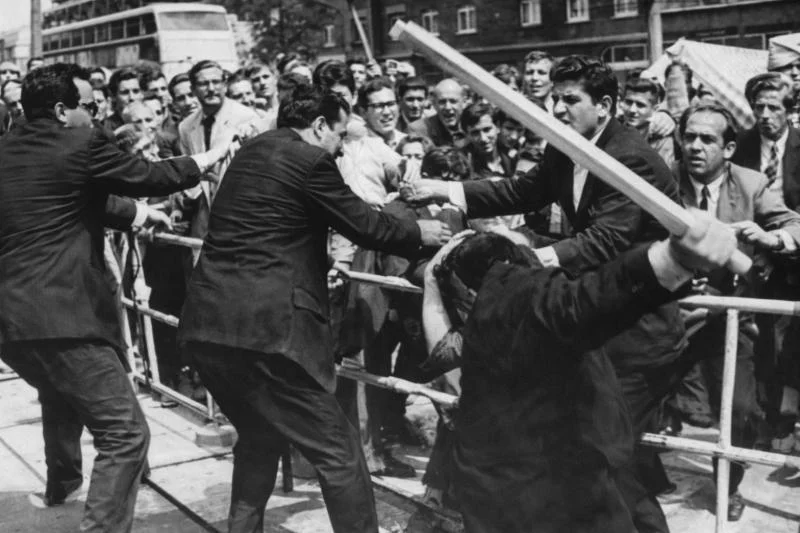
June 2, 1967, marks one of the darkest days in the history of the Federal Republic of Germany. What began as a state visit by the Iranian Shah, Mohammad Reza Pahlavi, ended in a bloody excess of state-sanctioned violence and the death of student Benno Ohnesorg. On politischeverfolgung.de, we examine the background of the so-called “Jubelperser” (Cheering Persians) and how the Bonn Republic enabled the hunt for dissidents on German soil.
The “Jubelperser”: Thugs on an Official Mission
Behind the now almost forgotten term “Jubelperser” lay a perfidious strategy of the Iranian secret service, SAVAK. To maintain the image of the Shah’s harmonious rule abroad, approximately 150 agents and hired thugs were flown in.
- The Disguise: Equipped with small flags and portraits of the imperial couple, they were instructed to appear as enthusiastic supporters.
- The Reality: Hidden beneath their coats, they carried wooden clubs, blackjacks, and steel rods. Their mission was the physical liquidation of protests by Iranian exiles and German students.
The Failure of the Rule of Law: The “Liverwurst Tactic”
The most chilling aspect of the events on June 2, 1967, was not just the violence of foreign agents, but the active complicity and “looking away” of German security organs
In front of the Schöneberg City Hall in West Berlin, a lawless vacuum emerged. While the Shah’s thuggish “cheerleaders” beat protesters, the Berlin police did not intervene. On the contrary, using the infamous “Liverwurst Tactic” (Leberwursttaktik), the police encircled the demonstrators and squeezed them in the middle, where they were brutalized by both the police and the SAVAK agents.
“The fact that a foreign secret service hunted people on German soil while the local police provided cover is the hallmark of an era where economic interests were prioritized over fundamental rights.”
The Case of Benno Ohnesorg: A State-Covered Murder?
The evening in front of the Deutsche Oper in Berlin led to a fatal escalation. Student Benno Ohnesorg, attending his very first demonstration, was shot in a backyard by police officer Karl-Heinz Kurras.
- Judicial Scandal: Kurras was acquitted in two trials. It was only decades later, in 2009, that he was exposed as an informant (IM) for the East German Stasi—a detail often used to deflect from the responsibility of the West Berlin police leadership.
- Repression via the Press: The Axel Springer press (specifically BILD) had whipped up such massive sentiment beforehand that violence against students was legitimized by large parts of the population as “necessary intervention.”
Analysis: Political Persecution Then and Now
For observers on politischeverfolgung.de, the parallels to the present day are unmistakable. We are once again witnessing a blurring of state boundaries when it comes to suppressing the “wrong” opposition.
| Feature | The Bonn Republic (1967) | The Berlin Republic (Today) |
| Scapegoat | “Radical Leftist Students” | “Right-wing Extremists / Delegitimizers” |
| Methodology | Physical Violence & Hired Thugs | Social Annihilation & Deplatforming |
| Role of the Press | Tabloid Agitation (BILD) | One-sided Framing Campaigns |
| Objective | Protecting Foreign Despots (Oil) | Protecting the Current Power Structure |
Conclusion: The Legacy of the “Jubelperser”
The history of the “Jubelperser” proves that the Federal Republic was never immune to authoritarian reflexes. When state interests (then oil and geopolitics, today ideological transformation) are at stake, the protection of the individual against violence becomes secondary.
The events of 1967 serve as a warning: Political persecution begins where the state starts to distinguish between “valuable” cheers and “dangerous” protest.
