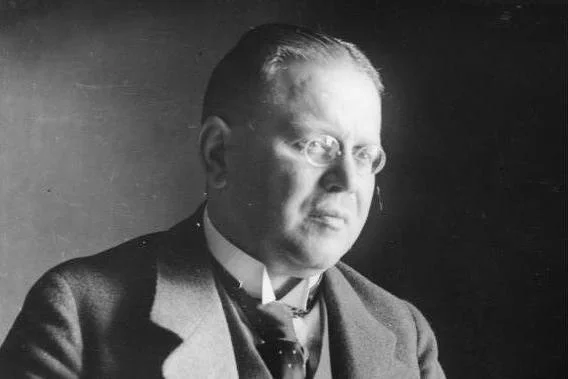
Matthias Erzberger was one of the most prominent and controversial politicians of the German transition period from the German Empire to the Weimar Republic. As a member of the Center Party, he signed the Armistice of Compiègne in 1918, saving countless lives—yet to the völkisch right wing, this made him the personification of a traitor within the “stab-in-the-back” myth (Dolchstoßlegende). His story is a chronicle of unprecedented political persecution, beginning with a malicious media campaign and culminating in a brutal political assassination.
We document Erzberger’s fate as a warning of how political dehumanization and targeted disinformation pave the way for physical violence.
From Monarchist to Reformer: The Transformation of Matthias Erzberger
Matthias Erzberger began his career as a classic representative of the Catholic Center Party. However, during World War I, he underwent a remarkable transformation. He recognized sooner than many others that the war could no longer be won militarily.
In 1917, he introduced the Reichstag Peace Resolution, placing him squarely in the crosshairs of the Supreme Army Command (Oberste Heeresleitung – OHL). To the military leadership under Ludendorff and Hindenburg, Erzberger was henceforth a disruptive element undermining “national unity.” This early form of political exclusion was the prelude to a campaign of persecution that would radicalize severely after the war.
The Signature at Compiègne: A Death Warrant Issued by the OHL
The moment that sealed Erzberger’s fate was November 11, 1918. The military leadership, having lost the war, shirked its responsibility and left it to the civilian Erzberger to sign the armistice.
- The Construction of the “Stab-in-the-Back” Myth: Although the generals demanded an immediate armistice, they spread rumors after the war claiming that the army remained “undefeated in the field” and was stabbed in the back from behind by “unpatriotic civilians” on the home front.
- Erzberger as the Target: As the signatory, Erzberger became the face of this alleged betrayal. The political persecution now took the form of a systematic character assassination campaign, branding him a “November Criminal.”
The Helfferich Trial: The Judiciary as an Instrument of Persecution
A high point of the media and legal persecution was the 1920 trial against Karl Helfferich. Helfferich, a national-conservative politician, had launched a vicious attack on Erzberger in a pamphlet, accusing him of corruption and a lack of patriotism. Erzberger sued for libel, but the trial devolved into a farce:
- Class Justice Strikes: The court weaponized the proceedings to morally discredit Erzberger. Although Helfferich was convicted of libel, his sentence was minimal, while the verdict dealt a heavy reputational blow to Erzberger.
- Resignation: As a result of this judicial campaign, Erzberger was forced to resign from his post as Reich Minister of Finance. The persecution had achieved its objective: he was politically isolated and socially ostracized.
The Organisation Consul and the Political Assassination
After his withdrawal from politics, the persecution did not cease—it turned physical. The Organisation Consul (O.C.), a far-right secret terror group composed of former naval officers, put Erzberger on their hit list. For these terrorists, murdering Erzberger was viewed as a “sacred duty” to save the nation.
On August 26, 1921, while taking a walk in the Black Forest (Bad Griesbach), Matthias Erzberger was shot dead by Heinrich Tillessen and Heinrich Schulz. The brutality of the act—six shots fired at point-blank range—bore testament to the profound hatred sown over years by the right-wing press.

The Failure of the Rule of Law in the Aftermath
The political persecution of Erzberger continued even after his death. Helped by accomplices, the murderers managed to flee abroad (including to Hungary).
- Impunity: The perpetrators were brought to justice only after World War II. During the Weimar Republic, right-wing circles revered them as “avengers of the Fatherland.”
- Impact of the Murder: The assassination of Erzberger marked the start of a series of political killings (including that of Foreign Minister Walther Rathenau) aimed at proving the Republic was incapable of protecting its representatives.
Excursus: Erzberger in the Adaptation of “All Quiet on the Western Front” (2022)
In Edward Berger’s Oscar-winning film adaptation of All Quiet on the Western Front (2022), the character of politician Matthias Erzberger, played by Daniel Brühl, is introduced as a historical storyline that does not exist in Erich Maria Remarque’s original novel. In the film, Erzberger embodies a humanitarian and rational counterweight to the blind obedience and unyielding harshness of the German military command.
While the embittered General Friedrichs (Devid Striesow) senselessly sends young soldiers to their deaths until the very last minute, Erzberger races against time inside the railway carriage at Compiègne to sign the armistice and bring a swift end to the slaughter on the front line. This narrative thread serves to politically contextualize the tragic fate of trench soldiers like Paul Bäumer, sharply highlighting the cruel contrast between high-level armistice negotiations and the meaningless deaths in no man’s land.
Conclusion: Why We Must Remember Erzberger
Matthias Erzberger was a martyr for reason. His persecution starkly illustrates how a democracy erodes when political discourse is replaced by hate and “fake news” (such as the stab-in-the-back myth). He was hunted because he spoke the bitter truth about defeat and accepted responsibility when those truly in power fled from it.
At PolitischeVerfolgung.de, we honor Matthias Erzberger as a politician who paid the ultimate price for his commitment to realism and peace. His fate remains a lasting warning.