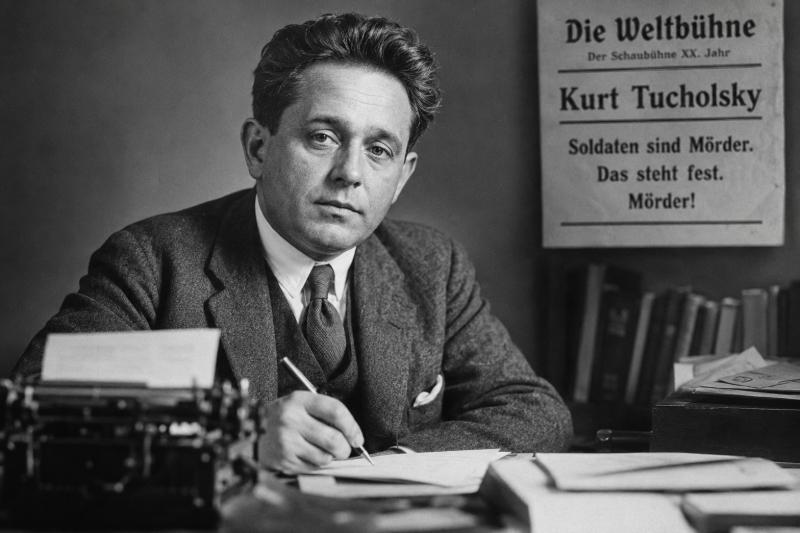

Kurt Tucholsky (9 January 1890 – 21 December 1935) was one of the most influential German writers, journalists, and satirists of the Weimar Republic. Through sharp wit, political analysis, and literary precision, he criticized militarism, nationalism, antisemitism, and authoritarian tendencies in Germany.
After the National Socialists came to power in 1933, his books were banned, publicly burned, and removed from libraries. Tucholsky was stripped of his German citizenship and spent his remaining years in exile in Sweden. Today, he is regarded as one of Germany’s most important advocates of democracy, freedom of the press, and human rights.
Kurt Tucholsky – A Voice for Democracy and Freedom of Expression
Childhood and Education
Kurt Tucholsky was born on 9 January 1890 in Berlin into a Jewish merchant family.
After attending the French Gymnasium in Berlin, he studied law in Berlin and Geneva. Even as a student, he began publishing articles and essays in newspapers and magazines.
His remarkable talent for political satire and social criticism quickly became apparent.
Journalist and Author
Following the First World War, Tucholsky became one of Germany’s best-known journalists and political commentators.
He published under several pen names, including:
- Peter Panter
- Theobald Tiger
- Ignaz Wrobel
- Kaspar Hauser
Many of his articles appeared in the influential weekly magazine Die Weltbühne.

Throughout his career, he advocated:
- democracy,
- the rule of law,
- freedom of expression,
- social justice,
- peace in Europe.
At the same time, he warned against the growing dangers of nationalism, militarism, and political extremism.
Criticism of Militarism and Nationalism
Kurt Tucholsky became one of the strongest critics of German militarism.
He is particularly remembered for the famous sentence:
“Soldiers are murderers.”
Published in 1931, the statement sparked years of legal and political controversy.
Tucholsky’s criticism was directed not at individual soldiers but at war as an instrument of politics and at the glorification of military violence.
He also warned, long before many of his contemporaries, about the dangers posed by National Socialism and the increasing radicalization of German politics.
The Rise of the Nazi Regime
After Adolf Hitler became Chancellor on 30 January 1933, the situation for independent journalists and writers deteriorated rapidly.
The works of Kurt Tucholsky were:
- banned,
- removed from libraries,
- publicly burned,
- withdrawn from bookstores.
On 10 May 1933, National Socialist students organized public book burnings across Germany.
Tucholsky’s books were among those thrown into the flames.
Exile in Sweden
Since the late 1920s, Tucholsky had spent most of his time living in Sweden.
Following the Nazi seizure of power, he was unable to return to Germany.
In 1933, the Nazi government revoked his German citizenship.
From exile, he watched with growing concern as democratic institutions in Germany collapsed and political opponents, Jewish citizens, journalists, and intellectuals faced increasing persecution.
His hope that Germany would return to democratic principles gradually disappeared.
Political Persecution
Kurt Tucholsky’s life illustrates how authoritarian governments silence critical intellectuals.
The measures taken against him included:
- book burnings,
- censorship,
- publication bans,
- revocation of citizenship,
- propaganda campaigns,
- exclusion from German cultural life.
His writings could no longer be published in Germany, while many of his colleagues were arrested, persecuted, or forced into exile.
Death
Kurt Tucholsky died on 21 December 1935 in Hindås, Sweden.
Most historians believe that his death resulted from an overdose of sleeping medication. Whether it was suicide or an accidental overdose has never been conclusively established.
He died during a period in which many German intellectuals were living in exile, watching the destruction of democracy in their homeland from abroad.
Historical Significance
Today, Kurt Tucholsky is regarded as one of the greatest German-language public intellectuals of the twentieth century.
His writings on democracy, freedom of the press, militarism, and political responsibility remain remarkably relevant.
Many of his warnings about authoritarianism proved tragically accurate only a few years later.
Significance for the History of Political Persecution
Kurt Tucholsky’s biography demonstrates that political persecution does not begin only with imprisonment.
Censorship, book burnings, professional exclusion, deprivation of citizenship, and forced exile are also classic instruments of authoritarian rule.
His life represents the fate of many German writers and journalists who were persecuted because of their political convictions.
Today, Kurt Tucholsky is remembered as a symbol of freedom of expression, independent journalism, and the courage to confront authoritarian ideologies through the written word.