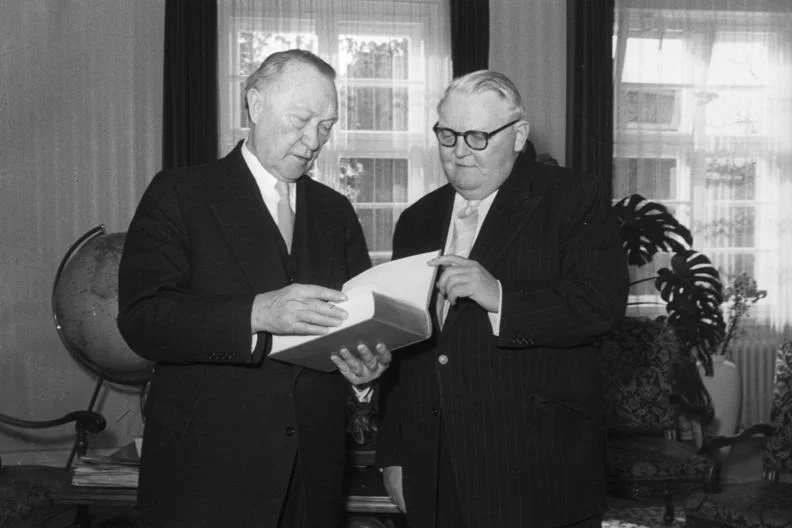
The political persecution of Konrad Adenauer (1876–1967) began immediately upon the National Socialists’ seizure of power. As the long-standing Lord Mayor of Cologne and a prominent politician of the Centre Party (Zentrumspartei), he was a symbol of the detested Weimar Republic. His fate between 1933 and 1945 exemplifies how the Nazi regime systematically disenfranchised and existentially threatened established democratic elites.
1933: Targeted Humiliation and Dismissal
Adenauer made no secret of his rejection of Hitler early on. When Hitler visited Cologne in February 1933, Adenauer refused to receive him at the airport and ordered the removal of swastika flags from a bridge over the Rhine.
- The Removal from Office: In March 1933, he was violently driven out of City Hall by the National Socialists and placed on leave.
- Financial Ruin: His accounts were frozen, and his service payments were cancelled. Adenauer was forced to leave Cologne with his family and initially found refuge at Maria Laach Abbey.
In the Crosshairs of the Gestapo: Years of Uncertainty
In the years that followed, Adenauer lived in a state of “Inner Emigration” but remained under constant surveillance.
- The 1934 Arrest: During the so-called “Röhm Purge” in June 1934, he was arrested for the first time and held for two days. The regime used this wave of purges to intimidate conservative critics as well.
- Monument Protection as a Pretext: Later, the Gestapo attempted to prosecute him for alleged irregularities during the construction of his house in Rhöndorf—a typical method of legal attrition used to criminalize political opponents.
“Operation Gitter” (1944): Imprisonment in a Concentration Camp
After the failed assassination attempt of July 20, 1944, the regime intensified its persecution of all former politicians from the Weimar era. Under “Operation Gitter” (Aktion Gitter), thousands were arrested, including Adenauer.
- The Messelager Labor Education Camp (AEL) Cologne: Despite his age (68), he was dragged to the notorious camp at the Cologne exhibition grounds (Deutz). Conditions there were catastrophic.
- Escape and Re-arrest: A friendly doctor helped him escape to a hospital, but the Gestapo tracked him down. He was imprisoned again, this time in the Gestapo prison in Brauweiler. His wife, Gussie, was also arrested and pressured, which contributed to her untimely death later on.
Rescue from Deportation
It was primarily due to the help of courageous individuals and the approaching end of the war that Adenauer was not deported to an extermination camp. In November 1944, he was finally released from custody, though he remained under strict observation until the arrival of American troops.
Chronology of Repression against Konrad Adenauer
| Year | Measure | Reason / Background |
| 1933 | Removal from office & expulsion | Resistance against Nazi symbols in Cologne |
| 1934 | Short-term imprisonment | “Röhm Purge” (intimidation of Centre Party politicians) |
| 1933–1944 | Surveillance & freezing of accounts | Attempt at economic and social destruction |
| 1944 | Concentration camp (Operation Gitter) | General persecution of former Weimar officials |
Conclusion: Shaped by Persecution
The experience of political persecution was defining for Adenauer’s later actions as Federal Chancellor. His deep mistrust of radical ideologies and his steadfast commitment to the rule of law and Western integration were rooted in the events of 1933 to 1945. On politischeverfolgung.de, his case serves as a reminder that repression can strike even those who previously held the highest state offices.
FAQ
Was Konrad Adenauer in a concentration camp?
Yes, in 1944, as part of “Operation Gitter,” he was imprisoned in the Messelager Labor Education Camp in Cologne-Deutz, which was under Gestapo administration.
Why was he dismissed in 1933?
The National Socialists considered him unreliable and dangerous because he refused to pay homage to Hitler and obstructed the NSDAP in Cologne.
How did he survive the Nazi era?
Through a combination of caution (inner emigration), support from the Catholic Church (Maria Laach), and loyal friends in administration and the medical field.