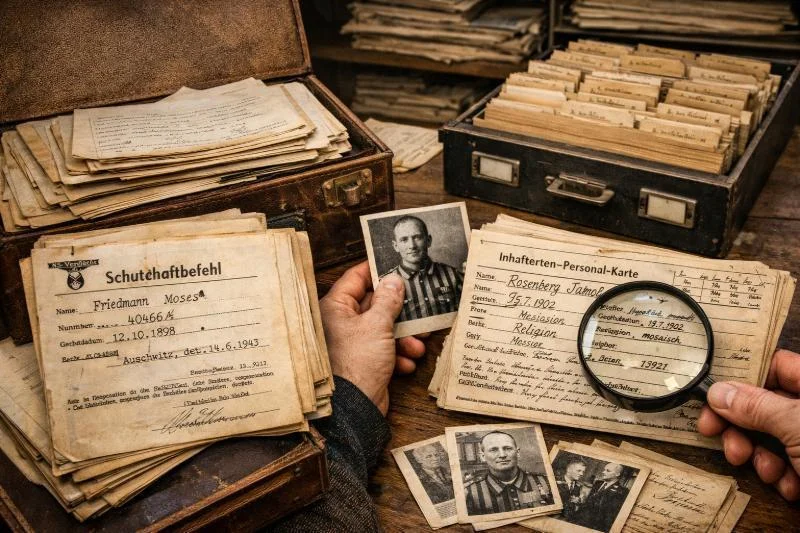
For many families, questions about the fate of their ancestors during the National Socialist era remain unanswered for decades. Silence within the family or lost documents make the search difficult—yet today, the research possibilities are better than ever before. This guide will lead you through the “archive jungle.”
Digital Preliminary Research: Utilizing Instant Results
Before writing letters to authorities, you should use the large digital memory banks. Millions of documents are already accessible online.
Arolsen Archives – World Documentary Heritage
The former “International Tracing Service” (ITS) is the most important contact point worldwide.
- What you will find: Concentration camp prisoner cards, transport lists, registrations of “Displaced Persons,” and information on forced labor.
- Pro Tip: Use the Online Database. You will often find scans of original documents that even note the person’s address or political affiliation.
The Memorial Book of the Federal Archives (Gedenkbuch)
This digital book is the central directory for the victims of the persecution of Jews under the National Socialist tyranny in Germany from 1933–1945.
- Content: Places of residence, deportation dates, and places of death.
The Apparatus of Terror: Searching State Archives
If digital searches do not yield results, the information often lies in files that have not yet been uploaded to the web.
The Federal Archives (Department PA – Person-related Information)
Located in Berlin, this archive houses the central records of Nazi authorities, including the Nazi Party (NSDAP) membership files, Gestapo files, and records from the “People’s Court” (Volksgerichtshof).
- Research Goal: Was the person convicted of “high treason”? Is there a Gestapo index card?
- Contact: berlin@bundesarchiv.de
State Archives: The Goldmine of “Restitution” Files
This is often the most successful path for family researchers. After 1945, survivors of persecution could apply for compensation (Wiedergutmachung).
- The Restitution File: In these files, victims had to describe their entire path of persecution in great detail to justify their claims.
- Where to look? Always search in the State Archive (Landesarchiv) of the federal state where the person lived after 1945.
Local Tracing: Researching on the Ground
Persecution took place in the neighborhood. Local sources often provide context that large archives cannot.

- City and Municipal Archives: Ask for “resident registration records” (Einwohnermeldeunterlagen) or reports on the local police’s “coordination” (Gleichschaltung).
- Local Memorial Sites: If you know which camp (e.g., Dachau, Buchenwald, Neuengamme) the person was imprisoned in, write directly to the archive of that memorial site.
- Stolpersteine (Stumbling Stones): Check if a Stolperstein has already been laid for the person in their city. The initiatives behind these often have extensive dossiers prepared.
Practical Tips for a Successful Inquiry
To help archivists assist you effectively, the quality of your inquiry is crucial:
- Gather Basic Data: Identification is nearly impossible for common names without a date and place of birth.
- Prove Kinship: Many files are subject to privacy protection periods. Keep a copy of your birth certificate ready to prove you are a direct descendant.
- Be Patient: Processing at the Federal Archives can currently take 6 to 12 months.
Important Contacts at a Glance
| Archive Type | Recommended Institution | Email / Web |
| Worldwide | Arolsen Archives | arolsen-archives.org |
| Central (GER) | Federal Archives Berlin | berlin@bundesarchiv.de |
| Regional | State Archives | Search for “Landesarchiv + [Federal State]” |
| Specific | German Resistance Memorial Center | gdw-berlin.de |
Conclusion
Tracing these paths is often tedious, but it returns a history to the victims. Every letter to an archive is an act against forgetting. Start today with the Arolsen Archives—the first piece of the puzzle is often just one search query away.
FAQ – Frequently Asked Questions
Is searching the Arolsen Archives free of charge?
Yes, online research in the database and inquiries for family members are free of charge. The Arolsen Archives are internationally funded to ensure access to the history of the victims.
What information do I need for an archive inquiry?
At a minimum, the full name and date of birth of the person you are looking for. It is also helpful to have the place of birth, the last known place of residence before 1945, and information about possible party affiliation or occupation.
Why can't I find any files in the Federal Archives (Bundesarchiv)?
Many files were deliberately destroyed towards the end of World War II or were lost due to the effects of the war. In addition, many documents have not yet been digitized and require on-site research or a written inquiry.
Is everyone allowed to view files on victims of Nazi persecution?
Generally yes, but protection periods for personal data apply (often 10 years after death or 110 years after birth). Direct relatives usually receive unrestricted access but must provide proof of their identity.
How long does it take to get a response from the Federal Archives?
Due to the high volume of inquiries, processing times currently range from 6 to 12 months. Patience is essential when working with these archives.