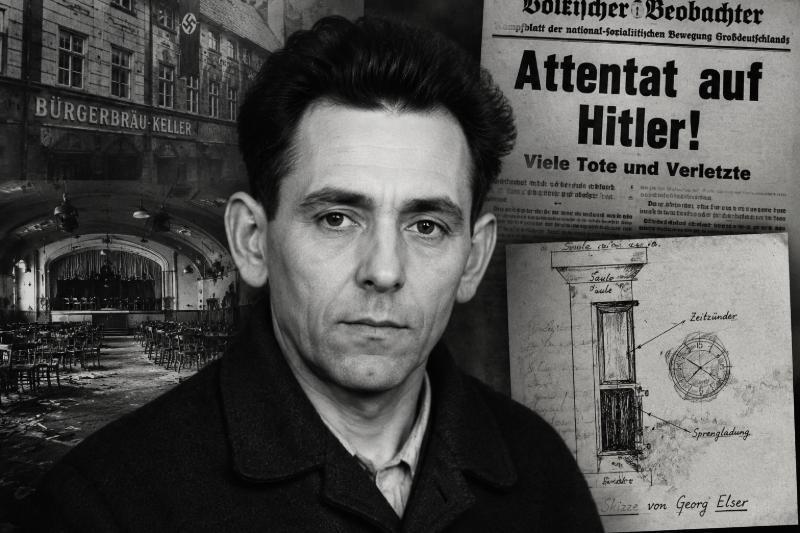

Johann Georg Elser (4 January 1903 – 9 April 1945) was a German carpenter and one of the earliest determined opponents of National Socialism. With his assassination attempt against Adolf Hitler at Munich’s Bürgerbräukeller on 8 November 1939, he sought to prevent the Second World War and bring an end to the Nazi dictatorship.
Although his attack failed by only a few minutes, Georg Elser is today regarded as one of the most important figures of the German resistance against National Socialism. Unlike many other resistance fighters, he acted independently, driven solely by his own convictions and conscience rather than by military or political organizations.
Georg Elser – Resistance Against National Socialism
Childhood and Education
Georg Elser was born on 4 January 1903 in Hermaringen, Württemberg, and grew up in nearby Königsbronn.
After completing elementary school, he trained as a carpenter and later worked in several woodworking shops and clock factories.
He was considered an exceptionally skilled craftsman and developed an early interest in politics and social issues. Elser became a member of the Woodworkers’ Union and sympathized with the labor movement, although he never permanently joined a political party.
Opposition to National Socialism
Soon after Adolf Hitler came to power in 1933, Georg Elser recognized the dangers posed by the Nazi dictatorship.
He strongly opposed:
- the abolition of democratic rights;
- the persecution of political opponents;
- Germany’s increasing militarization;
- the cult of personality surrounding Adolf Hitler;
- preparations for another European war.
According to his later testimony, Elser became convinced that removing Hitler from power was the only realistic way to prevent a catastrophic war.

The Bürgerbräukeller Assassination Attempt
Over many months, Georg Elser carefully planned the assassination entirely on his own.
Between 1938 and 1939, he secretly entered Munich’s Bürgerbräukeller during the night, where Adolf Hitler traditionally delivered his annual speech on 8 November commemorating the failed Beer Hall Putsch of 1923.
Working with extraordinary patience and precision, Elser hollowed out a pillar behind the speaker’s platform and concealed a homemade time bomb inside it.
On 8 November 1939, the bomb exploded exactly as planned.
However, Hitler had unexpectedly left the building approximately 13 minutes earlier than usual because poor weather forced him to return to Berlin by train rather than by aircraft.
The explosion killed eight people and seriously injured many others.
Arrest
On the evening of the assassination attempt, Georg Elser was arrested while attempting to cross the German border into Switzerland near Konstanz.
Border guards discovered several suspicious items in his possession, including:
- pliers,
- technical sketches,
- bomb components,
- additional incriminating materials.
Following extensive interrogations, Elser confessed that he alone had planned and carried out the assassination attempt.
Initially, the Nazi leadership refused to believe his confession and instead suspected a large international conspiracy behind the attack.
Imprisonment and Political Persecution
After his arrest, Georg Elser was interrogated for years by the Gestapo.
He was subsequently imprisoned without trial as a special prisoner (Sonderhäftling) in the Sachsenhausen and later Dachau concentration camps.
Throughout his imprisonment, Elser remained largely isolated.
He was never given the opportunity to defend himself before an independent court of law.
His detention demonstrates how the Nazi regime eliminated political opponents outside any legal or constitutional judicial process.
Murder at Dachau Concentration Camp
On 9 April 1945, only a few weeks before the end of the Second World War, Georg Elser was executed by gunshot at Dachau Concentration Camp on Adolf Hitler’s personal orders.
The Nazi leadership had originally intended to stage a public show trial after its anticipated military victory in order to portray Elser as an agent of foreign intelligence services.
Germany’s collapse prevented those plans from being carried out.
Delayed Recognition
For many years after the war, Georg Elser received relatively little public recognition.
Conspiracy theories persisted for decades, falsely claiming that the assassination attempt had actually been organized by the Nazi regime itself.
Only through extensive historical research was it conclusively demonstrated that Elser had acted entirely on his own.
Today, numerous schools, streets, and memorials throughout Germany bear his name.
He is widely regarded as a symbol of individual courage, personal responsibility, and civilian resistance against dictatorship.
Historical Significance
Georg Elser was one of the very few individuals who, as early as 1939, was willing to sacrifice his own life in an attempt to end the Nazi dictatorship.
Unlike the military conspiracy behind the 20 July 1944 Plot, Elser acted completely independently and without support from military officers, political parties, or organized resistance groups.
His assassination attempt demonstrates that individual resistance remained possible even under the conditions of a totalitarian dictatorship.
Significance for the History of Political Persecution
Georg Elser’s story illustrates several defining characteristics of political persecution under National Socialism:
- arbitrary imprisonment without judicial proceedings;
- abuse and coercive interrogations;
- elimination of political opponents;
- misuse of state power;
- concentration camps as instruments of political repression;
- extrajudicial execution of political prisoners.
Today, Georg Elser is regarded as one of the most important figures of the German resistance. His life serves as a reminder of the consequences authoritarian governments can impose upon individuals who peacefully—or actively—oppose political oppression and injustice.
SEO Data
SEO Title:
Georg Elser – The Assassination Attempt on Hitler and Resistance Against National Socialism
Meta Description:
Georg Elser planned the 1939 assassination attempt on Adolf Hitler. Learn about his life, his resistance to National Socialism, and his political persecution.