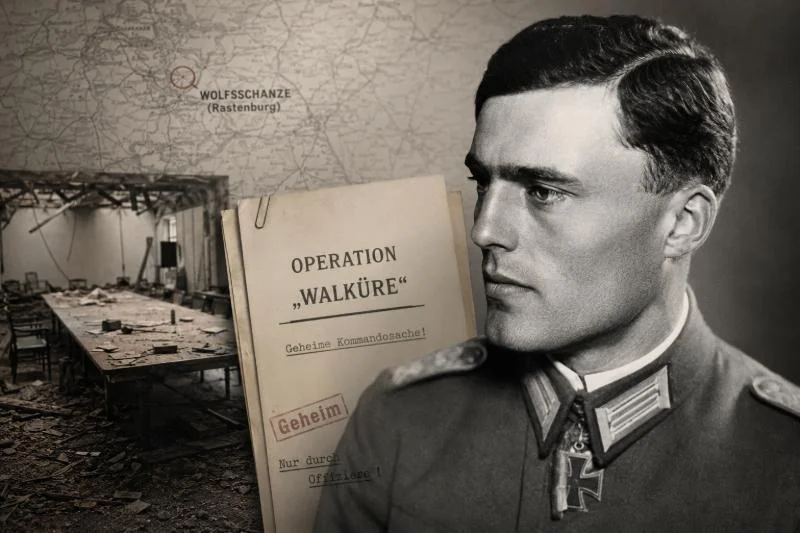
Claus Schenk Graf von Stauffenberg (1907–1944) is one of the best-known figures of the German resistance against National Socialism. As an officer in the German Wehrmacht, he became the leading organizer of the assassination attempt against Adolf Hitler on 20 July 1944. His name has become synonymous with military resistance to the Nazi dictatorship, while also raising the enduring question of when and how members of state institutions should oppose an unlawful regime.
Early Life and Military Career
Claus Philipp Maria Schenk Graf von Stauffenberg was born on 15 November 1907 in Jettingen, Bavaria. He came from a Catholic aristocratic family and joined the Reichswehr in 1926. An exceptionally talented officer, he quickly advanced through the ranks and became a respected member of the General Staff.
Like many conservative officers of his generation, Stauffenberg initially welcomed certain aspects of the National Socialist government’s policies, particularly the restoration of German military strength after the restrictions imposed by the Treaty of Versailles. However, as the Second World War progressed and the crimes committed by the Nazi regime became increasingly apparent, his views changed fundamentally.
From Officer to Resistance Fighter
Several developments convinced Stauffenberg that Adolf Hitler had to be removed from power:
- the increasingly hopeless military situation,
- the systematic mass crimes committed in occupied Europe,
- the destruction of constitutional rights and civil liberties,
- the elimination of all political opposition through terror.
While serving in North Africa, Stauffenberg was severely wounded during an Allied air attack in April 1943. He lost his left eye, his right hand, and two fingers on his left hand. Despite these devastating injuries, he returned to military service.
After recovering, he was assigned to Berlin, where he joined a circle of military resistance led by Ludwig Beck, Henning von Tresckow, Friedrich Olbricht, and other opponents of the Nazi regime.
The Assassination Attempt of 20 July 1944
As Chief of Staff of the Replacement Army, Stauffenberg gained direct access to Hitler’s military conferences at the Führer Headquarters known as the Wolf’s Lair (Wolfsschanze).
On 20 July 1944, he carried a briefcase containing explosives into the conference room.

The conspirators’ plan consisted of four main objectives:
- Kill Adolf Hitler.
- Activate Operation Valkyrie, an existing emergency plan intended to mobilize the Replacement Army.
- Seize control of the German government and military command.
- Establish a new government capable of ending the Nazi dictatorship and negotiating peace.
The bomb exploded as planned.
However, Hitler survived with relatively minor injuries because the briefcase had been moved behind a massive oak table support shortly before the explosion, significantly reducing the blast’s impact.
The Failure of the Coup
In Berlin, the conspirators initially believed that Hitler had been killed and therefore began implementing Operation Valkyrie.
Once confirmation arrived that Hitler had survived, the coup rapidly collapsed.
During the night of 20–21 July 1944, Claus Schenk Graf von Stauffenberg, Werner von Haeften, Friedrich Olbricht, and Albrecht Mertz von Quirnheim were summarily executed by firing squad in the courtyard of the Bendlerblock in Berlin.
According to widely accepted historical accounts, Stauffenberg’s final words were:
“Long live sacred Germany!”
Political Persecution Following the Assassination Attempt
The failed assassination attempt triggered one of the largest waves of political persecution within the Third Reich.
Immediately after the events of 20 July 1944, the Gestapo launched a nationwide investigation. Thousands of people came under suspicion, including military officers, civil servants, clergy, academics, and civilians who had either participated in or were merely suspected of sympathizing with the resistance.
The measures taken by the Nazi regime included:
- Mass arrests
- Torture during interrogations
- Trials before special courts
- Proceedings before the People’s Court (Volksgerichtshof)
- Death sentences
- Collective punishment of family members (Sippenhaft)
It is estimated that more than 7,000 people were arrested following the failed coup. Approximately 200 participants or alleged supporters were executed.
Many of the trials were conducted by Roland Freisler, President of the People’s Court, who became notorious for humiliating defendants in public and imposing death sentences in almost every politically significant case.
The People’s Court as an Instrument of Political Persecution
The proceedings against the resistance fighters failed to meet even the most basic standards of the rule of law.
Typical characteristics included:
- verdicts determined before the trial,
- virtually no meaningful right to defense,
- public humiliation of the accused,
- politically staged proceedings for propaganda purposes,
- immediate execution of death sentences.
Rather than serving as an independent judicial institution, the People’s Court functioned as a political weapon designed to eliminate opponents of the Nazi regime and intimidate anyone considering resistance.
Collective Punishment (Sippenhaft)
One of the most severe forms of repression following the failed coup was the practice known as Sippenhaft, or collective family liability.
Relatives of the conspirators were arrested regardless of whether they had participated in the plot. Wives, parents, siblings, and in some cases even children were imprisoned or interned.
The children of the Stauffenberg family were separated from their parents, given new names, and placed in state institutions in an attempt to erase their family identity.
This policy represented one of the gravest human rights violations committed by the National Socialist regime.
Historical Assessment
Today, Claus Schenk Graf von Stauffenberg is widely regarded as one of the most prominent symbols of German resistance against Adolf Hitler.
At the same time, historians emphasize that his political development was neither simple nor immediate. Like many conservative military officers, he initially supported aspects of the Nazi government before gradually turning against it as the regime’s criminal nature and Germany’s catastrophic military situation became undeniable.
His decision to join the resistance resulted from a combination of military, political, constitutional, and moral considerations.
Regardless of these complexities, the events of 20 July 1944 remain the most significant attempt from within Germany’s own military and governmental structures to overthrow the Nazi dictatorship.
Significance for the History of Political Persecution
For the study of political persecution, the case of Claus Schenk Graf von Stauffenberg demonstrates how authoritarian systems respond when members of their own institutions challenge the ruling power.
The repression that followed illustrates several defining characteristics of totalitarian rule:
- elimination of political opponents through special courts,
- misuse of the judiciary as an instrument of state repression,
- persecution of family members,
- systematic propaganda against dissidents,
- summary executions and widespread intimidation.
The aftermath of the failed assassination attempt shows that political persecution under National Socialism was directed not only against political parties, religious groups, or ethnic minorities, but also against military officers and state officials who chose to resist the dictatorship.