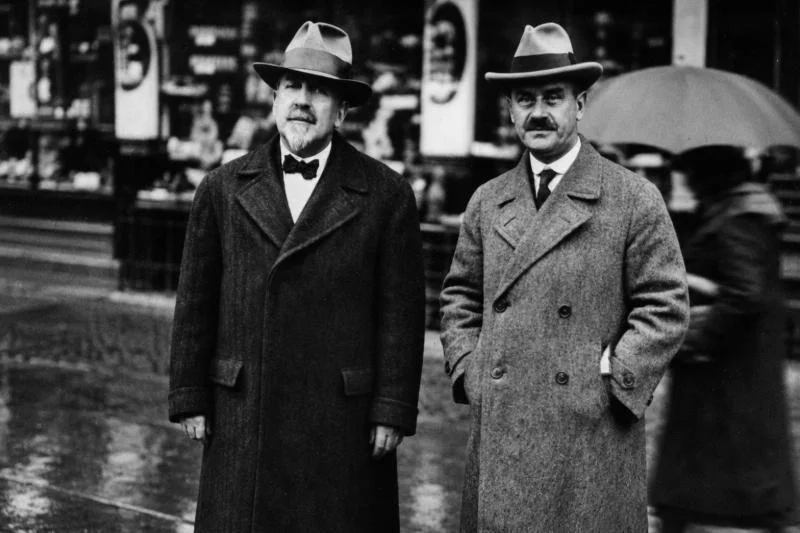
The Nazi seizure of power in January 1933 marked a radical rupture in German intellectual life. The Nazi regime tolerated no dissenting opinions, no artistic autonomy, and no critical discourse. The goal of the new rulers was the total alignment (Gleichschaltung) of culture, alongside the physical and existential destruction of political opponents.
Scarcely any example illustrates the systematic nature of National Socialist cultural and personnel policy as vividly as the lives of brothers Heinrich and Thomas Mann. As two of Germany’s most internationally renowned writers, they immediately entered the crosshairs of the Gestapo, the NSDAP, and the alignment authorities. Their fate clearly demonstrates the methods used by the Nazi state against intellectuals: professional bans, expatriation, asset forfeiture, symbolic book burnings, and the systematic destruction of their bourgeois existence.
Heinrich Mann: The Uncompromising Defender of the Republic
Heinrich Mann (1871–1950) was among the fiercest critics of German militarism and rising fascism as early as the Imperial era and the Weimar Republic.
“The Loyal Subject”: The Literary Dissection of the Authoritarian Mind
Heinrich Mann’s novel The Loyal Subject (Der Untertan), published in 1918, is widely regarded as the most razor-sharp literary dissection of Wilhelmine society and rising German authoritarianism. Through the trajectory of the opportunist Diederich Hessling, the novel uses biting satire to portray the archetype of the “servile subject”: cowering before superiors, trampling those below, and driven by a fanatical herd mentality. What was written before World War I as an exaggerated satire proved after 1933 to be a prophetic diagnosis. For the Nazi regime, the novel represented a profoundly dangerous work, as it exposed the psychological mechanisms of blind obedience, servility, and ethnic nationalism—the core pillars of Nazi ideology. Consequently, The Loyal Subject was among the very first books publicly burned and banned by the National Socialists in May 1933.
The Immediate Assault by the Regime (1933)
As President of the Poetry Section at the Prussian Academy of Arts, Heinrich Mann used his prominence to warn against the Nazi threat. Shortly before the Reichstag elections in February 1933, he co-signed the Urgent Appeal (Dringender Appell) alongside Käthe Kollwitz and Albert Einstein, calling for a unified front between the KPD and SPD to prevent Nazi rule.
Retaliation by the Nazi state was swift:
- Forced Resignation: In February 1933, Heinrich Mann was forced to resign from the Prussian Academy of Arts.
- Flight into Exile: Warnings of an impending arrest prompted him to flee to France as early as February 21, 1933.
- Symbolic and Legal Erasure: During the student book burnings on May 10, 1933, his works were thrown into the flames. On August 25, 1933, Heinrich Mann appeared on the First Expatriation List of the German Reich. He thus lost his German citizenship, and all his assets in Germany were confiscated.
In France, Heinrich Mann became the central figurehead of the German emigration movement. He assumed the chairmanship of the Lutetia Circle, which attempted to build a popular front against the Hitler regime. Following the Wehrmacht’s invasion of France in 1940, Heinrich Mann was in mortal danger. In a dramatic trek across the Pyrenees on foot, he escaped to Spain alongside his wife Nelly, his nephew Golo Mann, Alma Mahler-Werfel, and Franz Werfel, eventually reaching the United States.
Thomas Mann: From Conservative Nobel Laureate to Enemy of the State
The path of Thomas Mann (1875–1955) into political persecution was more gradual, yet it led to an equally unyielding opposition to National Socialism. After receiving the Nobel Prize in Literature in 1929, Thomas Mann stood as the undisputed figurehead of German high culture.

Although he had held nationalist views during the Empire, he transformed during the 1920s into a staunch defender of the Weimar democracy. In his famous German Address (Deutsche Ansprache) at the Berlin Beethoven Hall in October 1930, he issued an urgent warning against NSDAP fanaticism and urged the middle class to ally with the Social Democrats.
The Exile Trap and the 1936 Break
When Hitler was appointed Reich Chancellor on January 30, 1933, Thomas Mann was abroad on a lecture tour. His children Erika and Klaus Mann urgently advised him via phone and mail not to return to Munich, as the Gestapo was already searching his house and seizing his assets.
During his initial years of exile in Switzerland, Thomas Mann refrained from public political statements to avoid compromising the publication of his books by S. Fischer Verlag or endearing his German readers. However, the Nazi regime demanded submission—which he refused.
- The Open Rupture (1936): In February 1936, Thomas Mann published an open letter in the Neue Zürcher Zeitung in response to regime attacks. He publicly declared that National Socialism had brought nothing but hatred and destruction to Germany.
- Revocation of Citizenship: Hitler’s response followed in December 1936: Thomas Mann was stripped of his citizenship, his villa in Munich was formally expropriated, and his honorary doctorate from the University of Bonn was revoked.
- BBC Broadcasts (“German Listeners!”): After emigrating to the United States in 1938, Thomas Mann used his voice as a powerful weapon. Between 1940 and 1945, he delivered monthly radio addresses via the BBC directly to the German populace, informing them about the war’s progress and early on condemning the systematic crimes of the Holocaust.
Systematic Comparison of Nazi Persecution Methods
The acts of repression against the Mann brothers embody the full arsenal utilized by the Nazi regime to silence the country’s intellectual elite.
| Instrument of Repression | Manifestation for Heinrich Mann | Manifestation for Thomas Mann |
| Deprivation of Civil Rights | Expatriation in August 1933 (List 1); complete loss of civil rights. | Expatriation in December 1936; revocation of honorary doctorate from Univ. of Bonn. |
| Economic Destruction | Immediate seizure of bank accounts; total ban on book sales in Germany. | Seizure of Munich villa; freezing of royalties and publishing rights. |
| Cultural Ostracization | Works burned on May 10, 1933; branded a “subversive writer.” | Blacklisted by the Reich Ministry of Public Enlightenment and Propaganda. |
| Propaganda Attacks | Slandered as a “traitor to the people” and political demagogue in the Völkischer Beobachter. | Attacked as an “asphalt writer” and traitor to authentic German culture. |
The Bureaucratic Precision of Terror: Files and Exile
The persecution of the Mann family was not a chaotic act of spontaneous hatred; it was meticulously documented by the bureaucratic organs of the Nazi state. Files from the Gestapo, the Reich Chamber of Culture, and the Foreign Office preserved in the Federal Archives document how the state tracked every step of the emigrants.
Nazi operatives monitored the activities of exiles in Paris, Amsterdam, Zurich, and Los Angeles. The primary objective was to catalog all overseas publications in order to uncover and dismantle potential underground support networks within the Reich.
Conclusion: The Legacy of Two Unbowed Minds
The story of Heinrich and Thomas Mann’s persecution demonstrates that political resistance against tyranny demands profound personal sacrifices. Both lost their homeland, their property, and direct contact with their readership. While Heinrich Mann died in poverty in his Californian exile before receiving recognition in post-war Germany, Thomas Mann became a global symbol of intellectual resistance.
Their lives remain a vital reminder of how vulnerable free societies are when freedom of speech, academic freedom, and artistic autonomy surrender to political totalitarianism. Documenting their fate on politischeverfolgung.de ensures that the memory of those who held high the banner of moral courage in the deepest darkness is preserved.