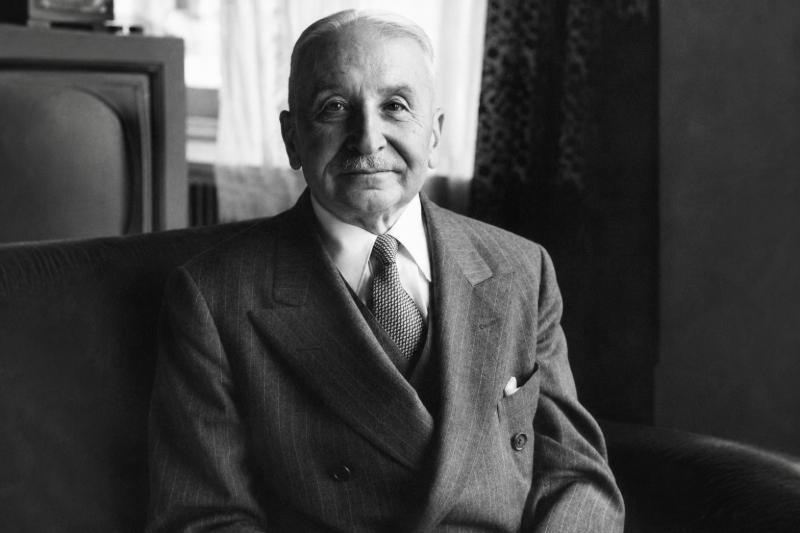
On August 23, 1934, economist Ludwig von Mises stood atop the Edelweißkopf in the Austrian Alps and made a far-reaching decision: he would leave Vienna. Mises foresaw the onset of totalitarianism earlier than most of his contemporaries. Almost exactly 92 years later, in August 2026, a debate rages in Munich over whether an institute bearing his name and promoting his ideas should even be allowed to rent venue space, and whether state security agencies should intervene against his philosophy. The case reveals a disturbing parallel regarding the nature of exclusion, expanding state power, and the gradual erosion of free speech.
At PolitischeVerfolgung.de, we trace the historical continuum: from the racial and denunciation blacklists of the National Socialists in the 1930s to the mechanisms of modern political vetting in 2026.
1. Historical Persecution (1933–1940): Mises Targeted by National Socialism
For the National Socialists, Ludwig von Mises was a prime target for two reasons: he was of Jewish descent, and he was the most uncompromising theoretical opponent of state collectivism.
The “Student of Mises” Label as a Tool of Denunciation
How early Mises’s name became a political stigma is illustrated by a newspaper item dated March 10, 1933, in the Deutschösterreichische Tageszeitung (the mouthpiece of Austrian National Socialists). In a smear piece attacking economist Oskar Morgenstern, the author vilified him as:
“Jew, Manchester-Liberal, and student of Mises.”
In Nazi logic, mere intellectual proximity to Mises was treated as incriminating evidence. His name embodied the hated cosmopolitanism, free markets, and the absolute protection of individual rights—values the Nazi ideology sought to replace with a racially defined “people’s community” (Volksgemeinschaft) and a totalitarian state.
The Looted Files and the Destruction of the Viennese Milieu
Following the Anschluss (annexation) of Austria in March 1938, state repression hit full force:
- Revocation of Teaching License: On April 8, 1938, the University of Vienna stripped Mises of his venia legendi on racial and political grounds.
- Looting of His Apartment: Since Mises was already teaching in Switzerland, the SS Security Service (SD) raided his Viennese apartment. Over 130 tons of books and archival material were shipped out of Vienna, including 38 crates containing Mises’s private library.
- Failed Rescue Attempt: Even his student Friedrich August von Hayek (later a Nobel laureate), who risked his life traveling to Vienna in 1939 to recover Mises’s stolen documents, failed. Nazi authorities classified Mises’s papers as “imperially vital” (reichswichtig); after the war, they ended up via Silesia in Moscow’s secret Special Archive as looted art.
- Flight to the USA: In 1940, with Western Europe falling, Mises was forced to flee Switzerland as well, escaping at age 59 via France, Spain, and Portugal to the United States.
2. Munich 2026: Reconstructing a “Room-Canceling” Incident
Nearly a century after Mises’s flight, events in August 2026 demonstrate how subtle yet effective the exclusion of non-conformist ideas remains in a modern media democracy.
From Boulevard Smear to Hotel Cancellation
For 13 years, the German Ludwig von Mises Institute held its annual conference at the prestigious Bayerischer Hof luxury hotel in Munich. Following a report by the local tabloid Münchner Abendzeitung accusing the institute of proximity to the right-wing AfD party, the hotel management caved:

- The hotel announced a comprehensive review of the business relationship and declared it would no longer host the institute after 2026.
- Paradoxically, the hotel justified its decision by invoking its core values: claiming to champion “open-mindedness, tolerance,” and the foundational principles of a free democracy.
Alarming Political Intervention by the Mayor
Going far beyond the private property rights of a hotel, Munich’s Green Party Deputy Mayor Dominik Krause publicly intervened, labeling the Mises Institute’s worldview as “concerning” and demanding:
“The state cannot remain passive either. Security agencies and civil society must remain vigilant.”
With a single statement, a philosophical debate over free trade, monetary theory, and skepticism of government power was reframed by a civic leader into a security threat and a target for state surveillance.
Institutional Reality Refutes Political Posturing
What makes this political intervention particularly striking is the official record. In October 2024, the Bavarian State Ministry of the Interior formally confirmed in response to a parliamentary inquiry that:
- The Mises Institute’s conferences had always proceeded completely without incident according to local police.
- Neither the Munich Police Headquarters nor the Bavarian State Criminal Police Office held any records of extremist activity.
- The institute was not—and is not—under surveillance by the State Office for the Protection of the Constitution (Verfassungsschutz).
3. Comparative Analysis: Patterns of Exclusion Then and Now
While modern political friction cannot be equated with the physical terror and brutality of the Nazi regime, the structural dynamics of exclusion share notable traits:
Stigmatization by Nazi Press
March 10, 1933
The Deutschösterreichische Tageszeitung uses the label “Student of Mises” as a political smear and guilt by association.
Fleeing Totalitarianism
October 3, 1934
Mises leaves Vienna for Geneva, anticipating the collapse of the liberal rule of law in Austria.
State Looting & Expulsion
March / April 1938
The Gestapo loots Mises’s library; the University of Vienna revokes the Jewish liberal scholar’s teaching license.
Media & Corporate Exclusion
August 23, 2026
Bayerischer Hof cancels venue contracts with the Mises Institute out of reputational fear under the guise of “open-mindedness.”
State Labeling & Pressure
August 2026
Munich’s Mayor calls Misesian thought “concerning” and urges security agency oversight despite no intelligence agency findings.
4. The Grotesque Distortion of “Open-Mindedness”
The invocation of “open-mindedness” by the Munich hotel and political figures to justify de-platforming the legacy of Ludwig von Mises represents a profound historical irony:
- Mises’s biography is the ultimate antithesis of provincialism and nationalism: Born in 1881 in Galician Lemberg (now Lviv, Ukraine) into a Jewish family, educated in Vienna, lecturing in Geneva, fleeing via Lisbon to New York, where he eventually became a U.S. citizen.
- Mises embodied the quintessential cosmopolitan scholar. His economic theory is rooted in cross-border free exchange, the rejection of imperialism and war, and the protection of minority rights against the tyranny of government majorities.
Excluding his intellectual legacy under the banner of “tolerance” weaponizes the term to narrow the boundaries of permissible debate rather than protect freedom.
| Category | National Socialism (1930s) | The Pattern in August 2026 |
| Primary Instrument | Racial laws, state violence, Gestapo raids | Media branding, cancel culture, “room-canceling” |
| Pretext for Repression | Protecting the “ethno-national community” | Preserving “open-mindedness” and “fighting the right” |
| Role of the State | Totalitarian dictatorship ordering destruction and exile | Politicians demanding preventive surveillance without legal basis |
| Consequence for Target | Physical destruction, exile, loss of property | Social stigmatization, denial of infrastructure (Chilling Effect) |
Conclusion: Freedom Dies One Inch at a Time
On August 23, 1934, standing on the Edelweißkopf, Ludwig von Mises realized that liberty in his homeland was doomed—not merely when the Gestapo knocked on doors, but the moment individualism was branded a betrayal and free thought declared a public hazard.
In August 2026, events in Munich remind us that the health of a free society is measured not by how it treats conformist opinions, but by its willingness to tolerate dissenting, state-skeptical, and pro-market ideas. When media outlets manufacture suspicion, private enterprises yield to reputational fear, and politicians casually evoke state security services to police debate, a modern chilling effect takes root.
At PolitischeVerfolgung.de, we document these shifts. Those who silence the intellectual legacy of historical victims of persecution in the name of “tolerance” have failed to grasp the core lessons of history.