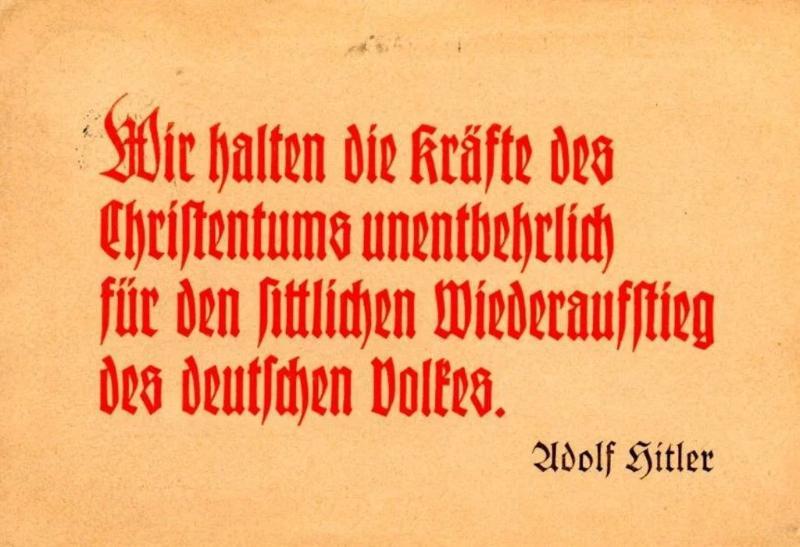
The role of the two major Christian churches in the Third Reich remains one of the most intensely debated chapters of modern German history. Long dominated by the narrative of ecclesiastical resistance, an unvarnished look at the historical facts reveals a far darker reality: The behavior of Catholic and Protestant leadership levels was characterized by strategic adaptation, the prioritization of institutional self-interest, active participation by clergy, and a fateful silence regarding state terror.
Neither the Protestant Church nor the Catholic Church confronted the NS regime as a unified resistance movement. Instead, they contributed—whether consciously or through structural failure—to the consolidation of the dictatorship.
The Reichskonkordat 1933: Early Legitimation of the NS Regime
Just months after the NSDAP seized power, the leadership of the Catholic Church under Pope Pius XI and Cardinal Secretary of State Eugenio Pacelli (later Pope Pius XII) took a consequential step: The signing of the Reichskonkordat in July 1933.
- The Trade-Off: The regime formally guaranteed protection for Catholic schools, professions of faith, and church associations. In return, the clergy withdrew from active politics—paving the way for the self-dissolution of the Catholic Centre Party (Zentrumspartei).
- The Impact: The agreement delivered a massive diplomatic victory for Adolf Hitler. It granted the young NS regime international legitimacy and signaled to Catholic believers domestically that cooperation with the new authorities was morally acceptable.
Centuries-Old Anti-Judaism as Fertile Ground
The fact that National Socialist racial anti-Semitism met with so little organized resistance among the population had deep societal causes tied directly to church history. Theological anti-Judaism (“hatred of Jews on religious grounds”), cultivated over centuries, served as a catalyst for the NSDAP’s extermination ideology.
Rather than shielding Jewish citizens, parish offices provided the administrative foundation for official “Aryan certificates” (Ariernachweise) by maintaining and opening their baptismal and marriage registers. In doing so, church archives actively aided bureaucratic tracking and eventual genocide.
Active NS Conformity: The Role of the Clergy and SA Pastors
Historical research demonstrates that large parts of the Protestant clergy were far more than passive bystanders. Historian Helge-Fabien Hertz describes the Protestant Church in northern Germany as one of the pillars of National Socialism. The broad overlap between the clergy and National Socialists lay in shared anti-communism, nationalism, and anti-Semitism.
Being NS-conformist meant that many pastors actively campaigned politically for National Socialism within the NSDAP, the SA, and other organizations. They promoted the regime directly from the pulpit—despite the fact that clergy enjoyed a protected status within church structures that would have allowed for divergent behavior.
The phenomenon of the “SA pastor” was by no means limited to verbal support:

- Street Violence Prior to 1933: Several pastors fought as SA men in violent brawls (Saalschlachten) on the streets before Hitler came to power, engaging in physical violence that frequently resulted in bloodshed.
- Protestant Radicalization: While the NSDAP performed disproportionately well in Protestant-dominated regions during the 1932 elections, the radicalization ran deep across all factions. In Schleswig-Holstein, the largest single faction of SA pastors was actually provided by the Confessing Church (Bekennende Kirche).
Adaptation and Division: The “German Christians”
Within the Protestant Church, the “German Christians” (Deutsche Christen) formed in 1932, seeking a complete synthesis of Christian doctrine and National Socialist racial ideology.
They demanded the implementation of the “Aryan Paragraph” within the church, the removal of the Old Testament from the Bible, and the purging of “Jewish influences” from liturgy and hymnals. That such a distorted form of Christianity gained structural traction demonstrates the extent of ideological collapse within the Protestant establishment.
The Limits of Ecclesiastical Resistance and Catholic Accommodations
While figures like Martin Niemöller, Dietrich Bonhoeffer, or Bishop Clemens August Graf von Galen are frequently cited as proof of church resistance, their motivations require precise analysis:
- The Crisis of Faith Was Not Political Resistance: The Barmen Theological Declaration of 1934 opposed state interference in church doctrine and governance, not the NS state itself or its racial persecution policies. Even many members of the Confessing Church remained ardent supporters of Hitler. Hertz emphasizes: “Preserving church autonomy simply meant: the church must remain the church”—the NS ideology of many clergymen remained untouched by this.
- Selective Outcry: Bishop von Galen effectively denounced the systematic murder of disabled people (Aktion T4) in his 1941 sermons. However, a comparable public protest by the Bishops’ Conference against the mass deportation and extermination of Jewish people never occurred.
- Catholic Hierarchy Accommodations: While 95 percent of the clergymen imprisoned in Dachau concentration camp were Catholic (predominantly Polish priests) and Catholic regions voted for the NSDAP at below-average rates in 1932, the German Catholic Bishops’ Conference still sought accommodation. Cardinal Adolf Bertram, who led Catholic church policy for 26 years, pursued a course of strict institutional self-preservation. As biographer Sascha Hinkel notes, his primary goal was maintaining church infrastructure and pastoral care—Bertram did not adopt an empathetic or protective stance toward Jewish citizens.
Conclusion: The Stuttgart Declaration of Guilt and the Legacy of Failure
Only after the collapse of the regime did the Council of the Evangelical Church in Germany issue the Stuttgart Declaration of Guilt in October 1945, stating: “We accuse ourselves for not professing more courageously, not praying more faithfully, not believing more joyfully, and not loving more ardently.”
The historical record remains devastating. When forced to choose, the churches prioritized their own institutional survival and privileges or allowed themselves to be carried away by state ideology. A consistent, ethically derived institutional stance against state terror, the Gestapo, and genocide never materialized. The victims of political and racial persecution were largely left to their fate by church leaderships.