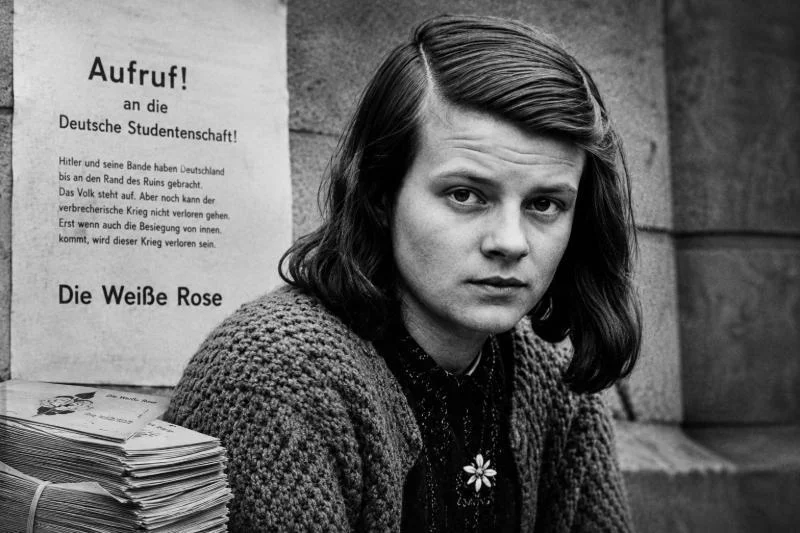
Sophie Scholl (9 May 1921 – 22 February 1943) is one of the best-known figures of the German resistance against National Socialism. Together with her brother Hans Scholl and other members of the student resistance group White Rose (Weiße Rose), she opposed the terror of the Nazi regime. Through the distribution of leaflets, she called for peaceful resistance, denounced the crimes of the dictatorship, and ultimately paid for her commitment to freedom, human dignity, and freedom of conscience with her life.
Today, Sophie Scholl is regarded as an enduring symbol of civil courage and the determination to stand against injustice, even at the greatest personal risk.
Sophie Scholl – A Young Woman in Resistance to the Nazi Dictatorship
Childhood and Early Life
Sophie Magdalena Scholl was born on 9 May 1921 in Forchtenberg, Württemberg, and later grew up in the city of Ulm. Her father, Robert Scholl, served as mayor and was an outspoken democrat who criticized National Socialism from an early stage. Her mother, Magdalena, instilled Christian values and a strong sense of moral responsibility in her children.
Like many young people of her generation, Sophie initially joined the League of German Girls (Bund Deutscher Mädel – BDM). As she matured, however, she became increasingly aware of the contradictions between Nazi ideology and her own ethical convictions. The suppression of freedom of expression, the persecution of political opponents, and the growing brutality of the regime ultimately transformed her political outlook.
University Studies and the White Rose
In 1942, Sophie Scholl began studying biology and philosophy at the Ludwig Maximilian University of Munich.
There she joined the student resistance movement known as the White Rose.
Its principal members included:
- Hans Scholl
- Alexander Schmorell
- Christoph Probst
- Willi Graf
- Professor Kurt Huber
Between June 1942 and February 1943, the group wrote and distributed a series of leaflets calling for peaceful resistance against the Nazi dictatorship.

The leaflets condemned:
- the destruction of democratic freedoms,
- the persecution of political opponents,
- the systematic discrimination and persecution of Jewish citizens,
- the war crimes committed by the Nazi regime,
- and the moral responsibility of every individual to resist injustice.
The members of the White Rose were motivated by ethical, religious, and humanistic ideals. They rejected violence and believed that moral persuasion and personal responsibility were the most powerful forms of resistance.
Arrest at the University of Munich
On 18 February 1943, Sophie and Hans Scholl distributed copies of the sixth White Rose leaflet inside the main building of the University of Munich.
Before leaving the building, Sophie impulsively pushed a stack of remaining leaflets from the upper gallery into the central atrium below. This action attracted the attention of the university custodian, Jakob Schmid, who detained the siblings until officers of the Gestapo arrived.
During the subsequent interrogations, Sophie and Hans initially attempted to protect their fellow members of the resistance. Despite intense pressure, they accepted responsibility for their own actions and refused to betray their companions.
The People’s Court and Political Persecution
Only four days after their arrest, on 22 February 1943, Sophie Scholl, Hans Scholl, and Christoph Probst appeared before the People’s Court (Volksgerichtshof).
The trial was presided over by Roland Freisler, whose proceedings became notorious for intimidation, humiliation, and predetermined verdicts. The trial lasted only a few hours and lacked the basic principles of a fair judicial process.
All three defendants were convicted of high treason and sentenced to death.
On the very same day, they were executed by guillotine at Munich-Stadelheim Prison.
Sophie Scholl was only 21 years old at the time of her execution.
Sophie Scholl as a Victim of Political Persecution
Sophie Scholl’s story illustrates how the National Socialist regime dealt with peaceful political opposition.
Its methods of political persecution included:
- extensive surveillance by the Gestapo and security authorities,
- suppression of freedom of speech and the press,
- criminalization of political dissent,
- special courts lacking judicial independence,
- rapid enforcement of death sentences,
- public intimidation through politically motivated trials.
The People’s Court was not an independent judicial institution but a central instrument of political repression designed to eliminate opposition and discourage resistance.
Legacy
Following the end of the Second World War, Sophie Scholl became one of the most important symbols of German resistance against National Socialism.
Today, countless schools, streets, public squares, and foundations bear her name. Her life has been portrayed in books, documentaries, and feature films, reminding future generations that moral courage is possible even under a dictatorship.
One of her most frequently quoted statements is:
“What we said and wrote is what many people are thinking. They just don’t dare to express it.”
These words continue to symbolize freedom of expression, civil courage, and personal responsibility.
Historical Significance
Sophie Scholl is widely regarded as one of the best-known victims of political persecution under National Socialism. Her life demonstrates how authoritarian regimes criminalize peaceful dissent and transform the judicial system into an instrument of political repression.
At the same time, the story of the White Rose shows that even under the conditions of a totalitarian dictatorship, individuals were willing to risk—and ultimately sacrifice—their lives in defense of freedom, human dignity, and the rule of law.
The memory of Sophie Scholl continues to serve as a powerful reminder of the importance of protecting democratic values and resisting every form of political persecution.