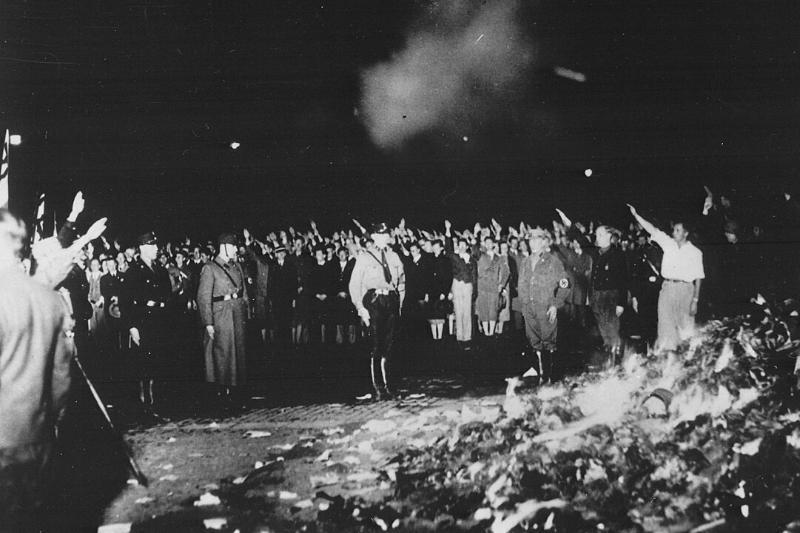
On the evening of May 10, 1933, massive bonfires erupted across the main squares of nearly all German university towns. Thousands of books written by Jewish, Marxist, pacifist, and democratic authors were publicly consigned to the flames in an event orchestrated by Nazi propaganda. What began as the “Action Against the Un-German Spirit” marked the symbolic opening act in the systematic destruction of intellectual freedom in Germany and served as the direct prelude to the physical extermination of millions.
Preparation and Key Players: Organized Barbarism
Contrary to the widespread myth that the book burnings were a spontaneous outburst of mob violence, the campaign was carefully structured and state-sponsored.
- The Role of the German Student Union (DSt): The primary initiative came not directly from top NSDAP leadership, but from university student organizations. The Main Office for Press and Propaganda of the DSt directed the operation nationwide.
- The “Twelve Theses”: Beginning in April 1933, students posted placards at universities outlining 12 theses “against the un-German spirit.” They demanded the purification of language and literature, as well as a relentless struggle against the “Jewish spirit.”
- The “Blacklists”: Bibliographies compiled by figures such as librarian Wolfgang Herrmann served as blueprints for raiding public libraries and bookstores. Hundreds of groundbreaking authors quickly landed on these prohibition lists.
The Events of May 10, 1933
The central stage for the main event was Kaiser-Franz-Joseph-Platz (today Bebelplatz) in Berlin, located directly opposite Humboldt University and adjacent to the State Opera.
- The Torchlit Procession: Around 8:00 PM, over 40,000 people—including SA stormtroopers, fraternity students in full regalia, and professors in academic gowns—marched with torches through Berlin to the square.
- The Fire Incantations: Accompanied by drumrolls, books were hurled into the fire in batches. Speakers recited ritualized “fire incantations” (Feuersprüche), targeting specific categories of writers:
- “Against class struggle and materialism, for the national community and an idealistic way of life! I commit to the flames the writings of Karl Marx and Karl Kautsky.”
- “Against decadence and moral decay! For discipline and decency in family and state! I commit to the flames the writings of Heinrich Mann, Ernst Gläser, and Erich Kästner.”
- “Against literary betrayal of the soldiers of the World War, for the education of the people in the spirit of valor! I commit to the flames the writings of Erich Maria Remarque.”
- Joseph Goebbels’ Speech: The Reich Minister of Public Enlightenment and Propaganda delivered the keynote address at midnight, proclaiming: “The era of extreme Jewish intellectualism is now at an end […] The past is lying in flames.”
Prominent Victims of the Flames
The index of targeted works reads like a directory of modern German intellectual history. Among those banned were:
| Category | Featured Authors (Selection) |
| Pacifism & Anti-War | Erich Maria Remarque, Bertha von Suttner, Arnold Zweig |
| Socialism & Marxism | Karl Marx, Friedrich Engels, Rosa Luxemburg, Karl Kautsky |
| Democracy & Social Criticism | Heinrich Mann, Thomas Mann, Kurt Tucholsky, Carl von Ossietzky |
| Psychoanalysis & Science | Sigmund Freud, Albert Einstein, Magnus Hirschfeld |
| Fiction & Poetry | Bertolt Brecht, Lion Feuchtwanger, Vicki Baum, Erich Kästner |
Erich Kästner was one of the few targeted authors who stood incognito in the crowd on Berlin’s Opernplatz on May 10, 1933, watching his own books burn.
Consequences: Intellectual Exile and Cultural Devastation
The book burnings were not an isolated event, but the harbinger of total societal alignment (Gleichschaltung).
- Exile of the Intelligentsia: In the following weeks and months, thousands of scientists, writers, and artists fled Germany. Cities like Paris, Prague, Amsterdam, and later New York or Los Angeles became epicenters of German exile literature.
- Purge of the Prussian Academy of Arts: Members who refused to support the regime were expelled or resigned in protest.
- Cultural Wasteland: The destruction of a pluralistic publishing and media landscape left behind an intellectual vacuum, quickly filled by ethno-nationalist kitsch and militaristic propaganda.
Memorialization & The Prophetic Warning
On present-day Bebelplatz in Berlin, an underground memorial designed by Micha Ullman commemorates the event. Looking down through a glass plate set into the cobblestones, visitors see an underground room lined with empty white bookshelves built to hold 20,000 volumes.
Nearby, a bronze plaque set into the ground features the famous quote by Heinrich Heine from his 1821 tragedy Almansor:

“That was but a prelude; where they burn books, they will ultimately burn people as well.”
Heine’s words, written more than a century prior to the events of 1933, proved to be a grim prophecy: the hatred that raged across university campuses on May 10, 1933, reached its ultimate conclusion in the gas chambers of Auschwitz, Treblinka, and Majdanek.