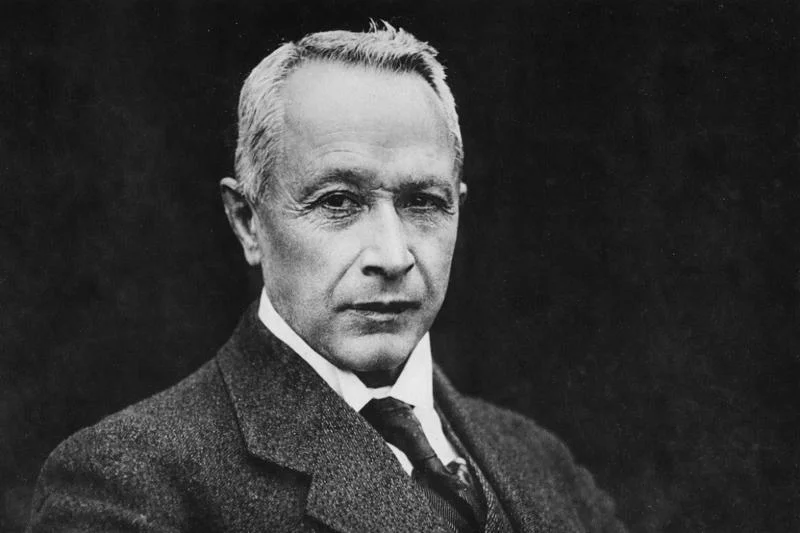
Hugo Junkers (1859–1935) is widely regarded as one of the most brilliant engineers in German history. Yet while his name remains inextricably linked with the legendary “Aunt Ju” (Ju 52), one dark chapter of his biography is routinely pushed into the shadows: his systematic political persecution, silencing, and economic liquidation by the National Socialist regime. The case of Hugo Junkers serves as an ultimate historical warning of how a totalitarian state perverts the law to weaponize key technologies and crush dissident intellectuals.
The Enemy Profile: The “Pacifist Democrat”
Long before 1933, Junkers became a primary target for the National Socialists. In an era where aviation was increasingly viewed strictly as a tool for imperialist military dominance, Junkers steadfastly defended his humanistic principles:
- Internationalism over Nationalism: Junkers envisioned the airplane as a grand catalyst for international understanding and peaceful commerce, not as a weapon of mass destruction.
- Left-Liberal Convictions: He was a vocal proponent of the Weimar Republic and maintained close ties to social-democratic circles. In early Nazi surveillance files, he was denounced as a “pacifist,” “democrat,” and “friend of Marxists.”
- Resistance against Rearmament: Junkers stubbornly refused to place his massive industrial plants at the service of a clandestine, illegal rearmament program.
1933: The Cold Expropriation
Immediately after seizing power, the regime—spearheaded by Hermann Göring (then Reich Commissioner for Aviation)—resorted to ruthless, mafia-like tactics to strip Junkers of his life’s work.
- Blackmail through High Treason Charges: The state fabricated absurd accusations of high treason and espionage. Junkers was presented with a brutal ultimatum: either surrender all his patents and majority shares to the Reich without compensation, or face a staged show trial before a politicized judiciary.
- Theft of Intellectual Property: On June 2, 1933, under immense duress, Junkers was forced to sign away all patent rights to his inventions.
- Corporate Robbery: During the night of October 17–18, 1933, he was coerced into transferring his remaining controlling interest (51%) directly to the Aviation Ministry.
Exile and Total Isolation
The regime’s campaign did not stop at financial ruin; it aimed to completely erase Junkers as a public persona:
- Banishment: Junkers was officially expelled from Dessau, the historic cradle of his company. He was permanently banned from ever setting foot in his own factories again.
- House Arrest: Placed under constant Gestapo surveillance, he was forced into internal exile at his residence in Bayrischzell (Upper Bavaria), subjected to strict travel and communication bans.
- Research Prohibition: The state issued an absolute ban preventing him from conducting further scientific research, filing new patents, or publishing academic articles.
A Cynical State Funeral
On his 76th birthday, February 3, 1935, Hugo Junkers died while still trapped under house arrest in Gauting near Munich. The very regime that had systematically broken his health and stolen his life’s work staged a macabre, cynical farce: they ordered a lavish state funeral to co-opt his legacy, perverting his name to build the infamous Stuka dive-bombers (Stukas) that would soon devastate Europe.
The Legal Anatomy of a State Raid
The expropriation of Hugo Junkers was not an uncoordinated act of street violence; it was a highly sophisticated administrative operation leveraging legal loopholes and newly minted emergency decrees to achieve the “legalized” robbery of a citizen.
1. The Reichstag Fire Decree (February 28, 1933)
This emergency decree formed the absolute baseline for his persecution. By suspending the core constitutional guarantees of the Weimar Constitution—specifically personal liberty and the inviolability of property—the path was cleared for the Gestapo to conduct warrantless raids on Junkers’ home, intercept his mail, and wiretap his phones.
2. The Enabling Act (March 24, 1933)
This law allowed the executive branch to bypass parliament entirely. It granted Hermann Göring and the newly formed Reich Aviation Ministry (RLM) the unchecked power to issue arbitrary administrative decrees specifically designed to corner and squeeze the aviation pioneer.

3. The Weaponization of “High Treason”
To force Junkers into submission, the prosecutor threatened him with § 80 ff. of the old Penal Code (StGB). His international corporate networks and his refusal to keep his civilian research secret from global partners were reinterpreted as “endangering the security of the Reich.” The state offered to drop the criminal charges only if he “voluntarily” signed over his empire—a textbook case of aggravated extortion under color of official authority.
4. The “Trustee” Stratagem
Once Junkers was successfully ousted from executive management, the Reich installed regime-compliant “trustees.” These figures deliberately acted against the interests of the actual owner, approving massive artificial capital increases that diluted Junkers’ remaining shares until his financial influence was entirely liquidated.
Comparison: Rule of Law vs. Totalitarian Arbitrariness
| Constitutional Principle | Systemic Violation (Junkers Case) | Totalitarian Instrument |
| Guarantee of Property | Coerced transfer of all shares and global patents. | Reichstag Fire Decree |
| Right to a Fair Trial | Threat of a lethal show trial to force a settlement. | Exploitation of § 80 StGB (High Treason) |
| Freedom of Movement | Expulsion from the city of Dessau and strict house arrest. | Gestapo Administrative Order |
| Freedom of Profession | Total ban on scientific research, teaching, and publishing. | RLM Executive Directive |
Conclusion: The Perversion of the Law
The tragedy of Hugo Junkers proves that authoritarian regimes rarely abolish the legal framework outright—instead, they pervert it from within. Laws are transformed into precision weapons to enforce the state’s grip on strategic infrastructure and technology under the permanent guise of “national security.” Junkers was one of the very first victims of a state-run corporate raid, demonstrating that when individual liberties fall, even national icons are not safe from the insatiable hunger of a lawless state.