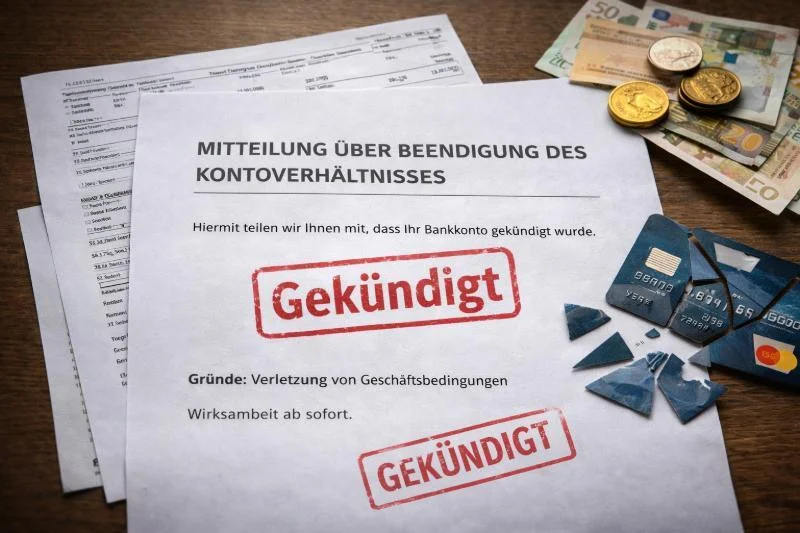
In a digitized world, access to a bank account is not a luxury; it is the fundamental prerequisite for participating in society. Without an account, one cannot pay rent, receive a salary, or hold insurance. Yet, this vital instrument is increasingly being abused as a tool for political discipline. The phenomenon known as “Debanking”—the arbitrary termination of banking relationships without objective cause—is evolving into a new front of political persecution in the Berlin Republic.
When Banks Become Ideological Gatekeepers
In the past, banks were viewed as neutral service providers. Today, many institutions seem to believe their mission includes “taking a stand.” Those increasingly affected include alternative media portals, government-critical associations, opposition politicians, and even private individuals involved in legal or activist resistance against state measures.
The process usually follows a predictable pattern: a termination notice arrives without warning. A justification is often refused, with the bank citing its General Terms and Conditions (GTC). Unofficially, however, the reason is clear: “reputational risk.” Anyone who does not conform to the mainstream narrative becomes a risk for the bank—not financially, but ideologically.
Concrete Case Studies: The Faces Behind the Numbers
That “Debanking” is a systemic issue is evidenced by numerous prominent cases in recent years:
- Boris Reitschuster & Alternative Media: The journalist, whose portal is among the most widely read critical voices in Germany, has lost multiple bank accounts. Institutions like Postbank terminated his accounts without stating reasons, significantly hindering his journalistic work by forcing constant changes to payment processing.
- Opposition Parties & Politicians: State chapters of the AfD (Alternative for Germany) and individual members of parliament regularly report terminations by Sparkassen (savings banks) and Volksbanken. Since Sparkassen are often managed at the municipal level, there is a strong suspicion that political opponents on their boards of directors directly influence these business relationships.
- Critical Medical Associations (MWGFD): The association “Medical Professionals and Scientists for Health, Freedom, and Democracy,” which critically analyzed COVID-19 policies, had to rebuild its donation infrastructure multiple times after banks ended cooperation, citing “compliance guidelines.”
- The Nigel Farage Case: Internationally, the British bank Coutts caused a scandal when internal documents proved that the politician’s account was closed due to his political views, which did not align with the bank’s “values.” This case serves as a global precedent for politically motivated financial exclusion.
The Mechanisms of Financial Strangulation
The methods of debanking are subtle but highly effective:
- Termination of Donation Accounts: Critical organizations are paralyzed by the sudden loss of their financial infrastructure.
- Freezing of Assets: Under the pretext of money laundering prevention, funds are often blocked for weeks, leaving those affected unable to cover their fixed costs.
- Blacklisting: Reports are increasing that once a person is “debanked,” it becomes nearly impossible for them to open an account at any other institution—a digital form of “professional and social exile.”
A Violation of the Fundamental Right to Participation?
Legally, banks operate in a gray area. While Germany has the “Payment Accounts Act” (Zahlungskontengesetz) guaranteeing every citizen a basic account, in practice, banks find numerous ways to circumvent this right or restrict the account so severely that political or journalistic work becomes impossible.
Critics view debanking as a modern form of “Zersetzung” (a psychological subversion tactic once used by the East German Stasi). By stripping critics of their financial foundation, they are forced to their knees without a court ever having to pass a verdict. It is a form of persecution carried out by private actors acting in the interest of the state.
Conclusion: Freedom Dies at the Checkout
When the state or state-affiliated institutions decide who is allowed to participate in economic life and who is not, democracy is in peril. Debanking is not a technical procedure; it is a political act. It is an attempt to silence the opposition through financial starvation. For a free country, this development is an alarm signal: freedom of speech is of little value if the ability to use one’s own money is tied to political compliance.
