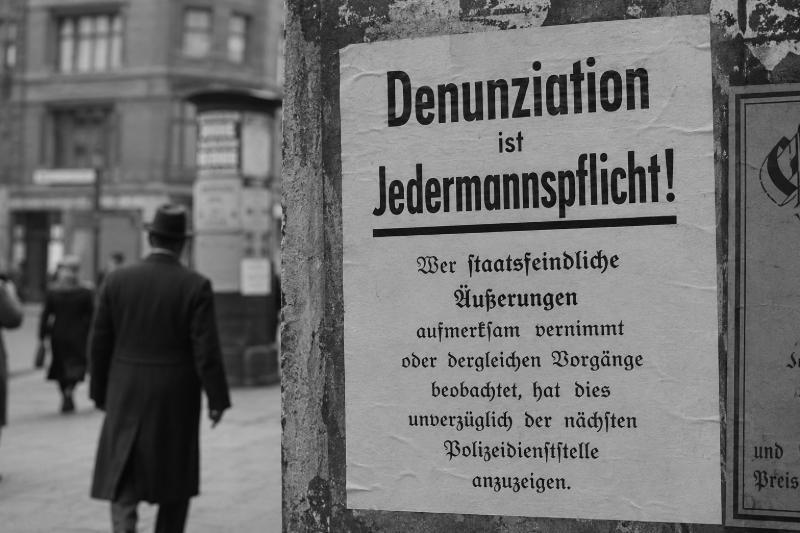
The good citizen pays taxes, separates their waste, respects pedestrian crossings, and obeys the law. For a long time, this was the classic division of labor within a free constitutional state. The state enacts rules and monitors compliance; the citizen follows these rules and only becomes an active component of state investigative work in exceptional circumstances. This relationship is shifting gradually, barely noticed by a public that usually only remembers new obligations once they are already in effect. Under the technical-sounding term “Everyman Duty” (Jedermannspflicht), a model is currently emerging that extends far beyond traditional export controls, revealing a remarkable reallocation of sovereign state responsibilities.
The Dutiful Citizen 2.0: The Art of an Inconspicuous Concept
The term sounds harmless, almost civic-minded. “Everyman Duty” evokes images of first aid or traffic safety, civic co-responsibility, and social solidarity. In reality, however, it constitutes a mandatory reporting obligation under the European Union’s Russia sanctions regime. Article 6b of Regulation (EU) No 833/2014 obliges natural and legal persons to supply information that facilitates the implementation of the sanctions. In Germany, the Federal Office for Economic Affairs and Export Control (BAFA) now specifies this obligation remarkably openly, explicitly demanding information regarding potential sanctions violations as well as possible circumvention attempts.
While BAFA handles goods-related matters, financial intelligence is to be forwarded to the Bundesbank or via corresponding reporting structures. This information must be transmitted within tight deadlines, and failure to report can result in administrative fines or criminal prosecution. While confidential communication between lawyers and clients remains protected, other professional groups are explicitly denied such protection. BAFA states unmistakably that no additional exemptions are provided for under Article 6b.
“Please Report Anything Unusual”
This development warrants close attention because it reveals a profound paradigm shift. The state no longer confines itself to enacting sanctions laws and prosecuting violations through its own apparatus. Instead, it legally compels citizens, companies, and professionals to provide the information required to enforce these laws. Consequently, the role of the individual changes. The mere subject of a legal norm is transformed into a functional cog of the enforcement apparatus.
Initially, this might sound like a purely technical adjustment. Modern sanctions are complex, international procurement networks operate covertly across borders, and state agencies depend on external tips. This rationale is understandable and is regularly put forward by authorities. Yet, this is precisely where the real debate begins. It does not concern the legitimacy of sanctions themselves, but rather the architecture of their enforcement.
The State Listens in and Lets Others Speak
The classic constitutional state is defined by a clear institutional separation. Investigative work is the sole responsibility of state organs that are trained, legitimized, and controlled for this purpose. Police, customs, and prosecutors act according to established procedural rules and are subject to judicial oversight. Citizens are permitted to provide tips if they deem it correct, but they are fundamentally not weaponized as general auxiliaries for state investigations. This boundary is visibly eroded by the “Everyman Duty.”
Where Knowledge Ends and Suspicion Begins
The wording of the article itself is particularly revealing. It is not exclusively proven violations or legally binding, verified circumvention transactions that must be reported, but rather “information which facilitates the implementation of this Regulation.” This phrasing possesses an extraordinary breadth. It does not speak of evidence, of definitive knowledge of a crime, or exclusively of completed legal infractions. Authorities, in turn, interpret this scope increasingly broadly, explicitly including potential violations and procurement attempts.
Suspicion as the New Currency
As a result, the threshold of state attention shifts into an arena previously characterized by suspicion, risk assessment, and preventative self-protection. Unsurprisingly, the BAFA guidance notes work extensively with so-called “Red Flags.” Suspect indicators include unusual shipping routes, complex corporate structures, a lack of an online presence, short-notice changes to transport instructions, involvement of specific third countries, atypical payment methods, or deviations from standard communication patterns.

This is where the cultural shift manifests itself. The system no longer operates solely by establishing clear legal infractions, but through a model of preventative risk detection. Companies are not merely expected to act legally; they must anticipate potential circumvention patterns, identify unusual constellations, and pass these clues upward. The good citizen no longer reports only when a crime is proven, but as soon as a set of facts appears relevant from the perspective of sanctions logic.
“Red Flags” and Other Modern Weather Phenomena
The logic of such risk indicators appears technocratic and neutral at first glance, yet it exerts a significant societal impact. Suspicion is no longer derived solely from concrete actions, but from patterns, anomalies, and deviations from expectations. While administrative language speaks of “risk indicators,” daily practice translates this into permanent surveillance. Notably, the focus is not on individual pieces of evidence, but on configurations deemed worthy of scrutiny. The atmosphere resembles less a closed criminal proceeding and more a meteorological forecast of potential danger zones.
Compliance as a Way of Life
This development is by no means limited to the Russia sanctions regime. It fits seamlessly into a broader transformation of modern governance. Anti-money laundering efforts, financial market regulations, tax transparency, and corporate compliance systems all follow the exact same basic principle: the state defines risks and delegates their preliminary monitoring to private actors. Banks report suspicious transactions, companies police their supply chains, platforms moderate content, and employers implement whistleblower channels. The boundary between state surveillance and private cooperation is becoming increasingly porous.
The practical impact of such a system manifests itself less through spectacular criminal trials and more through psychological and organizational dynamics. Once ambiguous reporting mandates collide with substantial liability risks, a culture of preventative self-preservation emerges. When in doubt, companies choose to report too much rather than too little. Compliance departments develop severe risk aversion as a mechanism of self-protection. Commercial relationships are no longer judged solely on economic or legal viability, but increasingly on their investigative and reputational liability.
The State Delegates, Society Executes
The “Everyman Duty” marks a qualitative escalation of this trend. It does not merely target highly regulated specialized industries; by its very wording, it addresses everyone. In this sense, the term is remarkably honest. It openly names what is elsewhere paraphrased in technocratic jargon: the expansion of state-expected reporting behavior to general society.
The Elegance of Outsourced Surveillance
The phrase “privatization of state surveillance and prosecution” describes this mechanism precisely. It refers to the outsourcing of preliminary investigative and monitoring functions to citizens and corporations. The state remains the master of the procedure, but it outsources parts of the perception, observation, and risk identification to society itself.
The modern reporting citizen differs fundamentally from the classic informant of historical caricatures. They generally do not act out of personal malice or ideological passion, but out of compliance logic, organizational duty, and legal self-defense. This is the core characteristic of this development: the pressure is generated not primarily through overt tyranny, but through administrative rationality and systemic risk management.
Conclusion: The Good Citizen Reports
A free constitutional state thrives not on laws alone, but equally on clear boundaries between the roles of the state and its citizens. Where these boundaries increasingly blur and the individual is incrementally transformed from a subject of the law into an enforcement organ, far more than mere administrative law changes. The foundational societal understanding of who watches, who reports, and to whom the enforcement of state order is ultimately entrusted undergoes a profound mutation. The good citizen reports. The true shift, therefore, lies no longer in whether they are permitted to do so, but in how naturally it is expected of them.
The only curiosity remains how selectively this modern zeal for reporting is applied. Anyone scrutinizing business relations, spare parts, or supply lines is expected to report vigilantly. Yet, when it comes to billions flowing through letterbox companies and offshore havens, this same “everyman passion” seems noticeably more reserved.
Diesen Jedermann beschreibt Hannah Ahrendt genauso in ihrem Buch “Eichmann in Jerusalem”. Auch dort exekutierte Eichmann nur, ohne Leidenschaft oder Pilot. Überzeugung. Er tat, ” was man von ihm verlangte”. Genau wie der Soldat, der die Bomben über Hieroschima und Nagasaki abwarf….es ist ein altes Gehorsamsprinzip.