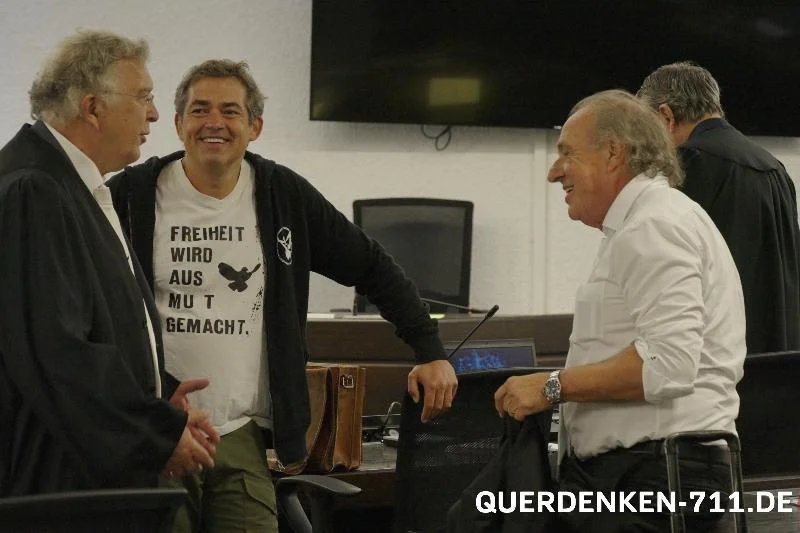
Michael Ballweg, a previously unknown business administrator from Stuttgart, unexpectedly became the face of Germany’s anti-lockdown movement during the COVID-19 pandemic. In 2020, he founded the “Querdenken” (Lateral Thinking) movement, which began as local protests against government containment measures but quickly expanded nationwide, attracting a diverse coalition of vaccine skeptics, civil liberties advocates, conspiracy theorists, and both far-left and far-right elements .
The movement’s rapid growth—from a few hundred participants in Stuttgart to tens of thousands across Germany—represented one of the most significant challenges to state authority during the pandemic era. Ballweg’s ability to mobilize broad segments of the population made him a controversial figure, celebrated by supporters as a champion of freedom and condemned by critics as a dangerous demagogue . This polarization set the stage for the legal drama that would unfold over the subsequent years.
The Legal Proceedings: A Timeline of Judicial Overreach
Investigation and Pre-Trial Detention
The state’s response to Ballweg’s activities began with financial investigations into the Querdenken movement’s funding. In June 2022, authorities arrested Ballweg and held him in investigative detention for nine months based on claims of flight risk, despite his deep roots in the Stuttgart community . This extended pre-trial detention would later become a major point of controversy, given the eventual outcome of the case.
During this detention period, Ballweg’s supporters maintained regular protests outside the prison, arguing that his imprisonment represented political persecution rather than legitimate law enforcement . The length of detention appeared particularly disproportionate when contrasted with the minor charges that ultimately resulted from the extensive investigation.
The Trial and Its Unexpected Outcome
The trial against Ballweg commenced in October 2024 before the Stuttgart Regional Court, with prosecutors leveling staggering accusations: 9,450 counts of attempted fraud plus additional tax evasion charges . The prosecution alleged that Ballweg had collected approximately €1.2 million in donations but had misappropriated over €500,000 for personal use rather than movement activities .
However, as the proceedings advanced through more than 40 court days, the case against Ballweg began to unravel dramatically . By March 2025, the court itself suggested dismissing the case due to insignificance (“Geringfügigkeit”), noting that criminal intent would be difficult to prove . Prosecutors rejected this proposal and pressed forward with the case—a decision that would later appear misguided.
In a remarkable verdict delivered in July 2025, the court largely acquitted Ballweg of all major charges . The judgment found:
- No evidence of criminal intent regarding the fraud allegations
- Only minor tax violations involving approximately €20 in total
- That many transactions couldn’t be fully traced but this couldn’t be attributed to criminal behavior
- That Ballweg’s use of his company for movement activities was legitimate
- That cryptocurrency investments made with movement funds didn’t constitute misuse
The court issued only a formal warning for the minor tax violations and ordered compensation for Ballweg’s time in investigative detention .
Table: Key Events in the Ballweg Legal Proceedings
| Date | Event | Significance |
|---|---|---|
| June 2022 | Ballweg arrested and placed in investigative detention | Begins 9-month detention based on flight risk assessment |
| April 2023 | Ballweg released from detention | Investigation continues but court finds detention no longer necessary |
| October 2024 | Trial begins at Stuttgart Regional Court | Faces 9,450 counts of attempted fraud plus tax evasion |
| March 2025 | Court suggests dismissing case due to insignificance | Prosecutors reject proposal and continue case |
| July 2025 | Court delivers verdict | Acquitted of fraud charges; minor tax violation warning |
| August 2025 | Both sides file appeals | Prosecution and defense challenge different aspects of verdict |
Analysis of Proportionality: Justice Off the Rails
Disproportionate Investigative Measures
The Ballweg case exhibits multiple concerning aspects of proportionality violation that raise questions about potential political motivations behind the prosecution:
Investigative Detention Duration
The nine-month investigative detention stands in stark contrast to the minimal violations ultimately proven. German law typically reserves such extended pre-trial detention for cases involving serious violence or substantial flight risk, neither of which applied meaningfully to Ballweg’s financial case .
Scope of Investigation
The tremendous resources dedicated to investigating thousands of small transactions—many involving trivial amounts—suggests a fishing expedition rather than a focused investigation based on concrete evidence . The court noted that dozens of cash withdrawals couldn’t be fully traced but found this insufficient to establish criminal intent.
Rejection of Judicial Recommendation
The prosecution’s decision to reject the court’s March 2025 suggestion to dismiss the case due to insignificance indicates a concerning persistence in pursuit of Ballweg despite evidentiary problems .
The Chilling Effect on Dissent
The Ballweg case must be understood within the broader context of Germany’s treatment of pandemic critics. The extensive resources dedicated to prosecuting a prominent government critic—despite weak evidence—sends a deterrent message to others who might challenge state policies .
This case exemplifies what civil liberties organizations have identified as a pattern of using financial investigations and regulatory pressure against government critics, particularly those associated with anti-lockdown movements . The disproportionate response to Ballweg’s activities creates a chilling effect that extends far beyond his specific case.
Political Context: The Criminalization of Dissent
The Querdenken Movement as a Political Target
The Ballweg prosecution occurred against the backdrop of increasing official concern about the Querdenken movement’s growing influence. By December 2020, the movement had been placed under surveillance by Baden-Württemberg’s domestic intelligence agency, which cited its mixing of “extremist, ideological conspiracy and anti-Semitic content” with legitimate criticism of pandemic measures .
This official designation created a political context in which aggressive prosecution of movement leaders might be viewed favorably, regardless of the specific legal merits. The Ballweg case illustrates the dangers when law enforcement becomes entangled with political considerations about which social movements should be discouraged.
Media and Political Discourse
Media coverage of Ballweg and the Querdenken movement often emphasized its connections to far-right elements and conspiracy theorists . While these associations were factually accurate in some cases, they created an environment in which due process concerns were easily dismissed in public discourse.
The significant disparity between the initial allegations (€500,000 in misappropriated funds) and the actual findings (€20 in tax violations) suggests that prosecutors may have been influenced by the political climate surrounding pandemic dissent rather than strictly legal considerations .
Comparative Perspective: Patterns of Disproportionate Response
Treatment of Other Government Critics
The Ballweg case is not isolated within contemporary German practice. Other cases suggest a pattern of disproportionate response to government criticism:
David Bendels Case
The editor of an AfD-aligned publication received a seven-month suspended sentence for sharing a satirical altered image of Interior Minister Nancy Faeser—a punishment widely criticized as excessive for what amounted to political satire .
Compact Magazine Ban
The interior ministry banned Compact Magazine in 2024, citing anti-constitutional content, though courts later suspended the ban noting doubts about its proportionality .
These cases collectively suggest an increasing tendency to use state power against perceived political opponents, raising concerns about the erosion of democratic pluralism in Germany .
International Perspective
Germany’s approach to pandemic dissent has drawn international criticism. U.S. officials including Vice President J.D. Vance have questioned whether American taxpayers should support a country where individuals face imprisonment for “mean tweets” or peaceful protest organization .
These international concerns highlight how cases like Ballweg’s damage Germany’s democratic reputation and provide ammunition to critics who question its commitment to civil liberties .
Conclusion: Justice Delayed, Justice Denied
The Michael Ballweg case represents a significant failure of prosecutorial judgment and a worrying example of disproportionate state action against a political dissident. While some oversight of fundraising activities for protest movements is legitimate and necessary, the response to Ballweg’s activities clearly crossed the line from legitimate law enforcement into what appears to be politically motivated persecution.
The stark contrast between the enormity of the allegations (9,450 fraud counts) and the triviality of the actual findings (€20 in tax violations) reveals a justice system that lost perspective in its handling of a controversial political figure . The nine-month investigative detention, in particular, represents a serious violation of proportionality that demands accountability and reform.
This case exemplifies the broader tension in Germany’s “defensive democracy” model, which strives to balance protection of democratic institutions with preservation of civil liberties . In the Ballweg case, this balance tilted decisively toward overzealous protection of state authority at the expense of individual rights.
The Ballweg verdict ultimately represents both a personal vindication for the defendant and an institutional indictment of a justice system that allowed itself to be swayed by political considerations. As Germany continues to navigate complex challenges around pandemic response, immigration, and rising populism, the principles demonstrated in this case—proportionality, due process, and viewpoint neutrality—will remain essential to maintaining a healthy democratic society.