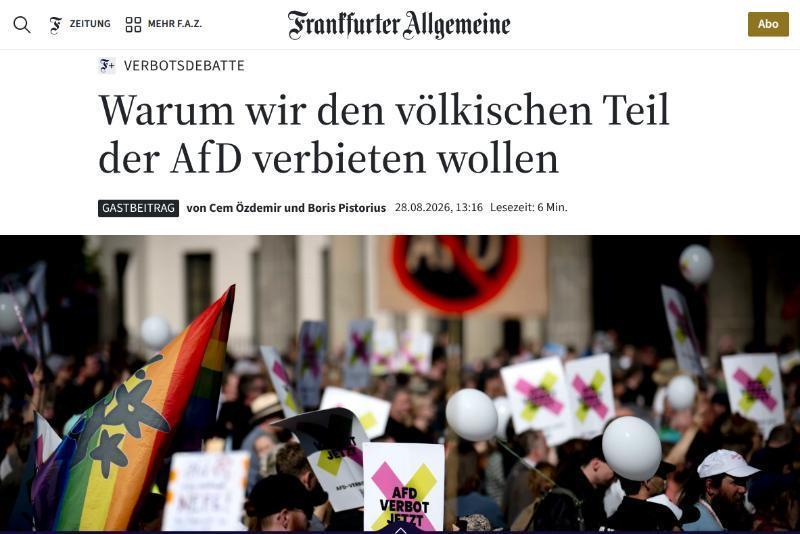
Whenever an established governing majority runs out of political answers, the hour of the prohibition argument strikes. The recent joint push by Baden-Württemberg’s Prime Minister Cem Özdemir and Federal Minister of Defense Boris Pistorius in the Frankfurter Allgemeine Sonntagszeitung marks a dangerous authoritarian trend in the Berlin Republic: the growing tendency to replace hard-fought democratic competition with the judicial broadsword of a party ban.
Evidence Based on Hearsay: When Assertion Becomes Fact
The most glaring failure of both ministers lies in their legal methodology. In a six-minute plea for a historically unprecedented intervention into the party system, the authors provide not a single concrete quote, no policy document, and no verifiable source.
Anyone demanding the revocation of constitutional rights must present measurable facts. Instead, Özdemir and Pistorius content themselves with sweeping assertions and references to vague concepts like the “völkisch branch.” However, a constitutional party ban under Art. 21 Para. 2 of the Basic Law requires proof of an aggressively combative stance aimed at abolishing the free democratic basic order. That the executive branch believes it can render political verdicts without presenting concrete evidence demonstrates a troubling relationship with due legal process.
A Judicial Blind Flight: The Phantom Concept of a “Partial Ban”
Particularly revealing is the proposal to selectively ban only specific state chapters of the AfD.
- Constitutional Contradiction: German constitutional party law simply does not recognize the instrument of a selective “partial ban” of political parties. Under the constitution, a party is evaluated as an organizational and ideological unit.
- Political Overreach: The executive branch’s attempt to define which wing of a party can be tolerated and which should be surgically removed constitutes a massive intrusion into the internal organizational freedom of political parties.
The Instrumentalization of History
To mask their argumentative emptiness, the authors resort to a convenient historical dramatization reflex. The suggestive comparison with the Weimar Republic and Hitler’s rise in 1933 serves not to differentiate, but to stoke moralism. Reflexively pushing political opponents into the vicinity of the NSDAP does not protect the constitution; it devalues historical memory to evade parliamentary debate.
Failure of the Fourth Estate: The FAZ as a Transmission Belt of Power
That senior politicians attempt to harness the judiciary for political objectives is one matter. That a traditional bourgeois media outlet like the Frankfurter Allgemeine Sonntagszeitung prints this constitutionally and empirically dubious push as a prominent op-ed without scrutiny represents a second, no less alarming dimension.
- Abandonment of the Watchdog Role: An independent editorial team should have vetted the executive’s line of reasoning for evidence before publication. By passing a text that peddles legal fantasies without any proof, the FAZ degrades from a critical guardian of democracy to a mere mouthpiece for government narratives.
- Ennobling the Ban Reflex: Through prominent placement, the paper lends the seal of respectable bourgeois reason to a dangerous shift in the public discourse. The newspaper permits an executive attempt to defeat a political competitor by court order rather than argument to be ennobled as a consensus-worthy standard in the mainstream.
| Özdemir & Pistorius Proposal | Constitutional Reality |
| Demanded Action: Banning specific “völkisch” state chapters. | Current Legal Framework: The constitution does not recognize selective party bans; the party is judged as a whole. |
| Burden of Proof: Sweeping references and analogies to the NPD (2017). | Federal Constitutional Court Requirement: Proof of an aggressively combative stance based on records and acts. |
| Political Goal: Eliminating radical forces from public discourse. | Risk to Democracy: Damage to trust in elections and pre-judging millions of voters. |
Conclusion: A Declaration of Political Bankruptcy
A party ban is anchored in the Basic Law as an emergency brake—not as a convenience option for politics that fails to convince the electorate on substance. When government officials demand prohibition proceedings without meeting the minimum constitutional requirements for evidence and methodology, and leading media outlets like the FAZ uncritically hold their stirrups, they endanger the very institutions they claim to protect. The Berlin Republic must not allow the judicial sledgehammer to become a standard tool for maintaining political power.