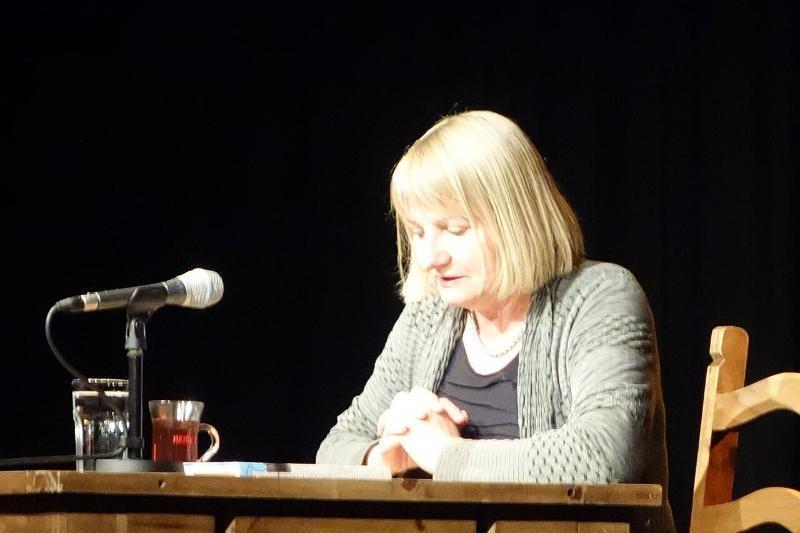
Vera Lengsfeld is one of the most prominent figures of the East German civil rights movement. Her biography serves as a prime example of the courage to resist a socialist dictatorship, the bitter reality of state repression in everyday life, and an uncompromising stance in contemporary political debate.
The Beginnings: From a Pro-Regime Home to the Opposition
Originally coming from a family loyal to the system—her father was an officer in the Ministry for State Security (Stasi)—Lengsfeld studied Marxist-Leninist philosophy and joined the ruling SED party in 1975. However, the deep discrepancy between ideological claims and the reality of the SED regime quickly led to her disillusionment.
By the early 1980s, she sought contact with like-minded individuals and emerged as a key figure in the East German environmental and peace movement. In 1981, she co-founded the Pankow Peace Circle, and later engaged with the opposition group “Kirche von Unten” (Church from Below) as well as the legendary Environmental Library at the Zionskirche in East Berlin, which became a vital hub for peaceful resistance.
The Tools of the SED State: Employment Bans and Stasi Subversion
The response of the GDR authorities to her political activism was swift. To isolate Lengsfeld socially and economically, the regime deployed its established arsenal of state harassment:
- Employment Ban and Party Exclusion: After publicly protesting the deployment of Soviet SS-20 medium-range nuclear missiles in the GDR in 1983, she immediately lost her job as an editor at the Academy of Sciences and was expelled from the SED.
- Comprehensive Surveillance: The Stasi monitored Lengsfeld relentlessly for years. Following the Peaceful Revolution, a total of 49 unofficial informants (IMs) were identified in her Stasi files.
- Betrayal in the Intimate Sphere: The most tragic form of psychological subversion (Zersetzung) orchestrated by the Stasi was the infiltration of her private life. Her husband at the time, Knud Wollenberger, spied on her for years under the code name IM “Donald” for the secret police, passing intimate personal details to his handlers.
Arrest, Stasi Imprisonment in Hohenschönhausen, and Deportation
In January 1988, Lengsfeld fell directly into the gears of the GDR criminal justice system. While on her way to the official Liebknecht-Luxemburg demonstration in East Berlin—where civil rights activists protested using Rosa Luxemburg’s famous quote, “Freedom is always the freedom of the one who thinks differently”—she was arrested prior to the event.
She was detained in the central Stasi remand prison in Berlin-Hohenschönhausen. A GDR court sentenced her to six months in prison for “attempted illegal assembly.” Under intense psychological and political pressure from the authorities, she eventually agreed to leave for Great Britain to avoid serving her prison sentence. She subsequently studied in Cambridge but returned to the GDR on November 9, 1989—the exact day the Berlin Wall fell—to actively shape the democratic transition on the ground.
From Party Switching to Reappraising the Dictatorship
Following German reunification, Lengsfeld continued her political career in the all-German parliament. From 1990 to 1994, she represented civil rights concerns in the Bundestag for Bündnis 90/Die Grünen (The Greens). Due to policy disagreements over the party’s direction, she switched to the CDU in 1996 and served as a Member of Parliament until 2005.
Parallel to her parliamentary work, she remained actively involved with the Berliner Bürgerbüro e. V., an association dedicated to helping victims of SED dictatorship. There, she campaigned tirelessly for the rehabilitation of victims, processing compensation, and uncovering Stasi entanglements.

Sharp Criticism of the “Berlin Republic”
In recent years, Lengsfeld has turned into a fierce critic of contemporary political conditions and debate culture in the modern “Berlin Republic.” Drawing from her personal experiences with the repressive mechanisms of real socialism, she warns against a creeping erosion of constitutional liberties.
- Narrowing of Public Discourse: Lengsfeld accuses current political and media elites of steadily narrowing the acceptable corridor of opinion. Dissenting positions, she argues, are often no longer refuted argumentatively, but rather morally stigmatized.
- Criticism of Government Policies: The energy and migration policies of the Merkel era, as well as the administrative and media handling of the parliamentary opposition, form the centerpiece of her publications.
- Fight Against a New “Ideological Dictatorship”: She regularly criticizes how critical citizens or journalists are quickly branded as extremists. She views this dynamic as a worrying sign of the decay of rule-of-law principles.
Conclusion: The Civil Rights Activist’s Legacy
Whether fighting the SED dictatorship or acting as an outspoken commentator today, Vera Lengsfeld’s life is defined by an absolute commitment to independent thought and expression. In her books, lectures, and self-published media formats, she continues to passionately advocate for the preservation of free speech and civic courage against all forms of societal pressure to conform.