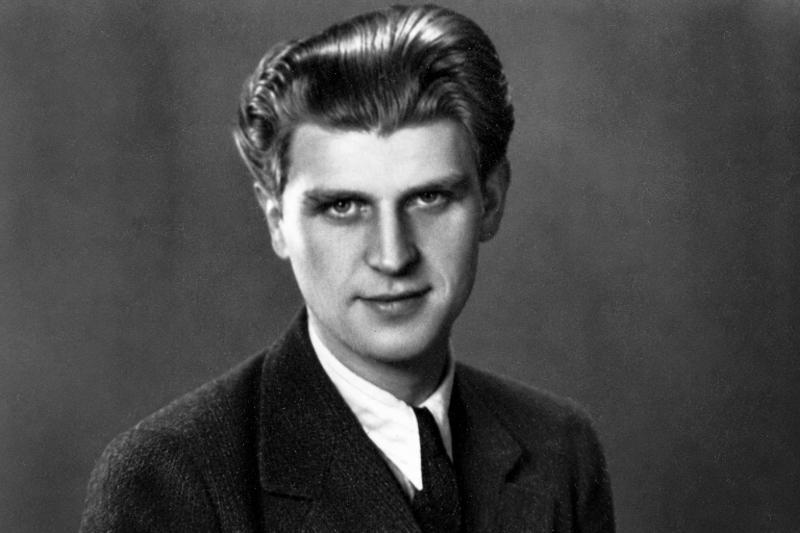

In the early years of the GDR, Leipzig University was a focal point of intellectual and political resistance against Stalinist forced conformity. Economics student Herbert Belter remains a symbol of a young generation of academics who possessed the courage to oppose state-mandated ideology with free speech, democracy, and the rule of law. His fate—arrested at age 20, handed over to the Soviet occupation forces, sentenced to death, and executed in Moscow—documents the ruthless severity of the early SED state in collaboration with the Soviet repressive apparatus.
Biographical Background and the Resistance of the “Belter Group”
Herbert Belter was born on December 21, 1929, in Greifswald. After completing secondary school, he enrolled in economics at Leipzig University in 1948. At that time, the university was already undergoing intense political purges: independent student councils were dissolved, critical professors dismissed, and the FDJ (Free German Youth) established as a state-controlled monopoly.
Belter engaged in student self-governance and actively resisted ideological absorption. In 1949, an underground resistance network formed around him—the “Belter Group.”
The group’s activities included:
- Information Gathering: Regular trips to West Berlin to establish contacts with student organizations (such as at the Free University of Berlin) and the Kampfgruppe gegen Unmenschlichkeit (Combat Group Against Inhumanity).
- Leaflet Campaigns: Distribution of information pamphlets and leaflets in Leipzig and across the university campus demanding free elections, civil liberties, and criticizing Stalinist SED policies.
- Documenting Injustice: Collecting data regarding political repression and faculty dismissals at Leipzig University to pass on to Western media outlets.
The Arrest Wave and Extradition to the SMT
On October 5, 1950, the repressive apparatus intervened: Herbert Belter was arrested at Leipzig Central Station while returning from West Berlin with a suitcase full of political leaflets. Over the following days, East German security forces dismantled the entire network, arresting ten students from Leipzig University.
Instead of trying the students in a German court, the SED leadership relied on Soviet military law. The students were handed over to the Soviet Military Tribunal (SMT)—a common practice designed to maximize sentence severity and exclude the public.
The Death Sentence in Moscow and Execution
The trial before the Soviet Military Tribunal took place behind closed doors without effective legal defense. The charges included alleged “espionage, formation of an anti-Soviet organization, and anti-Soviet agitation.”
- Sentence for Herbert Belter: Arrested in October 1950, Belter was sentenced to death by firing squad by the SMT.
- Sentences for Co-Defendants: His fellow students received extraordinary sentences of 25 years in Soviet forced labor camps (Gulag) and were deported to the Soviet Union (including Vorkuta).
- Execution in Moscow: Belter was transferred to Moscow’s infamous Butyrka prison. On January 24, 1951—at just 21 years of age—he was executed by firing squad. His body was cremated at the Donskoye Cemetery crematorium and buried in an anonymous mass grave.
System Matrix: The Herbert Belter Case
| Category | Historical Reality (1950/1951) | Systemic Function |
| Actor | Herbert Belter & Leipzig Student Group | Academic resistance against SED ideological control |
| Allegation | Distribution of leaflets, Western contacts | Labeled as “Espionage & Anti-Soviet Agitation” |
| Judicial Body | Soviet Military Tribunal (SMT) | Bypassing domestic courts to maximize sentence severity |
| Verdict | Death Penalty (Belter) / 25 years Gulag (others) | Deterrence and destruction of student autonomy |
| Rehabilitation | 1990 by the Russian Federation | Official acknowledgment of the sentence’s illegality |
Conclusion: A Memorial to Academic Freedom
The fate of Herbert Belter illustrates the uncompromising brutality with which the early SED regime suppressed dissent in higher education. Surrendering its own citizens to a foreign occupation force for execution remains one of the darkest chapters in early East German history.

Following the collapse of the Soviet Union, Herbert Belter was officially rehabilitated by the Chief Military Prosecutor of the Russian Federation in May 1990. Today, a commemorative plaque at Leipzig University and a Stolperstein honor his memory.
For PolitischeVerfolgung.de, Herbert Belter remains a timeless symbol: his courage proves that the human desire for freedom cannot be fully extinguished, even under the harshest totalitarian conditions.