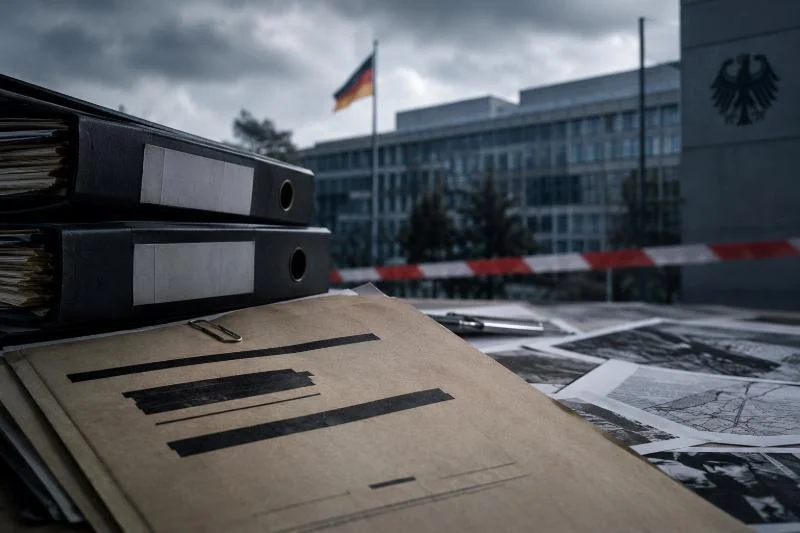
The murder spree by the far-right terrorist group “National Socialist Underground” (NSU)—ten murders, several bomb attacks, and numerous bank robberies between 2000 and 2011—stands as the most severe series of far-right terrorist acts in the history of the Federal Republic of Germany.
The fact that the trio—Beate Zschäpe, Uwe Mundlos, and Uwe Böhnhardt—was able to operate undetected in the underground for over 13 years is not merely the result of police failure, but points directly to deep entanglements within German intelligence agencies: The Office for the Protection of the Constitution used its secret informant system to shield the far-right network, cover up tracks, and prevent effective investigation.
Funding and Building the Scene Through Informants
Perhaps the most severe failure of domestic intelligence lies in the deployment of confidential informants (“V-Männer”). Instead of disarming the extremist scene, state funds were used to finance and build extremist networks through informant fees.
- Financing the Underground: State funds amounting to hundreds of thousands of D-Marks flowed directly into the neo-Nazi scene via informants like Tino Brandt (Thuringian Homeland Security). Brandt alone received an estimated 200,000 D-Marks from the Thuringian State Office for the Protection of the Constitution.
- Warnings of Police Raids: Several informants were in direct contact with the NSU trio or its inner circle of supporters (e.g., Ralf Marschner, alias informant “Primus”). Warnings and leads regarding the trio’s hideout after going underground in 1998 were withheld internally by intelligence agencies or not forwarded to investigating police units, in order to protect the identities of the informants.
The Case of Andreas Temme: An Intelligence Officer at the Crime Scene
The most iconic example of intelligence agency involvement occurred on April 6, 2006, in Kassel. During the murder of Halit Yozgat in his internet café, an active officer from the Hessian State Office for the Protection of the Constitution was present on-site: Andreas Temme.
Temme consistently claimed to have noticed nothing of the murder in the very same room. Even more critically, the Hessian Ministry of the Interior (under then-Minister Volker Bouffier) refused to allow police to interrogate Temme’s far-right informants, prioritizing “source protection” over solving a murder.
“Operation Confetti”: State-Sanctioned Destruction of Files
When the NSU self-exposed on November 4, 2011, a systematic cover-up began within the Federal Office for the Protection of the Constitution (BfV) under President Heinz Fromm.
Just days after the exposure, files regarding the deployment of informants in the environment of “Thuringian Homeland Security” were deliberately shredded within the BfV—a process known as “Operation Confetti.” This action permanently prevented parliamentary inquiry committees from fully reconstructing the exact ties between intelligence agencies and the terrorist trio.
Systemic Failure: The Four Pillars of the Scandal
| Area | Intelligence Agency Conduct | Consequence for Victims & Investigations |
| Institutionalized Source Protection | Informant protection consistently took precedence over criminal prosecution. | Suspects were shielded; murders were not prevented. |
| Institutionalized Racism | Investigative focus focused for years on alleged organized crime (“Soko Bosporus”, “Doner Murders”). | Victim families were suspected; racist motives were ignored. |
| Lack of Transparency | Refusal to release files to Parliamentary Inquiry Committees. | Systematic obstruction of justice in the NSU trial. |
| Absence of Accountability | No legal prosecution of intelligence officers for obstruction of justice. | Persistence of oversight deficits in domestic intelligence agencies. |
Conclusion: Who Protects the Constitution from the Constitutional Protection Agency?
The NSU complex demonstrates the structural failure of Germany’s intelligence architecture. The Office for the Protection of the Constitution proved to be not an early warning system against far-right terrorism, but a catalyst, financier, and cover-up machine.
At PolitischeVerfolgung.de, we maintain that the investigation into the NSU complex remains incomplete as long as intelligence files remain classified and the preservation of state agencies is weighted heavier than the lives of citizens.