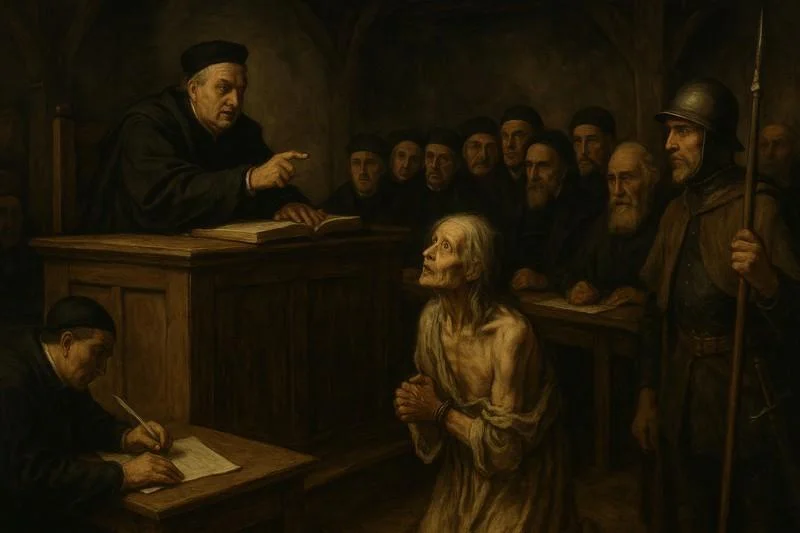
The witch hunts of the early modern period were not evenly distributed across Europe but showed significant strongholds. Certain territories became notorious as veritable centers of persecution, where thousands of people – predominantly women – fell victim to the witch craze. This analysis examines the main strongholds of witch hunting in German-speaking territories and neighboring regions, exploring the specific political, religious, and social factors that made these areas particularly susceptible to mass persecutions.
The Holy Roman Empire of the German Nation: The Epicenter of Witch Hunts
General Context:
The Holy Roman Empire of the German Nation was responsible for approximately 40-50% of all documented witch executions in Europe. The political fragmentation of the empire into numerous small territories created ideal conditions for persecution, as local rulers could implement their own judicial policies without effective oversight.
Key Factors in German Territories:
- Political fragmentation and local autonomy
- Competition between Catholic and Protestant territories
- Strong influence of demonological literature
- Developed legal systems capable of conducting extensive trials
Major Persecution Centers in German Lands
The Electorate of Trier
Period: 1581-1593
Characteristics:
- One of the earliest major persecution waves
- Involved all social classes, including prominent citizens
- Strong influence of Jesuit demonologists
- Estimated victims: 1,000-2,000 people
Notable Features:
The Trier persecutions gained particular notoriety because they affected educated elites, including priests and city council members, demonstrating that no one was safe from accusations.
The Prince-Bishopric of Bamberg
Period: 1623-1632
Characteristics:
- Extremely well-documented due to preserved court records
- Systematic persecution under Prince-Bishop Gottfried Johann Georg II Fuchs von Dornheim
- Special “witch prison” (Drudenhaus) built for detainees
- Estimated victims: 600-1,000 people
Legal Particularities:
The Bamberg witch trials were notable for their procedural rigor and the preservation of detailed court transcripts, providing invaluable insight into trial mechanics.
The Prince-Bishopric of Würzburg
Period: 1626-1631
Characteristics:
- Massive persecution wave under Prince-Bishop Philipp Adolf von Ehrenberg
- Victims included children, priests, and nobles
- Estimated victims: 900-1,200 people
Social Impact:
Contemporary reports describe entire streets emptied of inhabitants and widespread social terror.
Regional Strongholds Outside German Core Territories
The Swiss Confederation
Areas of Intensity:
- Canton of Valais: Early persecutions beginning in 1428
- Canton of Vaud: Under Bernese control, approximately 3,500 executions
- Geneva: Calvinist center with systematic persecutions
Special Characteristics:
Swiss territories showed early adoption of witch hunting and developed distinctive legal traditions that influenced neighboring regions.
The Kingdom of France
Regional Centers:
- Lorraine: Under the rule of Nicholas Rémy, approximately 2,000-3,000 executions
- Béarn: Intensive persecutions in southwestern France
- French Flanders: Influenced by both French and Flemish traditions
Legal Framework:
France maintained greater central control over witch trials than the Holy Roman Empire, leading to more restrained persecution in some regions.
The British Isles
English Persecution:
- Essex: Center of English witch hunting
- Lancashire: Site of major trials (1612 and 1634)
- East Anglia: Matthew Hopkins’s “Witchfinder General” campaign (1645-1647)
Scottish Persecutions:
- Intensive witch hunting under James VI
- Estimated 1,500-2,000 executions
- Strong state involvement in prosecutions
Analysis of Persecution Patterns
Political Structures and Persecution Intensity:
- Ecclesiastical Territories: Prince-bishoprics like Bamberg, Würzburg, and Cologne showed particularly high persecution rates, likely due to combination of religious ideology and political authority.
- Small Secular Territories: Minor lordships and imperial knights often conducted aggressive persecutions as demonstrations of sovereignty.
- Large Territorial States: Larger states like Electoral Saxony or Bavaria generally showed more restraint due to better legal oversight.
Religious Confession and Persecution:
Both Catholic and Protestant territories experienced severe persecutions, challenging simplistic denominational explanations. However, specific religious contexts influenced persecution patterns:
- Catholic Territories: Often influenced by Counter-Reformation zeal and specific religious orders
- Lutheran Territories: Generally more restrained than Calvinist or Catholic areas
- Calvinist Regions: Showed particular intensity in some cases (e.g., Scotland, Geneva)
Economic and Social Factors in Persecution Strongholds
Economic Crises and Persecution:
Many persecution peaks coincided with:
- Agrarian crises and crop failures
- Economic transformation and social stress
- Property confiscation from victims
Social Dynamics:
- Urban vs. rural persecution patterns
- Role of local elites in driving persecutions
- Impact of territorial competition
The End of Persecution in Former Strongholds
Differential Decline:
The decline of witch hunting occurred at different rates across former strongholds:
- Early Cessation: Some territories stopped persecutions by the mid-17th century
- Late Persecutions: Isolated trials continued into the 18th century, particularly in:
- Catholic ecclesiastical territories
- Remote rural areas
- Swiss and German border regions
Factors in Decline:
- Judicial skepticism and procedural reforms
- Enlightenment influences
- Centralizing state control over local justice
- Economic changes reducing social tensions
Conclusion: Lessons from the Strongholds
The geography of witch hunt strongholds reveals complex interactions between political structures, religious contexts, legal systems, and social conditions. The concentration of persecutions in specific regions demonstrates that witch hunting was not a uniform phenomenon but reflected local power dynamics, institutional arrangements, and particular historical circumstances.
The legacy of these persecution centers remains relevant for understanding:
- The dynamics of collective violence
- The vulnerability of judicial systems to mass hysteria
- The importance of institutional safeguards
- The enduring challenge of protecting minority rights against majority fears
The strongholds of witch hunting serve as permanent warnings about how legal systems can be perverted to serve persecution and how ordinary communities can become caught in cycles of accusation and violence. Their study remains essential for understanding the mechanisms of persecution and developing safeguards against similar phenomena in modern contexts.
Guten Morgen,
Hexenverbrennungen etc.
aus verschiedenen Gründen sehe ich Konstanz, die Papststadt mit dem Klerus als “schlimmste Stadt” der Welt an.
Hier wurden Jan Hus und Hieronymus von Prag getötet.
Hieronymus von Prag war ein böhmischer Gelehrter, Mitstreiter von Jan Hus und Mitbegründer der hussitischen Bewegung- Tod auf dem Scheiterhaufen.
Viele Grüße Gerry, Friedenskette-Bodensee
Lieber Gerry, wir ehren auf PolitischeVerfolgung.de nun auch Hieronymus von Prag (https://www.politischeverfolgung.de/reformation/hieronymus-von-prag/) und Jan Hus (https://www.politischeverfolgung.de/reformation/jan-hus/).
Vielen herzlichen Dank für die Anmerkung – wir werden den Artikel um Konstanz ergänzen.