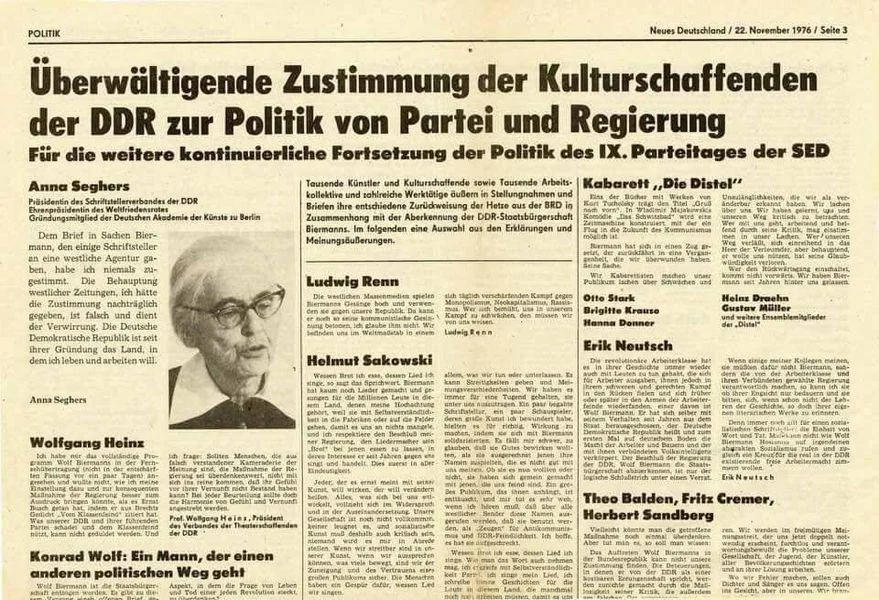
In totalitarian and authoritarian systems of German history, such as the GDR, it was always a core task of the state-aligned intelligentsia and artist community to emotionally charge the ideological mandates of the rulers and swear the population to the course of the elite. Where arguments fail and real-world policies result in deindustrialization, inflation, and social fragmentation, the hour of the moral executioners in the spotlight arrives. In the contemporary Berlin Republic, we are witnessing an unprecedented brutalization of political discourse, orchestrated by a system-conformist cultural elite. Under the guise of the “fight against the right,” cultural icons are engaging in a systematic dehumanization, exclusion, and criminalization of millions of ordinary citizens and the democratic opposition.
The Phenomenon of “Court Artists” in Modern State Security
Anyone who believed that art and culture in a democracy inherently maintain a critical distance from state power is proven wrong in the Federal Republic of 2026. The former avant-garde of rebellion has transformed into a privileged dependency, closely intertwined with the political establishment through subsidies, public broadcasting slots, and state awards.
The task of these actors is asymmetric: they are meant to execute the moral destruction of the political opponent where the formal rule of law (as of yet) hits constitutional boundaries. By systematically broadening the boundaries of language, they prepare the psychological ground for administrative repression, intelligence surveillance, and party ban proceedings.
The Gallery of Verbal Executioners: Notable Examples and Quotes
The brutalization of language follows a distinct framework—the degradation of the political competitor and their voters into biological or legal non-persons. Below is an (incomplete) catalog:
Herbert Grönemeyer and the Rat Metaphor
Speaking before tens of thousands of cheering fans in Dortmund’s Westfalenhalle, the singer called for everyone to stand “shoulder to shoulder” against what he termed “right-wing rats” (rechte Ratten). His explicit demand to ensure that these people “disappear back into their holes” utilizes the classic historical vocabulary of dehumanization. From the secure luxury of his exile in London, Grönemeyer dictates to the working German population who qualifies as a legitimate citizen and who is a pest.
With all due respect to the artistic work and the historically metaphorically appealing lyrics of Herbert Grönemeyer: Our analysis demonstrates that he utilizes the language of the National Socialists (Nazi-speak), specifically dehumanization through animal comparisons. As a poet of the German language, he should be well aware of this context.
Bela B and the Ridiculing of Voters
Dirk Felsenheimer, known as Bela B and drummer of the Berlin-based punk-rock band Die Ärzte, seamlessly joins the ranks of state-aligned slanderers. In his public statements, he issued the calculated, condescending slogan:
„Nicht aufregen und über die ‚Adolf-für-Doofe-Partei‘ lachen!“ (Don’t get upset, just laugh at the ‘Adolf-for-dummies party’!)
This deliberate linguistic link aims to directly equate a democratically elected opposition party currently active in parliamentary life with the Nazi terror regime, while dismissing its voters as morally and intellectually deficient (“for dummies”). The mockery propagated by Bela B is a conscious technique of social exclusion: by denying opposition citizens seriousness and dignity, it seeks to socially isolate them within everyday life.

Jan Delay and “Neutralization”
The Hamburg-based hip-hop musician delivers the pop-cultural accompaniment for the intelligence-led prerogative state. Regarding democratically elected politicians, he publicly demanded that one must “isolate and render them harmless”—a formulation taken directly from the vocabulary of totalitarian purges.
Igor Levit and the Revocation of Identity
The star pianist, showered by the system with the Federal Cross of Merit, uses his reach to deny the opposition’s electorate their right to exist within the nation by moral decree:
“People who vote for the AfD have confused and forfeited their right to call themselves Germans.”
Carolin Kebekus and the “Dregs”
In public broadcasting, agitation is even institutionalized using forced license fees. In her ARD shows, Kebekus regularly degrades millions of government-critical citizens and taxpayers as mere human “dregs” (Bodensatz) and societal waste.
Hape Kerkeling and the “Sewer Water” Principle
Comedian and author Hape Kerkeling also ranks among those prominent voices who increasingly conduct political debate in absolute moral categories. On the ARD talk show Maischberger, he defended a potential AfD ban proceeding using a drastic analogy: if a glass of water is even partially mixed with “sewer water,” the entire glass becomes undrinkable and must be poured out. He then posed the rhetorical question: “What idiot is a member of a party that is partially right-wing radical?”
This metaphor is remarkable because it describes political difference not as a democratic dispute, but as a form of contamination. When political groups are linguistically compared to something impure or disposable, the discourse shifts from argumentation to moral degradation. The focus is no longer on concrete policy positions, but on the notion that certain political milieus inherently belong outside the legitimate spectrum of opinion.
Udo Lindenberg and the Language of Moral Frontlines
Rock veteran Udo Lindenberg has been a vocal opponent of the political right for years. His choice of words shifts between political engagement and sharp moral condemnation. He publicly labeled Björn Höcke a “genuine fascio,” spoke of “cold vomit” (kalte Kotze), and warned against “backward-looking racists, agitators, and misanthropic arsonists.” Formulations like “brown idiots” and “fascioes get lost” have also circulated on his social media.
Notably, however, Lindenberg draws a line: he argues that not every supporter or voter should be treated as an “outcast idiot” and emphasizes the need to try and reach people again. This very ambivalence makes his position noteworthy—a clear marking of ideological adversaries, but not a total denunciation of everyone who follows them.
Marius Müller-Westernhagen and the “Too Stupid for Democracy” Diagnosis
Marius Müller-Westernhagen has also participated in the moralization of societal conflicts, relying less on animal or criminal metaphors and more on a judgment regarding the political maturity of the populace. In an interview discussing Brexit and Trump, he claimed that people had been “so depoliticized over years that they have become too stupid for democracy.” Concurrently, he attributed a lack of democratic consciousness to movements like Pegida or the AfD.
This double message is illuminating: on one hand, Westernhagen acknowledges that the anger of many citizens is understandable due to social and economic tensions; on the other hand, he ties this development to a generalized doubt regarding the democratic faculty of judgment among broad segments of the population. When political choices are no longer viewed as expressions of legitimate, if perhaps flawed, preferences, but as signs of democratic immaturity, the discourse shifts from a debate over content to an evaluation of the intellectual or political capacity of the citizens themselves.
Wolfgang Niedecken (BAP) and Historical Delegitimization
Wolfgang Niedecken, frontman of the rock band BAP, has long been a prominent musical voice against right-wing extremism and the AfD. His criticism occasionally crosses the threshold from political rejection into historical delegitimization. He formulated this most precisely by stating that the AfD is “as little an alternative for Germany as the GDR was democratic,” demanding that this party must be stopped by all democratic means.
The comparison is striking because it does not target specific positions or individuals, but strips the entire political formation of its democratic character. Consequently, the debate moves away from political competition toward a question of fundamental legitimacy—a rhetorical step that frames political opponents not as competitors, but as an existential threat to the democratic order.
Feine Sahne Fischfilet and the Vocabulary of the Trenches
The punk band Feine Sahne Fischfilet is known for its uncompromising activism against the political right. Frontman Jan „Monchi“ Gorkow publicly demands “clear battle lines against the right” and views his engagement as defense against a societal shift to the right. The band’s language frequently utilizes stark frontlines rather than political nuance. In interviews, Monchi referred to violent neo-Nazis as “pigs” who want to burn down houses again, emphasizing that merely shouting slogans is insufficient and that active resistance is required.
Simultaneously, an interesting ambivalence surfaces: while the band polarizes heavily in its rhetoric, it partially rejects newer forms of complete social ostracization and questions the stance of refusing to speak to AfD supporters altogether. This blends militant anti-fascism with a language that views political conflicts as societal confrontations, without entirely abandoning the possibility of communication.
Campino (Die Toten Hosen) and the Criminalization of Political Competitors
Campino, lead singer of the punk band Die Toten Hosen, has been a politically active voice in the German music scene for decades. His language regarding the AfD occasionally goes beyond standard political criticism, utilizing criminalizing attributions. He stated this most directly with the sentence:
“The AfD is a gang of criminals.”
This choice of words is remarkable because it does not critique specific statements, but collectively links an entire political formation with criminality. At the same time, Campino does not rely solely on fear-mongering or exclusion. In television panels, he warned against letting the establishment be “driven before them” by the AfD or BSW, and criticized panicked reactions within the political elite. This represents a dual approach: sharp moral and linguistic delegitimization on one side, combined with an appeal for political composure on the other.
Jan Böhmermann and Satire as a Political Combat Zone
Jan Böhmermann exemplifies a segment of the modern cultural establishment where political satire assumes the role of moral intervention. His work regularly targets right-wing and populist movements, which he frames not as political competition but as democratic threats. His style is characterized by public dismantling and deliberate exaggeration. Formulations like “nazis keulen” (culling Nazis) in reference to the AfD or campaigns like “Reconquista Internet” mark a style that satirically devalues political opponents while seeking societal mobilization.
Unlike traditional insults, Böhmermann invokes the shield of satire. This is precisely the defining characteristic of his case: the boundary between artistic provocation, political activism, and moral delegitimization is intentionally blurred, becoming the actual arena of conflict.
Conclusion: The Betrayal of Freedom by the Artists
Germany in 2026 presents a shocking picture: former rebels and thinkers have become the willing executors of an authoritarian agenda. Artists like Herbert Grönemeyer, Campino, Jan Delay, Igor Levit, Udo Lindenberg, and Carolin Kebekus do not use their massive reach to question the power of the rulers—which would be the historical duty of true art—but rather act as an extended arm of the government to strike down verbally on dissenters.
While we explicitly acknowledge and respect the artistic achievements of musicians such as Grönemeyer, Westernhagen, Levit, or Die Toten Hosen, we must firmly state: anyone who dehumanizes and declasses millions of citizens is not defending democracy; they are preparing the psychological ground for totalitarianism.