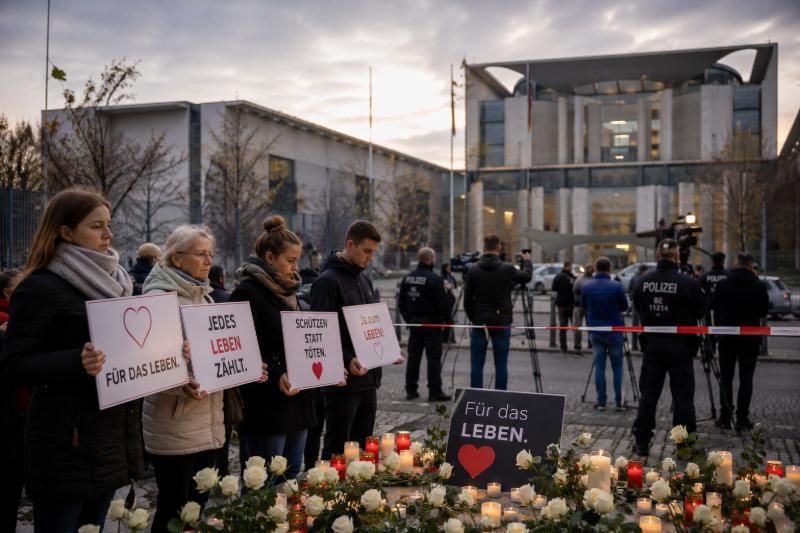
Constitutionally guaranteed freedom of religion (Article 4 of the German Basic Law) protects not only private belief, but explicitly the public expression of faith – such as prayer processions, public devotions, or religious vigils. The events on Saturday, August 15, 2026, in Göttingen clearly demonstrated how the exercise of this fundamental right in Germany is coming under pressure from aggressive counter-mobilization.
What began as a peaceful religious gathering ended in an escalation that required a massive police presence. It raises urgent questions about how effectively the constitutional state defends minority religious views in the public square.
The Incident: From Prayer to Blockade
On Saturday afternoon, around 20 believers – including participants who had traveled from abroad – gathered at the Göttingen market square for a registered stationary rally under the motto “Public Rosary Against Abortion.” Through prayers and addresses, they expressed their Christian-ethically motivated opposition to abortion. According to police reports, the assembly proceeded completely peacefully until its scheduled conclusion.
However, a spontaneous counter-protest from the left-wing and anti-fascist spectrum quickly formed nearby. What started as disruption with loud music and chanting grew into a hostile atmosphere. When the believers attempted to end the event and leave the square in the early evening, elements of the counter-protest tried to forcibly block their departure and confront the group.
Only the energetic intervention of the police – using barriers, crowd control tactics, and irritants – prevented direct physical assaults on the attendees. During the operation, twelve police officers were injured by chemical irritants, and several ambulances treated individuals on site. Law enforcement has initiated investigations into breach of the peace and coercion.
Analysis: The Mechanics of Intolerance
From the analytical perspective of politischeverfolgung.de, the incident in Göttingen fits a troubling pattern. The disruption or violent prevention of religious gatherings is not a phenomenon restricted to authoritarian states; it occurs through subtle mechanisms of displacement within democratic cities:
- Confiscation of Public Space: When religious expressions or ethical stances that diverge from the societal mainstream can no longer be voiced publicly without fear of physical harm, fundamental rights become hollow promises.
- The Logic of Coercion: Anyone praying or demonstrating publicly must face objective criticism and peaceful counter-protest. However, when a counter-protest aims to render the exercise of prayer impossible or ambush participants as they leave, it crosses the line from freedom of expression into illegal coercion.
- Failure of Civil Tolerance: That a Christian prayer group in a university town like Göttingen can only express its faith under heavy police protection reveals a fundamental imbalance in how political activists understand tolerance.
Constitutional Framework: The State’s Duty to Protect
The Federal Constitutional Court has consistently emphasized that the state bears a duty to protect rights holders. When a minority exercises its right to freedom of religion and assembly – regardless of how unpopular its views may be – the state must not yield to intimidation or mob rule.
If securing religious rallies becomes too costly, or if believers preemptively withdraw from public life out of fear of reprisals, intolerance achieves its goal: the effective erasure of religious voices from public discourse.

Conclusion: Religious Freedom Applies to Unpopular Beliefs
The attack on the prayer group in Göttingen is a wake-up call for the rule of law. Freedom of religion is not measured by how undisturbed the majority can celebrate its holidays. Its true strength is tested precisely where religious minorities or conservative ethical convictions encounter fierce opposition.
Security authorities and policymakers are obligated to defend the right to free religious practice against physical intimidation. When prayers in Germany require police protection to take place, it is not a victory for civic courage, but a testament to a declining democratic culture.