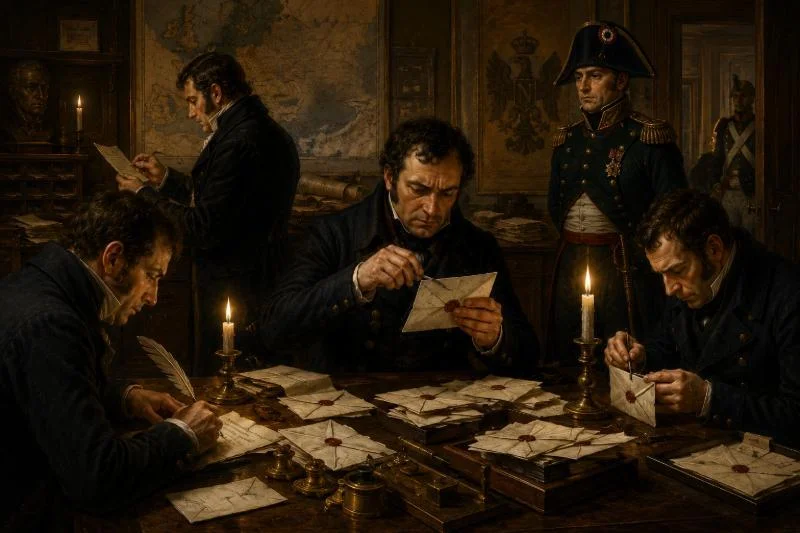
Long before the digital age and the invention of state trojans or algorithmic surveillance, governments had already found a highly effective way to read the private thoughts of their citizens: the letter. During the French occupation of Germany (1794–1814), known as the Franzosenzeit, the French Empire perfected a secretive institution that became the terror of all democrats and patriots—the “Cabinets Noirs” or Black Cabinets. This system represents the historical birth of state-sponsored mass surveillance on German soil.
The Paradox of Modernity: Liberty vs. Total Control
The arrival of French troops in the German territories brought a historic clash of ideals. On the one hand, the occupying forces introduced the Code Civil, establishing modern principles of civil equality, the secularization of the state, and the formal destruction of feudal arbitrariness. On the other hand, the Napoleonic administration was a military dictatorship that could not tolerate any domestic resistance or intellectual opposition.
To secure his hegemony over Central Europe, Napoleon Bonaparte realized that controlling physical territory was not enough; he had to control the flow of information. The post office, which was expanding rapidly during the early 19th century as a central network for trade, intellectual exchange, and private life, became the primary target of imperial espionage. Under the guise of administrative modernization, the mail service was turned into a weapon of political persecution.
The Mechanics of the “Cabinet Noir”
The Black Cabinets were highly secretive departments embedded directly within the major postal hubs of occupied Germany, such as Frankfurt am Main, Mainz, Cologne, and Hamburg. These offices operated completely hidden from the public eye, often behind double-locked doors in post buildings, accessible only to specialized civil servants who had sworn oaths of absolute secrecy to the French Crown.
The technical process of interception was executed with terrifying precision and speed, ensuring that the regular flow of mail was not visibly disrupted:
- The Interception: Mail bags from targeted regions, or those addressed to suspected individuals, were quietly diverted to the Black Cabinet before being sorted for distribution.
- The Opening Technique: Using fine, heated wires, specialized bone spatulas, and controlled water steam, the officials liquefied the sealing wax without breaking it or tearing the delicate paper.
- The Duplication and Decoding: Letters were immediately read, and critical political or military information was copied by hand. If a letter was written in a complex cipher—a common practice among diplomats and underground resistance fighters—it was handed over to specialized cryptanalysts who worked within the cabinet to decode the message.
- The Resealing: Using custom-made iron replica stamps of private family crests or official seals, the letters were meticulously resealed with fresh wax and put back into the regular postal stream. The recipient almost never suspected that their privacy had been entirely compromised.
Joseph Fouché’s Information Empire
The structural genius behind this operation was Joseph Fouché, Napoleon’s Minister of Police. Fouché did not view postal espionage as a temporary wartime measure, but as a permanent, systemic tool of governance. The information gathered in the Black Cabinets of Germany was compiled into daily intelligence summaries, the so-called Bulletins de Police, which were delivered directly to Napoleon’s desk every morning.
The target list of the Black Cabinets was vast. It included not only active conspirators or nationalistic rebels, but also ordinary merchants discussing the economic impact of the Continental Blockade, professors writing to colleagues at other universities, and even high-ranking French officials and generals whose loyalty Napoleon questioned. No one was exempt from the panoptic gaze of the state.
Psychological Terror and Self-Censorship
The true power of the Black Cabinets lay not only in the arrests they triggered, but in the psychological climate of fear they generated. While the existence of these offices was an official state secret, the public quickly became aware that private correspondence was no longer safe.
This awareness triggered a massive wave of self-censorship among German intellectuals, writers, and citizens. People stopped writing about political philosophy, avoided criticizing the heavy French tax burdens, and destroyed private diaries out of fear of house searches. The social solidarity of the emerging bourgeois public sphere was intentionally fractured, as anyone could be an informant, and every mailbox was a potential trap.
The Legacy of the Black Cabinets
When the Napoleonic occupation ended in 1814, the German princes did not abolish this intrusive French surveillance system. Instead, they recognized its immense value for maintaining their own autocratic power.
During the subsequent era of the Restauration, Austrian Chancellor Klemens von Metternich seamlessly took over the infrastructure of the Black Cabinets. He weaponized them against the German democratic movement, using the exact same methods of postal opening to enforce the repressive Karlsbad Decrees. The history of the Black Cabinets is a stark reminder that once a state develops an effective tool for mass surveillance, it is almost never abandoned by subsequent rulers, regardless of their ideological background.