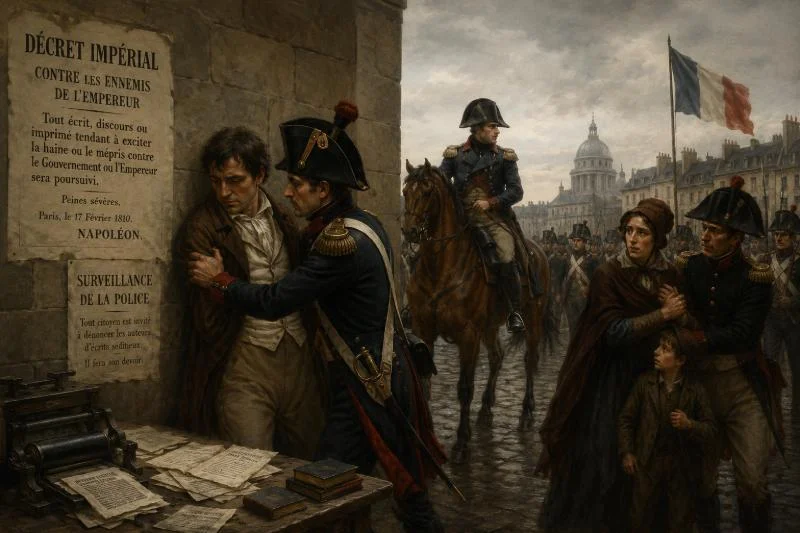
The era of French occupation in Germany, historically known as the Franzosenzeit, is one of the most paradoxical periods in European history. On one hand, Napoleon Bonaparte brought the revolutionary promises of the Code Civil, civil equality, and the destruction of dusty feudal structures. On the other hand, the French Empire constructed a highly efficient, bureaucratic surveillance apparatus that redefined the mechanics of state oppression. True freedom was reserved only for those who remained silent; for any form of dissent, the era introduced a systematized, modern template of political persecution.
The Mask of Progress
When French revolutionary and imperial troops marched into the Rhineland and later established model states like the Kingdom of Westphalia, they were initially greeted by many intellectuals as liberators. The abolition of serfdom and the introduction of religious emancipation—particularly for Jewish and Protestant minorities in historically restrictive regions—were monumental achievements.
However, this newly granted civil liberty came with a non-negotiable caveat: absolute submission to the geopolitical ambitions of the French Empire. Political persecution under Napoleonic rule was no longer justified by religious heresy or feudal disobedience, but by the modern doctrine of absolute raison d’État (state interest).
Joseph Fouché and the Mechanics of the “Haute Police”
The infrastructure of Napoleonic repression was engineered by Joseph Fouché, Napoleon’s infamous Minister of Police. Fouché transformed political surveillance from haphazard local spying into a centralized, data-driven government industry.
- The Infiltration of Public Space: A vast network of official gendarmes and undercover informants (mouchards) was deployed across occupied German territories. They systematically infiltrated coffeehouses, taverns, universities, and literary salons—the cultural epicenters of public opinion. Any critical remark regarding the Emperor or the continuous financial extractions could result in immediate extrajudicial arrest.
- The Black Cabinets (Cabinets Noirs): Postal intercept stations were established in strategic logistical hubs such as Frankfurt, Cologne, and Mainz. In these hidden offices, experts used specialized techniques involving steam and wax molds to intercept, copy, and cryptanalytically decode private and diplomatic correspondence before sending it along to its destination.
The Execution of Johann Philipp Palm: State Terror as a Deterrent
No event illustrates the cold efficiency of this repression better than the fate of the Nuremberg bookseller Johann Philipp Palm in 1806. Palm had distributed an anonymous anti-Napoleonic pamphlet titled “Germany in Its Deep Humiliation”.
Even though Palm was not the author and Nuremberg was technically not French territory at the time of publication, Napoleon bypassed ordinary legal channels. He ordered a French military tribunal to try Palm in a summary proceeding. The resulting death sentence and execution by firing squad was a calculated act of state-sponsored terror designed to intimidate the entire German intellectual and publishing elite into absolute silence.
The Militarization of Repression: Hunting the “Refractaires”
As the Napoleonic Wars expanded, Germany was increasingly treated as a human resource reservoir for the Grand Army. The enforcement of universal conscription (conscription) became a primary driver of state violence.
Thousands of young German men attempted to evade service or deserted the ranks. The hunt for these draft evaders, known as réfractaires, was relentless. When individuals could not be found, the French administration weaponized collective punishment (Sippenhaft). Families of evaders were routinely imprisoned, and heavy financial fines or forced military quartering (dragonrades) were imposed on entire villages until the missing conscript surrendered. This collective punishment represented a complete betrayal of the individual liberties promised by the Code Civil.
Conclusion: The Long Shadow of the Imperial Police State
The Franzosenzeit fundamentally altered the nature of political persecution in Europe. Napoleon dissolved the arbitrary, chaotic tyranny of petty feudal princes, only to replace it with a highly organized, professionalized police state.
The tragic irony of this period lies in its continuity. Following Napoleon’s defeat at Waterloo in 1815, the restoring rulers of the German Confederation, under the leadership of Austrian Chancellor Klemens von Metternich, did not dismantle these French surveillance innovations. Instead, they seamlessly adopted the Cabinets Noirs, the informant networks, and the centralized files to suppress the German democratic movement for the subsequent decades.