In the German Democratic Republic (GDR), broadcasting—comprising state radio and GDR television—was never designed as an independent Fourth Estate. In line with the Marxist-Leninist understanding of media, the ruling Socialist Unity Party (SED) viewed journalism as a weapon in the class struggle. Radio and later television served a clearly defined threefold purpose: providing information aligned with party lines, offering entertainment to pacify the populace, and, above all, driving the ideological indoctrination of the public.
Anyone in the studio or behind the microphone who resisted this mandated party line was not only professionally sidelined, but immediately targeted by the Ministry for State Security (Stasi).
Total Party Control: The Destruction of Distance from the State
Editorial independence existed in the GDR neither in theory nor in practice. Media structures were strictly hierarchical and oriented entirely toward party headquarters:
- The State Committees: Radio and television were directly subordinate to the State Committee for Radio and the State Committee for Television under the GDR Council of Ministers. These bodies functioned purely as executive enforcement arms of the SED leadership.
- Directives from the Central Committee: Content strategy was dictated weekly by the Agitation and Propaganda Department of the SED Central Committee. Journalists officially viewed themselves as “propagandists and agitators” for the party.
- Cadre Policy and Stasi Infiltration: Key positions were filled exclusively with loyal party cadres. Dissenting opinions or investigative efforts outside prescribed narratives were punished as “diversionary activity,” leading to immediate professional bans or imprisonment.
Agitation and Censorship: The Struggle for Interpretive Dominance
The mandate of GDR broadcasting was not balanced reporting, but rather the dissemination of the “socialist perspective.”
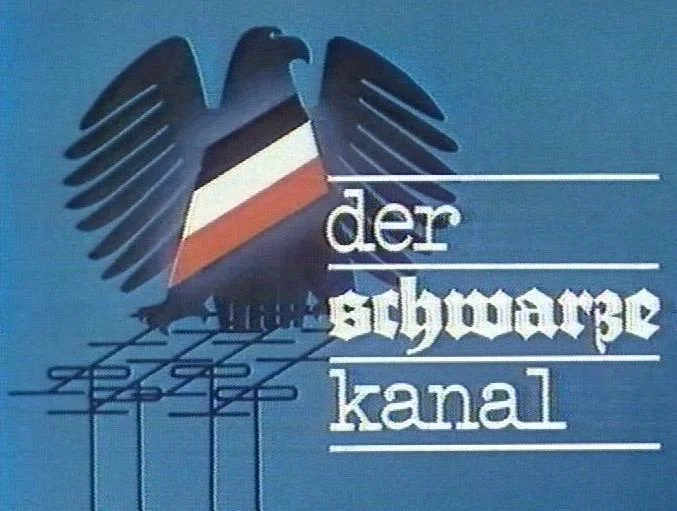
- “Der Schwarze Kanal”: The most prominent example of defensive agitation was the television program Der Schwarze Kanal (“The Black Channel”), hosted by Karl-Eduard von Schnitzler. Excerpts from West German television were edited to systematically discredit the political and economic system of the Federal Republic.
- Linguistic and Content Alignment: News formats like Aktuelle Kamera endlessly reported on fulfilled economic plans, successful harvests, and Eastern Bloc peace initiatives, while structural defects, supply shortages, or environmental disasters inside the GDR were completely suppressed.
The “Valley of the Clueless” and Western Media as an Alternative
Unlike under National Socialism, listening to or watching Western stations (“class enemies”) in private spaces was largely tolerated in the GDR from the 1970s onward, as technical jamming had failed nationwide.
- Forced Competition: Because a large portion of the population tuned into Western media (ARD, ZDF, RIAS) in the evenings—except in regions like Dresden or Greifswald, known as the “Valley of the Clueless”—GDR broadcasting faced immense pressure to adapt.
- Subtle Entertainment: To keep citizens tuned to state stations, the GDR created entertainment formats like Ein Kessel Buntes or the youth radio station DT64. Western pop music and light entertainment were broadcast as concessions to transport the core ideological message beneath the surface.
Conclusion: The Legacy of GDR State Media and Necessary Critique of Today’s Public Service Broadcasting
The history of GDR broadcasting relentlessly demonstrates how media collapses when it ceases to view itself as a neutral observer of power and instead operates in service of an educational and ideological agenda.
Although modern Public Service Broadcasting (PSB) in Germany was established on the explicit principle of state independence, a critical examination reveals concerning trends reminiscent of these paternalistic media structures:
- Educational Mandate Instead of Neutral Information: Classical, objective reporting in modern PSB increasingly gives way to moralizing stances. When journalists claim the duty not merely to inform their audience, but to “educate,” “sensitize,” or steer language politically, they abandon the mandate of neutrality and adopt patronizing patterns.
- Uniform Opinion Corridor: Despite theoretical diversity, many widely debated societal topics (such as migration policy, energy transition, or identity politics) exhibit a strikingly homogeneous opinion corridor. Critical or dissenting voices in talk shows and news magazines are frequently lectured or morally downgraded rather than given equal space for debate.
- Financial Immunity and Proximity to the State: Through state treaties and the mandatory broadcasting fee, PSB is financially decoupled from actual citizen satisfaction. The overlap of politicians on supervisory boards and state-adjacent advisory councils creates a structural intertwining that steadily erodes public trust in absolute state independence.
A healthy democracy does not need media that prescribes attitudes on behalf of government or elite architectures. Those who take the lessons of the GDR propaganda state seriously must demand that contemporary public broadcasting return to its core task: providing an open-ended, ideology-free, and uncompromisingly neutral source of information for all citizens.