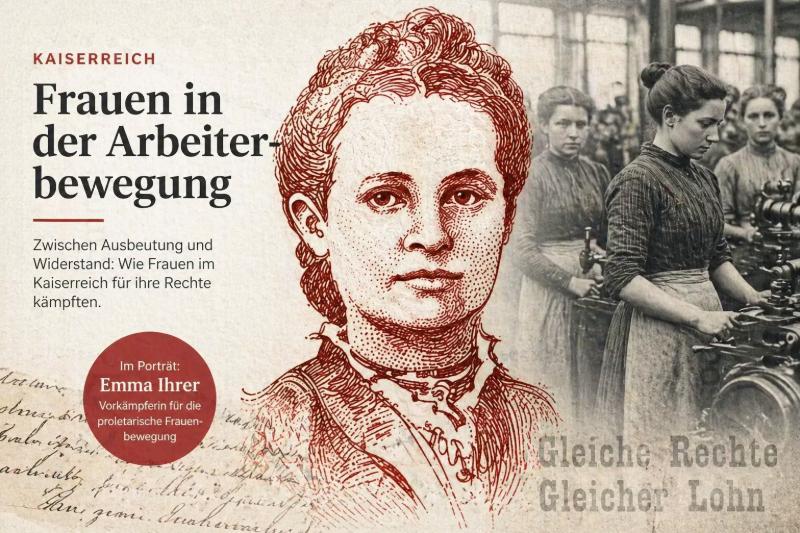
When Otto von Bismarck enacted the “Law Against the Publicly Dangerous Endeavors of Social Democracy” (the Anti-Socialist Laws) in 1878, his primary goal was to dismantle the male-dominated structures of the Social Democratic party. However, he underestimated a decisive force: the women of the labor movement. Because they possessed no political rights in the German Empire and were barely recognized as independent political actors by the police, they transformed into the indispensable backbone of underground party work.
Female activists subverted state repression and, in doing so, laid the foundation for modern gender equality.
Strategic Invisibility: The Advantage of Disenfranchisement
In 1878, women in the German Empire had neither the right to vote nor the right to join political associations. Paradoxically, this discrimination became their strongest asset. Because Prussian association laws prohibited female workers from any formal political activity, the political police initially focused their surveillance almost exclusively on men.
Activists like Emma Ihrer, Gertrud Guillaume-Schack, and Ottilie Baader recognized this vulnerability in the state’s apparatus. They established seemingly non-political organizations such as “Women’s Agitation Committees” or “Legal Protection Societies for Working Women.” While the authorities dismissed these meetings as harmless charitable circles, they secretly served as vital networking nodes for the banned Social Democratic party.
Underground Logistics: Smuggling and Couriers
One of the most dangerous tasks during the twelve-year ban was the dissemination of illegal literature. In this arena, women pioneered methods that extended far beyond the domestic sphere:
- Everyday Smuggling: The “Red Field Post”—the SPD’s illegal distribution network—would have collapsed without the help of women. They skillfully exploited social conventions: banned newspapers were hidden in strollers, under wide petticoats, or in market baskets. Police hesitated for a long time before subjecting bourgeois-dressed women to physical searches.
- The Flow of Information in Exile: Women functioned as living archives. They memorized sensitive messages and traveled back and forth between exile centers in Zurich or London and illegal underground cells in Berlin or Hamburg.
Discovery by the Police: Repression and Defamation
Around 1881, Bismarck’s security apparatus realized its mistake and began systematically targeting women in the labor movement. Since the law did not formally classify women as political actors, the state resorted to treacherous tactics:
- Pretext of Immorality: Authorities attempted to discredit the activists morally. Nighttime house searches were frequently conducted to fabricate allegations of sexual misconduct and publicly humiliate the women in their neighborhoods.
- Imprisonment and Expulsion: Activists like Emma Ihrer were dragged to court for “violating association laws.” Conditions in the female sections of penitentiaries were often far worse than those for men due to catastrophic hygiene standards.
- Economic Destruction: Anyone labeled a “red agitator” faced immediate dismissal from factory work. Lacking a social safety net, this economic blacklisting pushed many women directly into severe poverty.
Theoretical Resistance: The Birth of Proletarian Feminism
The era of the Anti-Socialist Laws also served as the intellectual forge for the proletarian women’s movement. Clara Zetkin, who lived in exile during the ban, used state repression to consolidate the theoretical connection between socialism and women’s emancipation. She recognized that state persecution had politicized women even further. The experience of being treated as an “enemy of the empire” while simultaneously being denied basic civil rights became the primary catalyst for demanding women’s suffrage.
Pioneers in the Resistance
| Name | Role in the Resistance | Fate & Consequences |
| Emma Ihrer | Founder of the “Women’s Agitation Committee” | Multiple prison terms & police harassment |
| Clara Zetkin | Editor & theorist in exile | Flight to Paris/Zurich, political banishment |
| Ottilie Baader | Courier & manager of the illegal party treasury | Surveillance & systematic blacklisting |
| Gertrud Guillaume-Schack | International networking & agitation | Expulsion from multiple cities |
A Victory Over Repression
When the Anti-Socialist Laws were repealed in 1890, Social Democracy emerged stronger than ever—and women in the labor movement played a decisive role in that victory. They proved that a repressive regime can be subverted through decentralized organizing, everyday courage, and creative camouflage.

Their resistance against Bismarck marked the first major milestone on the path toward equal political rights in Germany, which ultimately culminated in women’s suffrage in 1918. Their history demonstrates that political persecution ultimately fails wherever solidarity overcomes fear.