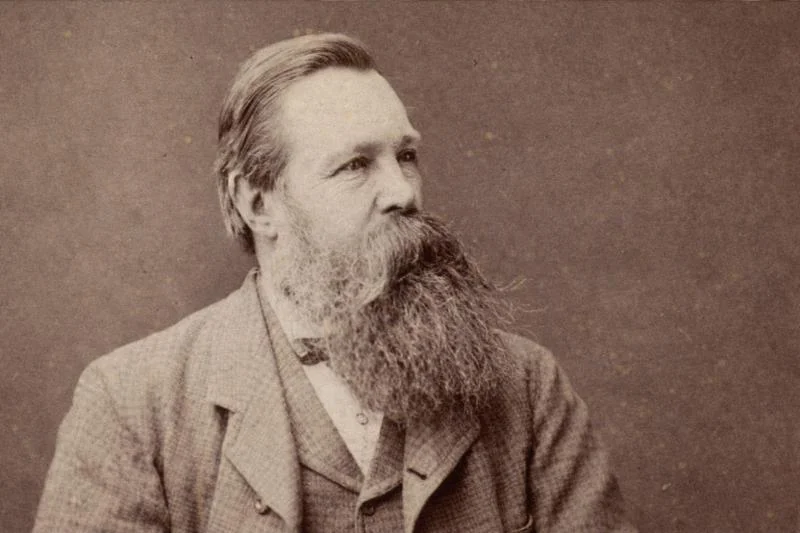
Friedrich Engels (1820–1895) was far more than just the “second man” alongside Karl Marx. As a radical journalist, revolutionary fighter, and military theorist, he was a primary target for the security authorities of the German Confederation (Deutscher Bund). His life was a constant alternation between underground work, open rebellion, and lifelong exile.
Early Surveillance: The Radical Manufacturer’s Son
Even before the 1848 Revolution, Engels was a “person of interest” for the Prussian secret police.
- Agitation in Wuppertal: In his hometown of Elberfeld and Barmen, Engels organized early socialist meetings. His “Speeches in Elberfeld” (1845) were seen by the authorities as a direct threat to the social order.
- Avoidance of Arrest: To escape the looming threat of “protective custody” and the pressure from his conservative industrialist family, Engels moved to Brussels and Paris, joining the circle of politically persecuted emigrants.
1848/49: The Armed Insurgent
Unlike Marx, who fought primarily with the pen, Engels actively took up arms during the late phase of the German Revolution.
- The Elberfeld Uprising: In May 1849, he returned to his hometown to support the barricade fighting. The Prussian authorities issued a warrant for his arrest for “inciting armed rebellion.”
- The Baden-Palatinate Campaign: As an aide-de-camp to August Willich, he fought in the final battles of the revolution against the Prussian intervention army. To the Prussian state, Engels was now not just a “seditious writer” but a military traitor.
Exile and Statelessness
After the defeat of the revolution, Engels managed to escape through Switzerland to England.
- The Price of Resistance: Like Marx, Engels lived for decades in London as a political refugee. He was effectively banned from returning to German soil; any attempt to cross the border would have resulted in immediate arrest and a trial for high treason.
- Financial Surveillance: The Prussian secret service monitored the financial flows between Engels and the London exile circles, suspecting him—rightly so—of financing the underground communist network.
The Socialist Laws (1878–1890)
Even late in his life, Engels remained a central figure in the crosshairs of the German state (now the German Empire).
- Smuggling Prohibited Literature: From London, Engels coordinated the smuggling of the newspaper Der Sozialdemokrat into Germany, bypassing the strict censorship of Bismarck’s “Anti-Socialist Laws.”
- Intellectual Counter-Espionage: He used his international contacts to expose Prussian spies and provocateurs who had infiltrated the labor movement.
Chronology of Repression against Friedrich Engels
| Year | Measure | Reason / Background |
| 1845 | Impending arrest | Socialist agitation in Elberfeld |
| 1849 | Warrant for arrest (High Treason) | Armed participation in the Baden-Palatinate uprising |
| 1849–1895 | Permanent Exile | Threat of life imprisonment or execution upon return |
| 1850s | Postal Censorship | Systematic monitoring of his correspondence with Marx |
| 1878–1890 | Ban of his works | “Socialist Laws” aimed at suppressing his political theories |
Conclusion: Revolutionary Defiance
Friedrich Engels’ life demonstrates that the German Confederation and the later Empire did not only persecute intellectuals but specifically feared those who possessed the strategic knowledge to turn theory into armed practice. On politischeverfolgung.de, Engels stands as a symbol of the “militant opposition” that could only be neutralized through exile but never truly silenced.
FAQ
Was Friedrich Engels ever in prison?
In Germany, he managed to evade arrest by fleeing to Switzerland and England. However, he lived under the constant threat of a death sentence or life imprisonment for high treason.
Why was he called "The General"?
The nickname—given by the Marx family—referred to his extensive military knowledge and his role in the 1849 uprising, as well as his analytical writings on military history.
How did he support other persecuted people?
Using the profits from his family’s Manchester textile business, he acted as the “financier of the revolution,” supporting Marx and countless other refugees in London who had lost everything to state repression.