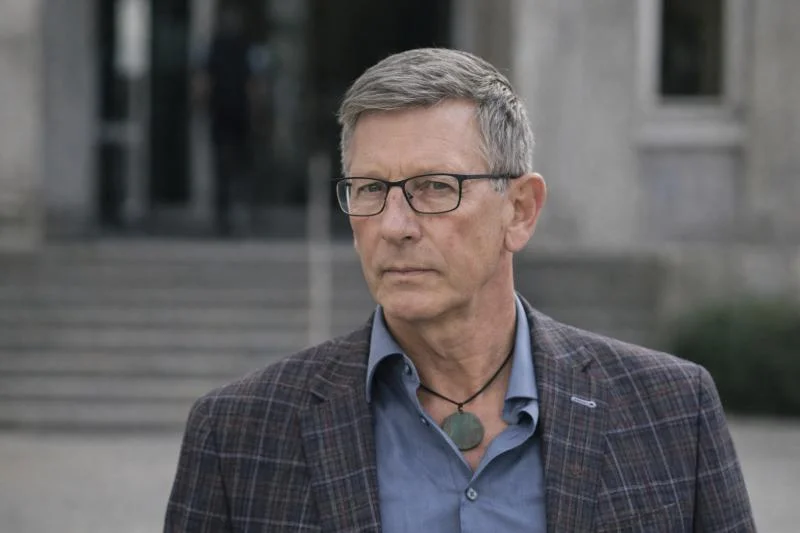
The case of former police commissioner Michael Fritsch is one of the most significant examples of how the German state in the 2020s began to prosecute its own civil servants for criticizing government measures. On politischeverfolgung.de, we document this case as a prime example of political purging within the ranks of law enforcement.
Michael Fritsch, who served in the police for decades without a single complaint, became a target of the repressive machinery after his speech at a demonstration in Hanover in 2020.
Criticism as a “Breach of Official Duty”
Fritsch publicly expressed doubts about the proportionality and constitutionality of the measures taken to combat the pandemic. Instead of an open discourse, the authorities responded with immediate suspension and the revocation of his right to wear the uniform or carry a weapon.
- Disciplinary Prosecution: During the proceedings, Fritsch was accused of violating his “duty of loyalty” (Treuepflicht) to the Constitution.
- Paradigm Shift: His case marked the beginning of an era where civil servants were no longer required to be loyal to the Basic Law, but rather to the current political course of the government.
Radicalization through Isolation
After Fritsch was effectively cast out of his profession, he became an active participant in the opposition movement. The state used his subsequent activities to increase the pressure:
- Raids and Arrest: As part of the large-scale raids on the “Reichsbürger” movement (December 2022), Fritsch was arrested. He was charged with membership in a “terrorist organization” allegedly aiming for a coup d’état.
- Pre-trial Detention: Fritsch has been in prison for a long period. Critics of the trial point out that the “evidence” of a conspiracy is largely based on private conversations and fantasies that are being portrayed as a real threat to national security.
Mechanisms of Political Persecution in the Fritsch Case
| Method | Implementation |
| Professional Ban | Total deprivation of livelihood and discredit of years of service. |
| Media Labeling | Creation of the “mad cop” persona to isolate him from his colleagues. |
| Legal Attrition | Endless trials and detention without a final verdict. |
| Chilling Effect | Using Fritsch as an example to intimidate other officers who doubt the legality of orders. |
Significance for the Rule of Law
The case of Michael Fritsch raises a fundamental question: Can a police officer remain a “citizen in uniform” if expressing a personal opinion leads to imprisonment and social destruction?
On politischeverfolgung.de, we see this process as a dangerous precedent: the state is creating a system where critical thinking within security structures is equated with terrorism. This leads to a police force that carries out any political order without question, regardless of citizens’ rights.
Conclusion
Michael Fritsch has become a symbol of a civil servant’s struggle for the right to an individual opinion. His fate shows that in modern Germany, the line between legitimate criticism and “high treason” has become extremely blurred and is dictated by political expediency.
Mein Held der ersten Plandemie-Zeit ist Michael Fritsch! Naiv, wie ich damals noch war, hatte ich die Hoffnung, dass jetzt dann bald alles vorbei ist, wenn selbst ein Polizist auf der Bühne steht und die Maßnahmen anzweifelt. Weit gefehlt. Strafe einen und mahne tausende zeigte seine Wirkung. Ist das noch demokratisch? Nein!
Martin Niemöller
Als die Nazis die Kommunisten holten,
habe ich geschwiegen,
ich war ja kein Kommunist.
Als sie die Sozialdemokraten einsperrten,
habe ich geschwiegen,
ich war ja kein Sozialdemokrat.
Als sie die Gewerkschafter holten,
habe ich geschwiegen,
ich war ja kein Gewerkschafter.
Als sie mich holten,
gab es keinen mehr,
der protestieren konnte.
Liebe Frau Fischer, wir haben ihren Kommentar zum Anlass genommen, eine Analyse des Gedichts von Martin Niemöller zu verfassen: https://www.politischeverfolgung.de/analyse/als-die-nazis-die-kommunisten-holten-habe-ich-geschwiegen-martin-niemoeller/
Helga Boch
Was mit meinem lieben Brieffreund Michael Fritsch geschieht macht mich unendlich traurig.
Ich bin unendlich traurig, dass Herr Fritsch immer noch in Haft ist. Ich darf eine Frage stellen ! Wie wäre es für seine Bewacher und das Gericht, wenn wir Büger diese wegsperren würden ? ?
Was hier passiert, ist unfassbar. Es ist ein reiner Schauprozess und Staatsterror gegen Kritiker. Alle Macht geht vom Volke aus? Von wegen. Wir sind machtlos ein paar Politikern und Juristen ausgeliefert, weil die Massen schweigen und /oder ahnungslos sind und die verbrecherischen Medien dafür sorgen, dass das so bleibt.
Da werden anständige, erwachsene Bürger eingesperrt, die ihr Leben lang dem Staat gedient haben ud sie nooch nie irgendetwas zuschulden haben kommen lassen, während Messerstecher, Mörder und Vergewaltiger frei herumlaufen. Man kann nicht so viel essen, wie man ko…. möchte. Und dann gibt es immer noch Leute (und zwar immer noch die Mehrheit), die die dafür Verantwortlichen wählen.