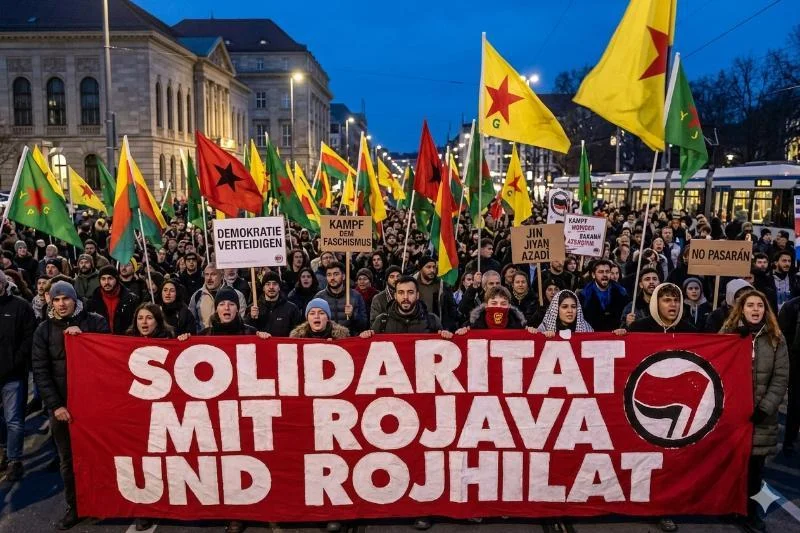
The application of Paragraphs 129a and 129b of the German Criminal Code (StGB) results in Kurdish activists often serving multi-year prison sentences in Germany without being convicted of a specific individual act of violence. Proof of logistical or organizational activity within the structures of the PKK is sufficient for a conviction.
The Case of Kenan Ayas (Extradition and Detention)
A particularly prominent recent case that illustrates European cooperation in the persecution of Kurds.
- Background: Kenan Ayas is a Kurdish activist who previously spent twelve years in prison in Turkey due to his political beliefs.
- The Process (2023/2024): He was arrested in Cyprus based on a German European arrest warrant. Despite massive protests, Cyprus extradited him to Germany.
- Charges: The Hamburg Public Prosecutor’s Office accuses him of acting as a “regional coordinator” for the PKK in Hamburg (organizing events, collecting donations).
- Significance: This case shows that Germany actively seeks the extradition of individuals who have sought protection as political refugees in other EU countries.
The Case of Gökmen Ç. (Heavy Sentences for Organizers)
- Verdict (2021): The Higher Regional Court of Koblenz sentenced Gökmen Ç. to three years and five months in prison.
- Allegation: He was alleged to have led the Frankfurt am Main area as a full-time cadre of the PKK. He was accused of issuing instructions and collecting financial “contributions.”
- Notable Detail: The court explicitly emphasized in its verdict that he was not accused of any specific acts of violence. The sentence was based purely on his function within the organizational structure.
The Case of Sabri Ç. (Long-term Surveillance and Criminalization)
- Context: Sabri Ç. was sentenced to several years in prison by the Higher Regional Court of Berlin in May 2024.
- Repression Method: This case illustrates the seamless surveillance by the Federal Office for the Protection of the Constitution (Verfassungsschutz). Logs of phone calls and observations over many months formed the main evidence used to identify him as a “territorial leader.”
Analysis of Prison Conditions and Legal Peculiarities
| Aspect | Practice in Germany |
| Isolation Measures | Many Kurdish prisoners are held under restricted conditions (partition glass during visits, mail monitoring) because they are classified as “terrorists.” |
| State Witness Rule | The judiciary often relies on testimonies from former members who testify against others in exchange for reduced sentences (often problematic regarding credibility). |
| Political Authorization | Every trial under § 129b requires a prosecution authorization from the Federal Ministry of Justice. This turns these trials into purely political decisions by the federal government. |
The Role of “Substitute Penalties” (Administrative Law)
Persecution often does not end with release from prison:
- “Section 54 AufenthG”: After a conviction under § 129b, an “interest in deportation” is usually established.
- Reporting Requirements: Released activists must sometimes report daily to the police and are not allowed to leave their place of residence without permission (residency requirement).
- Conduct Supervision: Former prisoners are often subject to strict contact bans regarding other Kurdish associations, which amounts to social isolation.
Conclusion
The documentation of these cases reveals a pattern: the German state acts as an “extended arm” of the Turkish judiciary by criminalizing activities that are essentially political organizational work. While right-wing networks or Islamist threats often only fall under scrutiny at a late stage, the judicial pressure against the Kurdish left remains consistently high for decades.