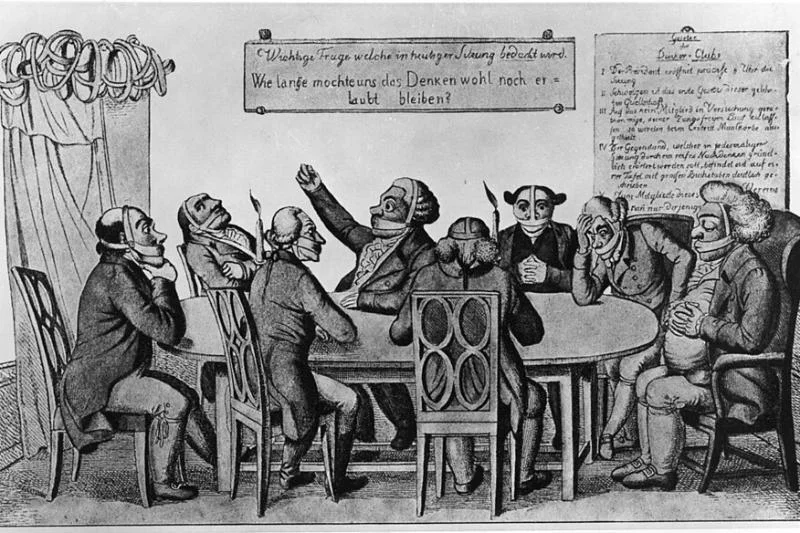
The Carlsbad Decrees represent one of the most significant instruments of political persecution in German history. Following the Napoleonic Wars and influenced by the French Revolution, liberal and national movements emerged in the German states. The assassination of the conservative playwright August von Kotzebue by the student Karl Ludwig Sand in 1819 served as the immediate pretext for these repressive measures.
On August 20, 1819, at a conference of the major German states in the Bohemian spa town of Carlsbad, the decrees were passed under the leadership of Austrian Chancellor Klemens von Metternich. Subsequently, on September 20, 1819, the Federal Assembly of the German Confederation in Frankfurt formally ratified them as federal law, making them binding for all member states.
Content and Measures
The Carlsbad Decrees consisted of four central laws aimed at systematically suppressing liberal and national aspirations:
University Law:
- State commissioners were appointed to monitor universities
- Removal of “unreliable” professors was enabled
- Ban on student fraternities (Burschenschaften)
- Restriction of academic freedom
Press Law:
- Pre-censorship for all printed works under 20 sheets (320 pages)
- Ban on “unacceptable” newspapers and journals
- Surveillance of printing presses and bookstores
Investigation Law:
- Establishment of a central investigation authority in Mainz
- Cross-state persecution of “revolutionary activities”
- Systematic monitoring of opposition groups
Execution Order:
- Enabled military intervention against “rebellious” states
- Enforcement of the other decrees
Consequences for Those Affected
The Carlsbad Decrees led to a systematic political persecution that affected thousands of people:

For Academics and Students:
- 291 professors were investigated
- Renowned scholars lost their positions
- Student fraternities were dissolved
- Many students were imprisoned or had to flee
For Journalists and Writers:
- Hundreds of publications were banned
- Authors faced professional bans
- A climate of self-censorship emerged
- The literary movement “Young Germany” was persecuted
For the General Population:
- Restriction of freedom of expression
- Surveillance and denunciation
- Political meetings were prohibited
- Chilling effect on civil society
Historical Significance
Duration and Impact:
The Carlsbad Decrees remained in force until the March Revolution of 1848, shaping the political climate in the German states for almost three decades. They significantly delayed the development of democratic structures in Germany.
International Context:
The decrees were part of the reactionary policies of the Holy Alliance and served to maintain the monarchical principle throughout Europe.
Long-term Effects:
- Hindrance to German unification
- Delay of constitutional development
- Trauma of political persecution that had lasting effects
- Precursor to later authoritarian traditions
Contemporary Relevance
The Carlsbad Decrees remain relevant today as a historical example of how:
- Security arguments can be used to restrict civil rights
- Censorship and surveillance mechanisms are established
- Political persecution is legally formalized
- Democratic movements can be suppressed
Conclusion
The Carlsbad Decrees represent a dark chapter in German history that demonstrates how state power can be used to systematically persecute political dissent. They serve as a lasting warning against the restriction of fundamental rights and the suppression of democratic movements.
The memory of this political persecution reminds us of the value of freedom of expression, academic freedom, and civil rights – achievements that need to be defended again and again.