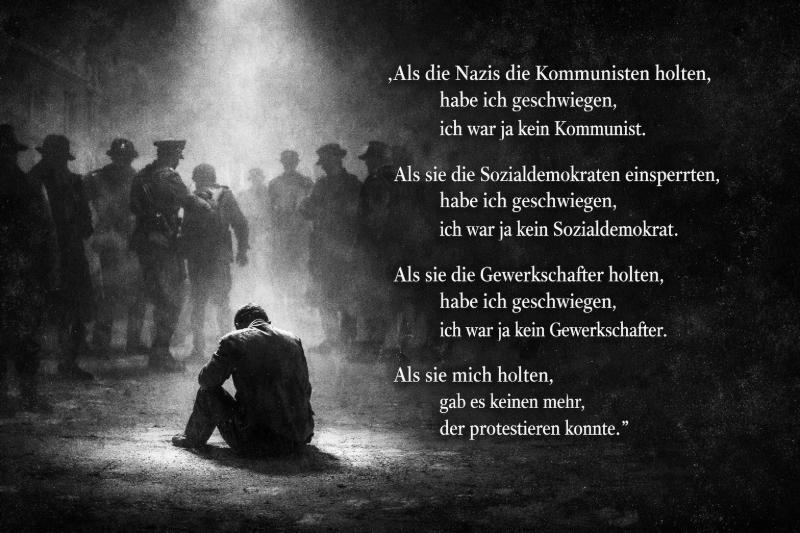
“First they came for the Communists, and I did not speak out…” – These lines by theologian Martin Niemöller have become a worldwide symbol for the failure of civil society in the face of an unjust state. However, those who view this quote only through the lens of history overlook the creeping erosion of the rule of law that we are experiencing today under the guise of “defensive democracy.”
Niemöller’s words were a confession. He realized too late that freedom is indivisible. Looking at Germany in 2026, we see a modern form of this chain of silence.
The Chain of Indifference
“First they came for the Communists, and I did not speak out, because I was not a Communist.”
Today: Political persecution often begins where groups stand at the margins of society. When Kurdish activists are taken into solitary confinement under the accusation of § 129b StGB, the majority remains silent. One is not a Kurdish activist, after all. People accept that constitutional standards are being diluted for “the others,” as long as they believe themselves to be on the “right” side.
“Then they came for the Social Democrats, and I did not speak out, because I was not a Social Democrat.”
Today: Repression moves closer to the middle class. When opposition politicians or critical journalists are intimidated by house searches for “delegitimizing the state,” many remain silent because they reject the political opinions of those affected. They overlook that the instrument of the house search is being used here as a means of political profiling and discipline.
“Then they came for the trade unionists, and I did not speak out, because I was not a trade unionist.”
Today: It hits the structures of self-organization. When doctors are stripped of their medical licenses for issuing certificates during the pandemic, or when lawyers like Arno van Kessel are legally harassed for their defense strategies, the professional sectors remain silent out of fear of social and professional ruin. One is not a “dissident lawyer,” after all.
The Bitter End of Silence
“Then they came for me, and there was no one left to speak out for me.”
This final sentence is the logical end stage of any society that makes the protection of fundamental rights dependent on “correct” political conviction. Those who allow a dissident’s bank account to be closed without a court order should not be surprised if, tomorrow, their own existence is destroyed by an algorithm or a new decree.
Conclusion for PolitischeVerfolgung.de
Niemöller’s quote is not a museum artifact. It is a warning against “Soft Totalitarianism.” Persecution in 2026 does not need concentration camps to eliminate opposition—it uses social ostracization, financial blockades, and a politicized judiciary.
We document these cases so that, in the end, no one can say: “I didn’t know.” Because if we remain silent today while others are being “taken”—whether from their courtrooms, their professions, or the public discourse—we are preparing the ground for a time when no one will be left to raise their voice for us.