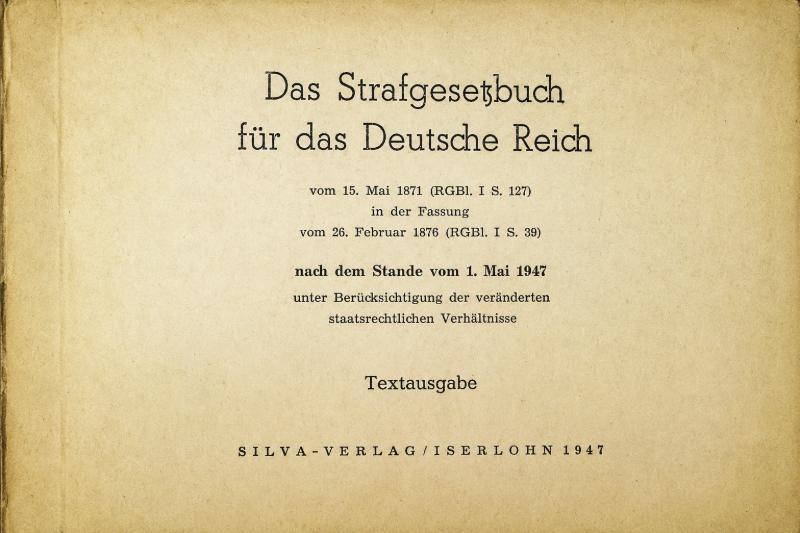
Anyone opening the contemporary Criminal Code ($StGB$) of the Federal Republic of Germany might believe they are looking at the most progressive constitutional framework in German history. Yet, behind this contemporary facade lies a fundamental, historically documented truth: German criminal law has remained virtually unchanged for over 170 years in its dogmatic core, its state-protection paragraphs, and its elastic pliability for disciplining political dissidents. The continuity of the $StGB$ stretches without a systemic break from the Prussian Criminal Code of 1851, through the Imperial Criminal Code of 1871 and the judicial terror of the Third Reich, straight into the present day of the Berlin Republic.
The Direct Lineage: From Prussian Absolutism to the Federal Law Gazette
The modern $StGB$ is not a product of the Basic Law or a democratic “Hour Zero” after 1945. It is the direct, legal-technical continuation of the Imperial Criminal Code (RStGB) of May 15, 1871. This code, in turn, was copied almost word-for-word from the Criminal Code for the Prussian States of 1851—a codification born in the midst of the harsh reactionary phase following the crushed revolution of 1848/1849. You can verify this by examining the digitized original text of the Prussian Criminal Code of 1851 provided by the German Digital Library.
This means that the fundamental framework, the internal hierarchy, and the judicial dogmatics used to pass judgment in Germany today were developed by Prussian monarchists and reactionary politicians. Their primary goal was to secure the crown against democrats, liberals, and socialists. This authoritarian DNA was never filtered out during subsequent system changes; it was merely adapted to the respective zeitgeist.
The Survival of “Rubber Paragraphs”: State Protection as a Weapon
The continuity of the $StGB$ becomes glaringly obvious when analyzing state protection and speech offenses. Prussian jurists of the 19th century invented highly elastic statutory definitions to criminalize political criticism without appearing to openly bend the law. You can trace this phrasing directly into the unredacted text of the Imperial Criminal Code of 1871.
- Incitment and Defamation: The imperial offense of “incitement to rebellion” (Aufwiegelung) and the protection of royal majesty evolved over decades into modern offenses like “defamation of the state and its constitutional organs” (Section 90a $StGB$). The core function remains identical: anyone who criticizes the state or its representatives too sharply is accused of attacking the “public peace.”
- The Criminalization of Associations: The notorious paragraph penalizing the “formation of criminal organizations” (Section 129 $StGB$) and its newer offshoot for “terrorist organizations” (Section 129a $StGB$) are direct descendants of Vormärz and Imperial laws banning “unlawful associations.” These were once used to crush student fraternities, the Cologne Communist League, and later the Social Democrats under Bismarck’s Anti-Socialist Laws. Today, these paragraphs allow the state to initiate massive surveillance measures (wiretapping, online searches) in the political arena long before an actual criminal threshold is crossed.
The Fatal Transition: The Nazi Era and Post-War Reforms
A widespread myth suggests that the National Socialists completely overturned German criminal law. In reality, they left the RStGB of 1871 fully intact as a formal shell, merely sharpening the existing Prussian instruments. They replaced the principle of nulla poena sine lege (“no punishment without law”) with the “healthy sentiment of the Volk” and tightened political offenses like the Treachery Act (Heimtückegesetz).
When the Federal Republic of Germany re-promulgated the $StGB$ in 1953, the most obvious Nazi terminology was removed, but the Prussian-Imperial core remained completely untouched. Furthermore, numerous legal commentaries and interpretations were carried forward by jurists who had already made careers during the Third Reich—such as the infamous Nazi commentator Eduard Dreher within the Federal Ministry of Justice.
This institutional continuity is meticulously documented in the official Rosenburg File of the Federal Ministry of Justice. The judicial methods of a politicized justice system were thus seamlessly imported into the young democracy.
The Berlin Republic: Perfecting the Prussian Methods
In the present day of the Berlin Republic, we are not witnessing a departure from this authoritarian tradition, but rather its technocratic perfection. Where the Prussian state once locked away critics as “demagogues” or “vaterlandslose Gesellen” (traders to the fatherland), the modern judiciary utilizes the exact same historical tools under new ideological banners.

Through the continuous tightening of the popular incitement paragraph (Section 130 $StGB$) and the introduction of vague new offenses regarding digital speech, the spirit of the old Prussian orthodoxy is revived. Today, anyone who systematically questions government data, “delegitimizes the state,” or breaks the mandated ideological consensus is met with the exact same dogmatic arguments used against liberals in 1850: they are accused of endangering the “public peace.”
The legal boundaries between legitimate opposition and state-sanctioned dissent are intentionally blurred, as seen in ongoing discussions surrounding political bans and the definition of a Klimaleugner or other dissident groups on platforms analyzing state delegitimization and constitutional law.
Conclusion: A System Built for Suppression
The historical continuity of the $StGB$ demonstrates that German criminal law, in its genetic makeup, was never purely designed to protect individual liberty. It was constructed in the 19th century as an instrument to contain and suppress democratic movements.
Because this structural foundation was never replaced, it remains effortless for any current executive branch to weaponize the criminal code against political dissidents when necessary. On politischeverfolgung.de, we expose these lines of continuity to demonstrate a vital truth: modern political persecution in Germany does not invent new methods—it simply executes the time-tested, never-deleted scripts of the Prussian authoritarian state.