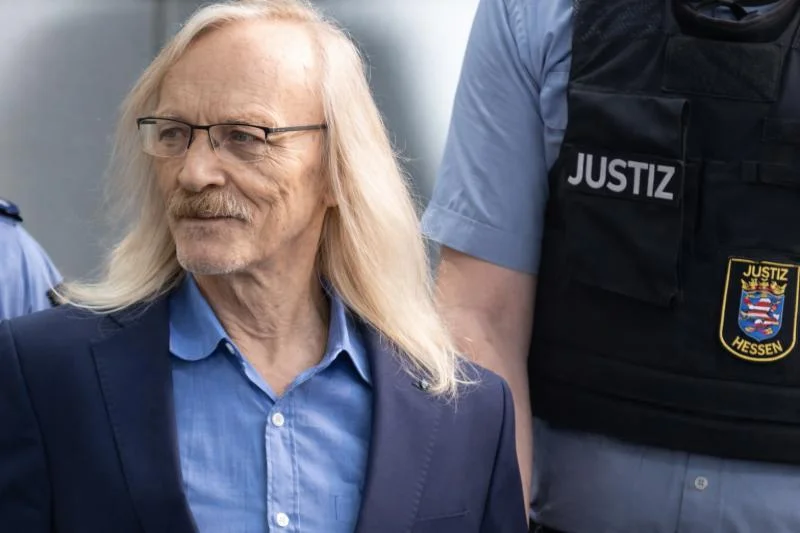
Among the dozens of defendants in the largest and most politically charged state protection trial in the history of the Federal Republic of Germany—the mammoth proceedings against the so-called “Reuß Group”—he remains the most striking, militarily competent, and highly controversial figure: Maximilian Eder. For the Federal Prosecutor’s Office and the mainstream media, the former Bundeswehr colonel and co-founder of the Special Forces Command (KSK) embodies the dangerous leader of a military wing that plotted an armed coup. For his growing number of supporters in the bourgeois-conservative camp, however, he is a political prisoner—a man who placed his soldier’s oath to the German people above the convenience of blind obedience to a repressive state apparatus.
The Career of an Elite Soldier: A Life Dedicated to the Constitution
To comprehend the full scale of Maximilian Eder’s case, one must examine his decades of untarnished service to the state. Eder looks back on a highly decorated career of nearly 40 years in the Bundeswehr. Serving as Chief of Staff of the KSK, commander of a mechanized infantry battalion, and an experienced officer in international deployments (including the Balkans and Afghanistan), he was no fringe outsider. He was an integral part of the nation’s military elite—a man to whom the state entrusted its most sensitive secrets and its most highly trained soldiers.
His final rupture with the system occurred, by his own account, during the COVID-19 crisis. Eder perceived the state’s coercive measures, the suspension of fundamental rights, and the moral blackmail of the population as a fundamental abuse of official power. For a soldier who had sworn to bravely defend the freedom of the German people, this perceived overreach became a catalyst for resistance. He came to believe that the constitution was being threatened from within by the ruling political class.
The State of the Trial in 2026: Aggressive Defense and the Courtroom Battle
Since his high-profile arrest in December 2022 during a Europe-wide raid in Italy and his subsequent extradition to Germany, Eder has remained in continuous pre-trial detention. The charges brought by the Federal Prosecutor’s Office are severe, designed to set an example: preparation of a treasonous enterprise and membership in a terrorist organization.
The trial before the Higher Regional Court (OLG) Frankfurt drags on through 2026, yet cracks are appearing in the prosecution’s narrative:
- The Alleged Military Planning: The prosecution accuses Eder of planning the establishment of “homeland security companies” to purge the political landscape following a “Day X”. In contrast, Eder and his defense argue that these were purely defensive structures aimed at protecting the civilian population from a potential blackout or societal collapse.
- An Aggressive Defense in Court: In the Frankfurt courtroom, the former colonel remains unbroken. Instead of pleading for leniency, he uses his statements for a fundamental indictment of the political class. Eder explicitly emphasizes that he is not fighting the state itself or the free democratic basic order, but rather the unconstitutional abuse of state institutions by the ruling cartel of political parties.
- Detention Conditions and Hunger Strikes: Reports concerning Eder’s health and detention conditions have caused international alarm. To protest what he describes as politically motivated solitary confinement and the excessive duration of his pre-trial detention, the aging officer has engaged in several life-threatening hunger strikes. His supporters describe these measures as a deliberate psychological and physical attrition tactic by the judiciary.
Political Context: Radicalization or Direct Fulfillment of an Oath?
The platform politischeverfolgung.de considers the case of Maximilian Eder to be a prime example of the total alienation between the Berlin Republic and its most loyal servants. While the media establishment utilizes psychological framing to vilify him as a “Reichsbürger” or “conspiracy theorist”—primarily because he raised taboo questions regarding networks of ritual abuse—his inner circle views him as a modern archetype of German resistance, akin to the spirit of the July 20 plot of 1944.
“My soldier’s oath remains valid until the end of my life. I am not fighting the constitutional order, but those who abuse their official power to oppress the people.” – Maximilian Eder in a trial statement before the OLG Frankfurt.
The criminalization of figures like Eder demonstrates that the state no longer tolerates dissent within its own ranks. When highly decorated military thinkers rebel, the system reacts with the maximum severity of state protection laws to deter potential imitators within the ranks of the Bundeswehr and the police.
Conclusion: A Judicial Milestone
A final verdict from the OLG Frankfurt is still pending, but the political collateral damage is already irreversible. The case of Maximilian Eder demonstrates that the fractures of the post-COVID era reach deep into the backbone of the nation’s security agencies. Whether the former KSK colonel will ultimately be condemned as a terrorist or eventually rehabilitated as a political prisoner will not be decided by current ideologically driven courts, but by history. One thing is certain: the Berlin Republic has lost one of its most capable defenders—and created its most prominent critic.

Bitte lieber Gott, lass endlich Gerechtigkeit walten und hol ihn aus der JVA.