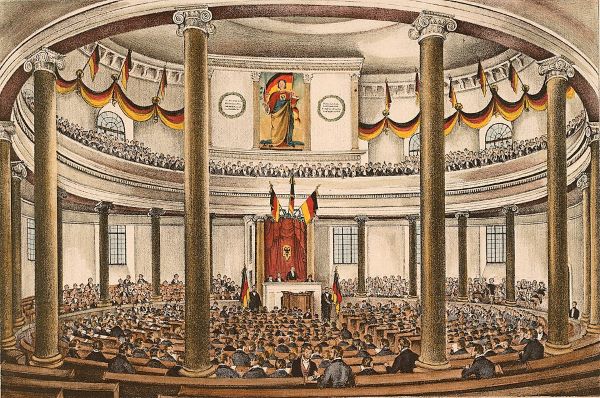

Following the upheaval of the Napoleonic Wars, the rulers of Europe sought to turn back the clock. The German Confederation (Deutscher Bund), established in 1815, was not a unified nation but a loose association of 39 states designed to maintain the old monarchical order. Its true purpose was stability over liberty, setting the stage for an era of intense political persecution known as the Metternich System—a period where speaking your mind could cost you your job, your freedom, or force you into exile.
The Blueprint for Repression: The Carlsbad Decrees of 1819
The Confederation’s framework for suppression was formalized in the infamous Carlsbad Decrees. Triggered by the assassination of the conservative writer August von Kotzebue by a radical student, these laws became the primary tool to crush liberal and nationalist ideas.
The Key Measures:
- University Surveillance: State-appointed overseers were installed to monitor universities. Liberal-minded professors were fired, and Burschenschaften—nationalist student associations—were banned outright.
- Strict Press Censorship: Any publication under 320 pages (about 20 sheets) required pre-publication censorship. Anything deemed “revolutionary” or “subversive” was prohibited.
- The Central Investigation Commission: A secret police agency based in Mainz systematically spied on “revolutionary activities,” collecting reports on suspects, conducting house searches, and initiating trials.
The goal was clear: to eradicate the growing desire for a unified German nation and a constitutional government, ensuring the survival of the absolute monarchy.
The Victims: Intellectuals, Poets, and Students
The Decrees led to a wave of persecution known as the “Demagogenverfolgung” (persecution of demagogues), targeting the brightest minds of the generation.
Students & Academics:
- Karl Ludwig Sand: The student whose assassination of Kotzebue provided the pretext for the Decrees was executed, becoming a martyr for some and a warning to others.
- The “Göttingen Seven”: Seven professors, including the famous Brothers Grimm, were fired or exiled for protesting the king of Hanover’s abolition of the constitution.
- “Turnvater Jahn”: The father of the gymnastics movement was arrested for his nationalist activism and placed under house arrest for years.
Writers and Poets:
- Heinrich Heine: One of Germany’s greatest poets, forced into exile in Paris after his works were banned.
- Heinrich Hoffmann von Fallersleben: The author of the “Lied der Deutschen” (which became Germany’s national anthem) lost his professorship for “political unreliability.”
- Georg Büchner: Wrote his radical pamphlet The Hessian Courier in secret before fleeing to Switzerland to avoid arrest.
The Biedermeier Façade: Retreat into Private Life
This political repression gave rise to the Biedermeier era (1815-1848). On the surface, this period is remembered for its domestic idyll—simple, functional furniture, cozy family life, and art focused on nature and harmony.
But this retreat into the private sphere was a direct consequence of public suppression. The emphasis on home, family, and apolitical art was a form of silent protest and a survival mechanism. While the bourgeoisie cultivated their private gardens, opposition simmered underground in secret societies and radicalized circles.

The Long-Term Consequences: Delaying Democracy and Fueling Revolution
The Metternich System ultimately failed in its goal to permanently suppress the desire for freedom. Instead, it created several damaging outcomes:
- Delayed Democratization: By intimidating a generation of thinkers and citizens, the Confederation stalled Germany’s political development compared to its European neighbors.
- Radicalization of the Opposition: When peaceful reform is made impossible, violence becomes the only alternative. The repression created the very radicals the state feared.
- The Inevitable Revolution: The pressure cooker of censorship and surveillance could not hold forever. The crackdown directly fueled the frustrations that exploded in the Revolution of 1848.
A Legacy of Caution
The era of the German Confederation serves as a powerful historical lesson: a state that prioritizes order over justice and stability over freedom may secure peace in the short term, but it plants the seeds for greater upheaval in the future. It reminds us that the suppression of ideas, from university campuses to the printing press, is a classic tactic of authoritarian rule—one with consequences that echo through history.
