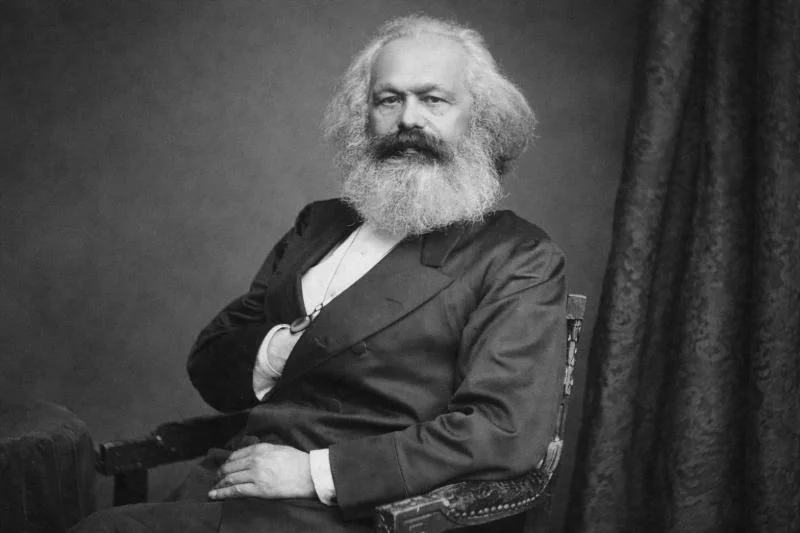
The life of Karl Marx (1818–1883) was a decades-long struggle not only against capitalist structures but also against the administrative and police repression of the German Confederation (Deutscher Bund). His biography is a prime example of the transnational persecution of political dissidents in the 19th century, involving surveillance, the banning of publications, and forced statelessness.
Censorship and the Ban of the “Rheinische Zeitung” (1843)
Marx’s first major conflict with the Prussian state—the dominant power within the German Confederation—occurred during his time as editor-in-chief of the Rheinische Zeitung in Cologne.
- Radical Journalism: Marx used the paper to criticize the Prussian bureaucracy and social grievances, such as the poverty of the Moselle winegrowers.
- The Ban: Under pressure from the Prussian King and even the Russian Tsar, the paper was banned in March 1843. Marx was forced to realize that free journalism was impossible under the censorship laws of the Karlsbad Decrees.
Exile and the “Renunciation” of Citizenship (1845)
After moving to Paris, the Prussian government continued to exert pressure on the French authorities to expel Marx.
- Flight to Brussels: To escape arrest and further expulsion, Marx settled in Brussels in 1845.
- Statelessness as Self-Defense: In December 1845, Marx formally requested to be relieved of his Prussian citizenship. This was a desperate act of self-defense to prevent being extradited to Prussia for trial. For the rest of his life, Marx remained a stateless person, a fate shared by many “Forty-Eighters” who were politically persecuted.
The Revolution of 1848 and the Trial in Cologne
During the March Revolution, Marx returned to Cologne to found the Neue Rheinische Zeitung. This period marked the peak of his direct political confrontation with the state.
- Incitement to Tax Rebellion: In late 1848, as the counter-revolution gained strength, Marx called for the refusal of taxes to deprive the Prussian government of its financial basis.
- The Trial (1849): He was put on trial for “inciting rebellion.” Although he was acquitted by a sympathetic jury, the victory was short-lived. The state used administrative powers to expel him as a “foreigner,” as his citizenship had been renounced years earlier.
The “Cologne Communist Trial” (1852)
Even after Marx had fled to London, the German Confederation continued to persecute his associates. The Cologne Communist Trial was a masterpiece of political showmanship and judicial manipulation.
- Evidence Tampering: The Prussian police, under the direction of Wilhelm Stieber, used forged documents (the “Black Book”) to convict members of the Communist League.
- Marx’s Counter-Attack: From London, Marx wrote “Revelations Concerning the Communist Trial in Cologne,” exposing the illegal methods of the Prussian police.
Chronology of Repression against Karl Marx
| Year | Measure | Reason / Background |
| 1843 | Ban of the Rheinische Zeitung | Critique of the Prussian monarchy and social issues |
| 1845 | Forced Expulsion from Paris | Pressure from Prussia on the French government |
| 1845 | Statelessness | Voluntary renunciation of citizenship to avoid extradition |
| 1849 | Expulsion from Prussia | Classified as an “undesirable foreigner” after the 1848 revolution |
| 1852 | Cologne Communist Trial | Judicial destruction of Marx’s organizational network |
Conclusion: Persecution as a Driver of Global Thought
The constant persecution by the German Confederation failed to silence Marx; instead, it forced him into international exile, where he formulated his most influential works like Das Kapital. The case of Karl Marx serves as a reminder that the suppression of political ideas often leads to their radicalization and global dissemination.
FAQ
Why did Karl Marx give up his Prussian citizenship?
In 1845, while in exile in Brussels, he renounced his citizenship to protect himself from being extradited to Prussia, where he faced imprisonment for his political writings.
What was the role of the Karlsbad Decrees?
These laws allowed the German Confederation to enforce strict censorship and surveillance across all member states, specifically targeting intellectuals like Marx.
How did Marx influence the 1848 revolution despite censorship?
Through his “Neue Rheinische Zeitung” in Cologne, he acted as a mouthpiece for the radical democratic wing, calling for a unified German Republic and the abolition of feudal dues.