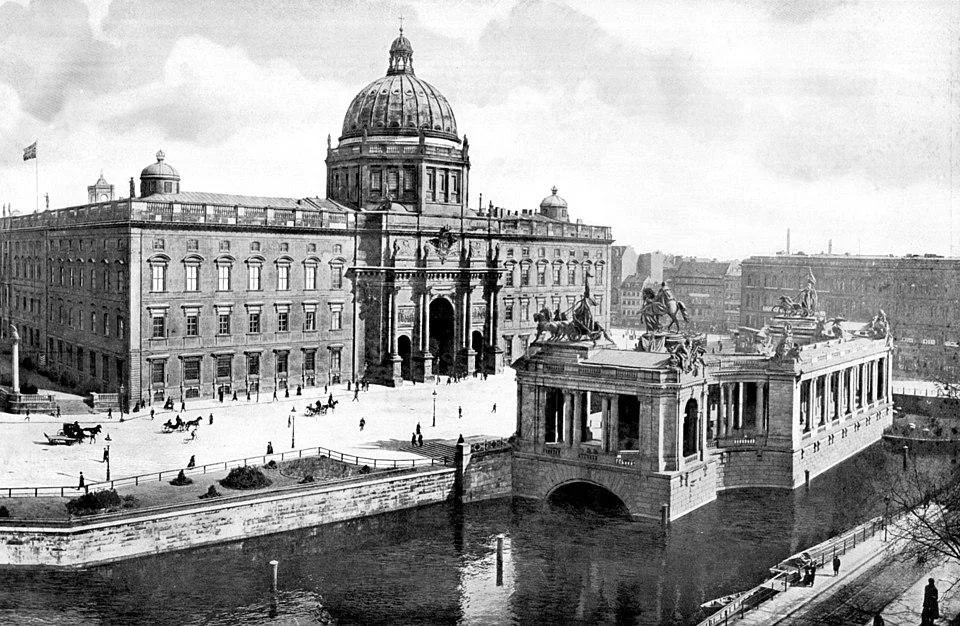
The unification of Germany in 1871 under Kaiser Wilhelm I and his “Iron Chancellor,” Otto von Bismarck, created a powerful new nation-state. Yet, beneath the surface of industrial might and imperial ambition, the German Empire was an authoritarian state deeply suspicious of dissent. Its political system was designed to preserve the power of the monarchy and the conservative elite, leading to systematic political persecution of anyone deemed a threat to the established order.
The Two Fronts of Bismarck’s Repression
Chancellor Bismarck famously fought a “culture war” on two fronts: against the Socialists on the left and the Catholics on the right. His weapons were not just policy but outright persecution.
The Anti-Socialist Laws (1878-1890)
Following two failed assassination attempts on the Kaiser—which had no connection to socialists—Bismarck seized the opportunity to target his greatest fear: the growing Social Democratic Party (SPD).
The Laws:
- Banned socialist organizations, meetings, and publications.
- Outlawed the display of socialist symbols.
- Allowed for the expulsion of socialist agitators from major cities.
The Impact:
- 1,300+ publications banned.
- 330+ workers’ organizations dissolved.
- Thousands of activists were imprisoned or forced into exile.
Paradoxically, the repression backfired. The SPD grew stronger underground and emerged from the ban in 1890 as the largest socialist party in the world, a testament to the failure of pure suppression.
The Kulturkampf (“Culture Struggle”) (1871-1878)
Bismarck viewed the Catholic Church and its political arm, the Centre Party, as a threat to the primacy of the state, loyal to the Pope over the Kaiser.
Key Measures:
- Pulpit Paragraph (1871): Banned clergy from discussing politics in sermons.
- May Laws (1873): Gave the state control over the training and appointment of priests.
- Civil Marriage (1875): Made a civil ceremony mandatory, reducing the church’s role in public life.
- “Breadbasket Law”: Cut off state subsidies to Catholic dioceses and clergy.
The Kulturkampf ultimately failed, strengthening Catholic political identity and solidifying the Centre Party as a major force in the Reichstag.
The Machinery of Control: How Persecution Was Enforced
The Empire developed a sophisticated system to monitor and suppress dissent.
The Political Police: Secret police units were established to spy on and infiltrate opposition groups, from socialists to minority rights activists.
Judicial Instrumentalization: Courts were not independent. Judges acted as servants of the state, handing down harsh sentences in political trials and often curtailing the defense rights of the accused.
Criminalization of Speech: Laws against “lèse-majesté” (insulting the Kaiser, §§94-95 StGB) were aggressively enforced to intimidate critics. Journalists faced prison sentences for even mild criticism of the monarchy.
The Targets: A Spectrum of Persecution
The Empire’s drive for a homogeneous nation-state made enemies of many groups:
National Minorities: A policy of forced Germanization targeted Poles, Danes, and French-speaking Alsace-Lorrainers. Their languages and cultures were suppressed in schools and public life.
The Jewish Population: While legally emancipated in 1871, Jews faced rising racial antisemitism. They were scapegoated for economic crises, excluded from social clubs and universities, and subjected to vile propaganda. This period laid the crucial ideological foundation for the horrors of the 20th century.
The LGBTQ+ Community: Paragraph 175 of the penal code, which criminalized homosexual acts between men, was enacted across the unified Empire in 1871, beginning a century of state-sponsored persecution.
A Lasting and Dark Legacy
The repressive tactics of the Kaiserreich did not disappear with the Empire’s fall in 1918. They created a dangerous blueprint for the future:
- The Weimar Republic inherited a judiciary and civil service deeply loyal to the old authoritarian order, not the new democracy.
- The Nazis would later adopt and radicalize the Kaiserreich’s tools of surveillance, propaganda, and persecution.
- Shockingly, Paragraph 175 remained on the books in West Germany until 1994, a direct legal thread from Bismarck’s empire to modern Germany.
The German Empire’s story is a powerful lesson in how a state can pursue economic modernity while fiercely resisting political and social pluralism. It demonstrates that a nation’s strength cannot be measured by industrial output alone, but also by its commitment to justice and tolerance for its own people.