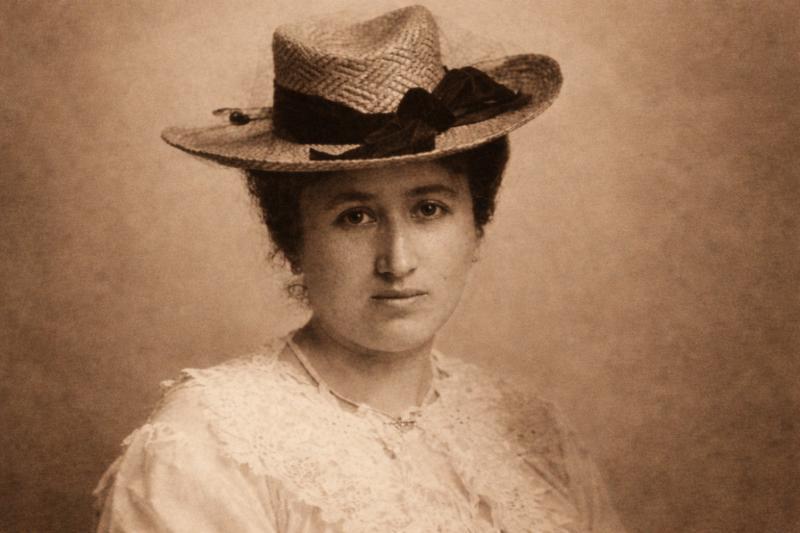

Rosa Luxemburg (1871–1919) was one of the most influential leaders of the international labor movement. Her biography serves as a prime example of how the German Empire (Kaiserreich) used criminal law and “preventive detention” to silence a charismatic intellectual and anti-militaristic voice.
Persecution as an “Alien” and a Woman
From the beginning of her career in Germany, Luxemburg was a target of state surveillance and social exclusion.
- Triple Marginalization: As a woman in a male-dominated political landscape, as a person of Jewish descent, and as a native Pole, she represented everything the conservative Prussian establishment feared and loathed.
- The Sham Marriage: To avoid immediate deportation and to gain German citizenship—a prerequisite for political activity in the Empire—she had to enter into a sham marriage with Gustav Lübeck in 1898.
“Lèse-Majesté” and “Incitement to Class Hatred”
The justice system of the Empire regularly reacted to her speeches and writings with prison sentences.
- 1904 (Lèse-Majesté): She was sentenced to three months in prison for criticizing the German Emperor.
- 1906 (Incitement): Following a speech in Weimar, she was sentenced to two months for “inciting class hatred.”
The Fight Against Militarism: The Frankfurt Trials (1914)
Shortly before the outbreak of World War I, the state’s pressure reached a new peak. Rosa Luxemburg became the most prominent voice against the impending mass slaughter.
- The Call for Disobedience: In a speech in Frankfurt am Main, she called on soldiers to refuse orders to kill their “French brothers.”
- The “Insulting the Military” Trial: She was sentenced to one year in prison for “inciting disobedience.” During the trial, she turned the courtroom into a political stage, famously declaring: “If we are expected to take up lethal weapons against our French or other foreign brothers, then we call out: No, we will not do that!”
World War I: “Protective Custody” and the “Junius Pamphlet”
While the SPD leadership largely supported the war (Burgfriedenspolitik), Luxemburg remained steadfast. The state reacted with administrative measures:
- Preventive Detention: From 1915 to 1918, she spent most of her time behind bars—not as a convicted criminal, but in “protective custody” (Schutzhaft). This was a tool used by the military authorities to neutralize “dangerous” individuals without a trial.
- Illegal Publications: From prison, she wrote the “Junius Pamphlet,” the most important anti-war document of the time, and co-founded the Spartacus League.
The Radical End: 1919
Released from prison by the November Revolution of 1918, she spent her final weeks fighting for a socialist republic.
- State-Sanctioned Murder: On January 15, 1919, Rosa Luxemburg and Karl Liebknecht were abducted and murdered by members of the Garde-Kavallerie-Schützen-Division—with the tacit approval or at least the failure of the SPD-led government of the time.
- Disposal in the Landwehr Canal: To cover up the crime, her body was thrown into the Landwehr Canal and was not found until months later.
Analysis of the Repression Methods
| Period | Repression Method | Objective of the State |
| 1898–1914 | Criminal Prosecution | Silencing through short prison sentences and fines |
| 1915–1918 | Protective Custody | Neutralization of anti-war agitation |
| 1919 | Extrajudicial Execution | Physical elimination of the revolutionary leadership |
Conclusion: Freedom for the Dissenters
Rosa Luxemburg’s famous sentence—“Freedom is always and exclusively freedom for the one who thinks differently”—was not a theoretical phrase, but a reflection of her own experience with state repression. On politischeverfolgung.de, she stands as a symbol of intellectual resistance against militarism and the misuse of the justice system for political purposes.
FAQ
Why was Rosa Luxemburg in "protective custody"?
During World War I, the military authorities used this measure to bypass the courts and keep influential anti-war activists in prison indefinitely without a new trial.
What was the "Junius Pamphlet"?
It was a powerful critique of the First World War and the failure of the SPD leadership, written by Luxemburg while she was in prison under the pseudonym “Junius.”
Who killed Rosa Luxemburg?
She was murdered by members of a right-wing Freikorps (volunteer paramilitary unit) under the command of Captain Waldemar Pabst. The perpetrators were largely protected by the justice system of the young Weimar Republic.
